Egyptian Cobra
The Egyptian cobra (Naja haje) is a large, highly venomous snake belonging to the cobra family (Elapidae). It is widespread across semiarid regions of…
What is Egyptian cobra?
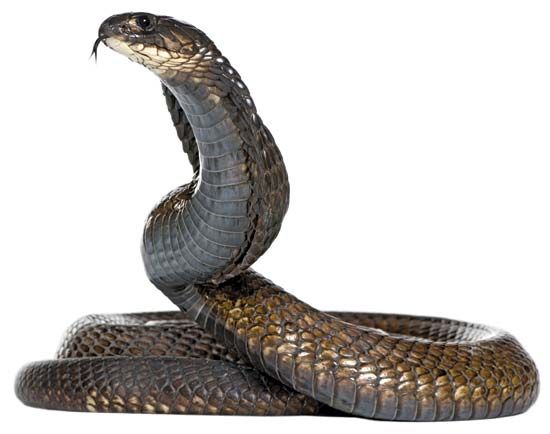
The Egyptian cobra (Naja haje) is a large, highly venomous snake belonging to the cobra family (Elapidae). It is widespread across semiarid regions of northern and eastern Africa, the Arabian Peninsula, and northern South Africa.1
Historically, this species is famously associated with ancient Egypt, where it was depicted on the crowns of pharaohs and is widely believed to be the legendary asp that caused the death of Cleopatra.12
Physically, the Egyptian cobra can reach lengths of up to 2.4 meters (8 feet), though it typically averages 1.5–1.8 meters. It is a nocturnal hunter that feeds primarily on toads, lizards, and birds. When threatened, it raises its body and expands its neck ribs to form a characteristic hood. Its venom contains neurotoxins that affect the nervous system; while potentially lethal to humans, antivenin is effective if administered promptly.12
How do neurotoxins affect the body after a snake bite?
Neurotoxins are specialized poisons that target the nervous system, which controls vital functions including breathing, heartbeat, and sensory perception. When introduced into the body through a snake bite, these toxins act on the brain and nerves in one of two primary ways:31
- Nervous Excitation: This can manifest as muscle cramps, twitching, vomiting, and convulsions.1
- Nervous Depression: This often leads to paralysis and a dangerous weakening or total arrest of respiration and heartbeat.1
The severity of these effects depends on factors such as the potency of the venom, the victim’s age, and the location of the bite. While neurotoxic venom is a serious medical concern, antivenin—a specialized antibody preparation—is highly effective at neutralizing these toxins if administered promptly after the injury.145
What is the historical significance of the cobra in ancient Egyptian pharaonic crowns?
The rearing cobra depicted on the crowns of ancient Egyptian pharaohs is known as the uraeus. This symbol served as a powerful emblem of sovereignty and divine protection.671
The uraeus represented Wadjet, the cobra goddess who acted as the tutelary deity of Lower Egypt. Egyptians believed that the pharaoh’s uraeus possessed the supernatural ability to spit fire at his enemies, reinforcing his authority. When represented alongside Nekhbet, the vulture-goddess of Upper Egypt, the cobra symbolized the king’s unified reign over all of Egypt.61
Beyond its role as a royal insignia, the cobra held deep mythological significance. Wadjet was revered as a protector who helped Isis shield the infant god Horus from his uncle Seth. The imagery of the cobra remains one of the most enduring symbols of ancient Egyptian royalty and religious belief.617
How do snake charmers safely interact with venomous cobras?
Snake charmers interact with venomous cobras by relying on the snake’s natural defensive behaviors rather than any actual ability to “charm” the animal with music. When a cobra is threatened, it assumes an upright, defensive posture and expands its hood; the snake sways in response to the rhythmic movement of the charmer’s instrument, not the sound itself, as snakes do not hear the music.82
To minimize the risk of a lethal bite, snake charmers often employ several dangerous practices:
- Physical Modification: Charmers may remove the snake’s fangs or regularly “milk” the snakes to drain their venom supply.82
- Handling Techniques: Experienced charmers are familiar with the cobra’s strike range and speed, allowing them to maintain a distance that avoids the snake’s relatively slow strike.2
- Defensive Management: Because snakes have a limited supply of venom and prefer not to waste it on non-prey, they often strike defensively without injecting venom—a phenomenon known as a “dry” bite.9
Despite these methods, the practice remains hazardous. In many regions, such as India, the tradition has declined significantly due to stricter enforcement of laws forbidding the keeping of snakes.8
Sources
- Egyptian cobra — Encyclopædia Britannica
- cobra — Encyclopædia Britannica
- Did you know? — Merriam-Webster
- Venom — Encyclopædia Britannica
- antitoxin — Encyclopædia Britannica
- Wadjet — Encyclopædia Britannica
- Favorite Pictures in the Dictionary | Uraeus — Merriam-Webster
- Indian cobra — Encyclopædia Britannica
- snake charmer — Merriam-Webster
- snake - Snakes and humans — Encyclopædia Britannica
Published on · 3 min read