Indian Cobra
The Indian cobra (Naja naja), also known as the spectacled cobra, is a highly venomous snake belonging to the family Elapidae. It is one of the "big four"…
What is an Indian cobra?
The Indian cobra (Naja naja), also known as the spectacled cobra, is a highly venomous snake belonging to the family Elapidae. It is one of the “big four” species responsible for the majority of snakebites in India.1
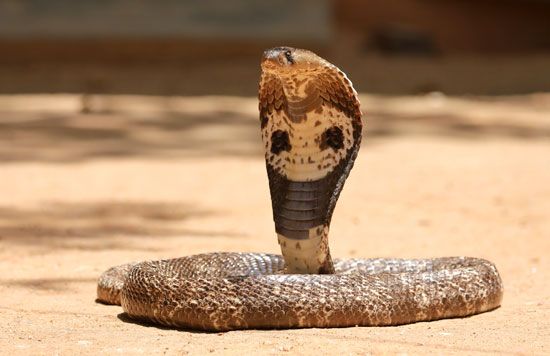
Characterized by an impressive hood that it expands when threatened, the snake features a distinctive black-and-white mark on the back of its hood resembling a pair of spectacles. Generally measuring 1 to 1.5 metres in length, it inhabits diverse environments across the Indian subcontinent, including forests, agricultural lands, and urban areas.1
The Indian cobra is culturally significant in Hinduism and is famously associated with snake charmers, though the practice has declined due to legal protections. While its bite is dangerous and can cause paralysis or respiratory failure, the species is not endangered and is classified as a species of least concern.1
Where is the Indian cobra commonly found?
The Indian cobra (Naja naja) is widely distributed throughout the Indian subcontinent. Its range includes:
- Countries: India, Pakistan, Sri Lanka, Bangladesh, Nepal, and Afghanistan.1
The species is highly adaptable and thrives in a diverse array of environments, both wild and cultivated. These habitats include savannas, grasslands, mangroves, scrublands, and tropical rainforests. Furthermore, because their primary prey—the black rat—is often found near human settlements, Indian cobras are frequently encountered in villages and cities.1
When seeking shelter, they typically occupy holes in tree hollows, termite mounds, rock piles, or the dens of other small animals.1
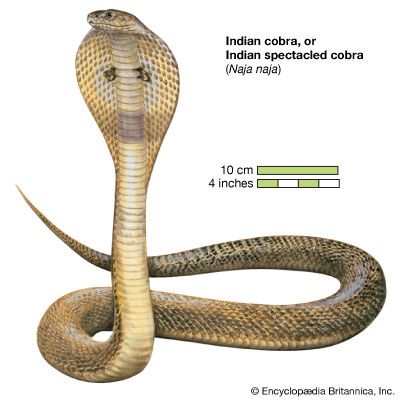
What does an Indian cobra look like?
The Indian cobra (Naja naja) is a large, highly venomous snake typically measuring 1 to 1.5 metres (3.3 to 4.9 feet) in length, though some rare specimens can reach up to 2.2 metres (7.2 feet).4
Its appearance is defined by several key features:
- The Hood: Like all cobras, it possesses an impressive hood created by expanding its neck ribs when threatened.4
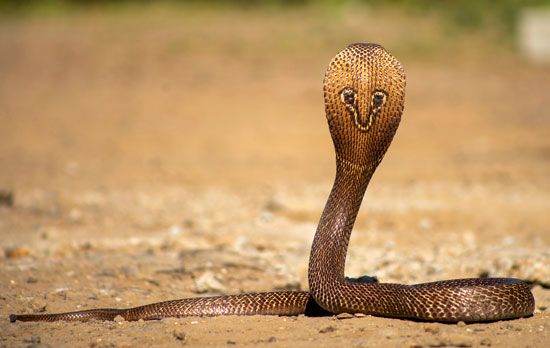
- Distinctive Markings: The back of the hood features a black mark outlined in white that resembles two eyes connected by a curved line, which is why it is often called the “spectacled cobra.” The front of the hood displays two light half-circles with dark centers, and a black band is visible on the front of the neck.4
- Coloration: The scales vary widely in color, ranging from gray, white, and tan to brown, yellow, black, or reddish, and they are frequently speckled in bands.4
When feeling threatened, the snake adopts an upright posture, raising the top third of its body and expanding its hood while hissing.4
How does the Indian cobra defend itself?
When threatened, the Indian cobra (Naja naja) employs a distinct defensive display to intimidate potential predators or threats. It adopts an upright posture, raising the front third of its body off the ground, and expands its neck ribs to form its characteristic hood, often accompanied by loud hissing.1
This defensive stance is intended to warn off intruders. If the threat persists, the snake may resort to biting. Unlike vipers, the Indian cobra cannot retract its fangs, which are fixed at the front of its mouth. Its bite delivers highly dangerous venom containing neurotoxins that affect the nervous system, potentially causing paralysis, respiratory failure, and cardiac arrest in humans if medical treatment is not sought immediately.13
While the Indian cobra is a formidable defender, it faces few natural predators. Some animals, such as mongooses, are capable of hunting adult cobras by relying on their speed, thick skin, and a degree of resistance to the snake’s venom.1
Sources
- Indian cobra — Encyclopædia Britannica
- spitting cobra — Encyclopædia Britannica
- cobra — Encyclopædia Britannica
- Egyptian cobra — Encyclopædia Britannica
Published on · 3 min read