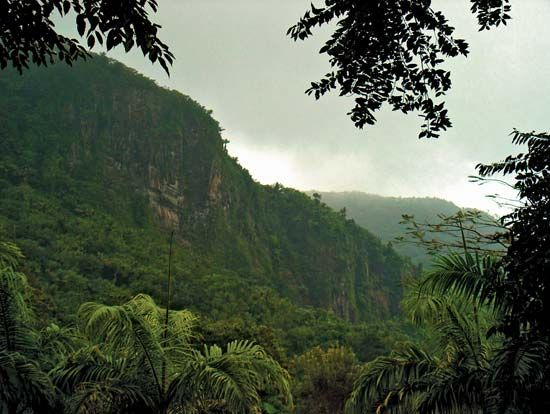
Elfin Woodland
An elfin woodland is a rare ecosystem characterized by a stunted forest found at high elevations in tropical wet or temperate coastal regions. These…
What is Elfin woodland?
An elfin woodland is a rare ecosystem characterized by a stunted forest found at high elevations in tropical wet or temperate coastal regions. These woodlands are defined by short, gnarled trees that are heavily draped in epiphytes, while the forest floor is typically covered in mosses and ferns.12
Compared to surrounding lower-elevation forests, elfin woodlands generally exhibit lower biodiversity, featuring a limited variety of woody species and vertebrate animals. While they share similarities with elfinwood—also known as krummholz, which occurs near the tree line in Alpine regions—elfin woodlands are distinct in their specific environmental requirements. Notable examples include coastal areas in California, Oregon, and northern Mexico, as well as the UNESCO World Heritage site at Mount Hamiguitan in the Philippines.13
What are epiphytes and how do they survive on trees?
An epiphyte is a plant that grows upon another plant or object solely for physical support. Unlike parasitic plants, epiphytes do not derive nourishment from their host; they are often called “air plants” because they do not require contact with the ground.45
How Epiphytes Survive
Epiphytes thrive by occupying niches high in the forest canopy, which allows them to access sunlight that would otherwise be blocked by dense vegetation. They obtain essential resources through several specialized adaptations:5
- Water Absorption: Most epiphytes absorb water from rain and atmospheric water vapor using their roots, though many species also utilize specialized leaves to capture moisture directly from the air.5
- Nutrient Acquisition: While they may receive some minerals from rainfall, they primarily absorb nutrients from organic debris—such as decaying leaves—that collects on the branches of their host trees.5
- Reproduction: Because they occupy isolated habitats, many epiphytes rely on wind to disperse their dustlike or feathery seeds. Others produce edible fruits that encourage birds and other animals to assist in seed dispersal.5
How does the krummholz forest differ from an elfin woodland?
While both elfin woodland and krummholz (also known as elfinwood) describe stunted, gnarled forest ecosystems, they differ primarily in their environmental context and geographic distribution.1
- Elfin Woodland: This ecosystem is typically found at high elevations in tropical wet regions or temperate coastal areas. These forests are characterized by trees that are heavily draped in epiphytes, with a forest floor covered in mosses and ferns.61
- Krummholz: Derived from the German words for “crooked” and “wood,” this term refers to the stunted, twisted vegetation found near the tree line in Alpine regions or high latitudes. Its growth form is primarily an adaptation to harsh, freezing winds and extreme exposure near the limit of tree growth.728
In short, while both represent stunted forest forms, elfin woodlands are defined by their moisture-rich, epiphyte-heavy environment, whereas krummholz is defined by its proximity to the alpine timberline and its struggle against cold, wind-swept conditions.681
What is a cloud forest and how is it related to elfin woodlands?
A cloud forest is a type of vegetation found in tropical mountainous regions, typically at altitudes between 1,000 and 2,500 meters (3,000 and 8,000 feet). These ecosystems are characterized by heavy rainfall and persistent condensation caused by moisture-laden air currents cooling as they are deflected upward by mountains, resulting in a layer of clouds at the canopy level year-round.32
The relationship between cloud forests and elfin woodlands is rooted in their shared environmental characteristics. An elfin woodland is essentially a specific, extremely stunted form of forest that can occur within these tropical or temperate mountainous regions. Both ecosystems feature short, gnarled trees and are heavily blanketed in epiphytes—such as mosses, ferns, and orchids—which thrive in the high-humidity conditions common to both environments. While cloud forests are defined by their specific climatic reliance on persistent cloud cover, the term elfin woodland specifically highlights the stunted, “elfin” stature of the trees found in these high-elevation, wet environments.39
Sources
- elfin woodland — Merriam-Webster
- Elfin woodland — Encyclopædia Britannica
- Cloud forest — Encyclopædia Britannica
- Did you know? — Merriam-Webster
- epiphyte — Encyclopædia Britannica
- tree - Tree lines — Encyclopædia Britannica
- krummholz — Merriam-Webster
- 12 Lovely and Unusual Words for the Natural World | Krummholz — Merriam-Webster
- cloud forest — Merriam-Webster
Published on · 3 min read