Cloud Forest
A cloud forest is a type of tropical mountainous ecosystem characterized by persistent cloud cover at the canopy level and frequent, heavy rainfall. These…
What is Cloud forest?
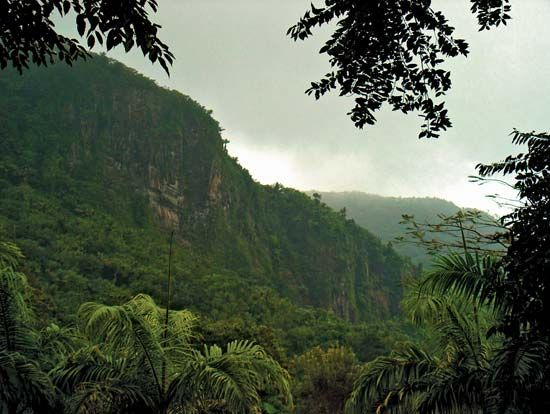
A cloud forest is a type of tropical mountainous ecosystem characterized by persistent cloud cover at the canopy level and frequent, heavy rainfall. These forests typically occur at altitudes between 1,000 and 2,500 meters (3,000 and 8,000 feet), where moisture-laden air currents are deflected upward by mountains, causing the air to cool and condense.1
Because of their specific requirements for elevation, climate, and proximity to the sea, these forests are rare, covering only about 1 percent of global woodlands as of 2022. They are found in regions including Central and South America, southern Mexico, Southeast Asia, eastern Africa, and New Guinea.1
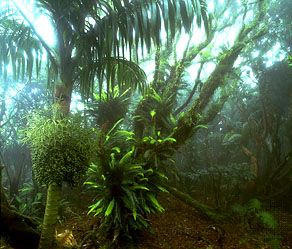
The trees in these environments are often short and crooked, frequently draped in mosses, ferns, lichens, and epiphytes like orchids. Unfortunately, these fragile ecosystems are in decline due to deforestation, global warming, and other human-related activities.1
What are epiphytes and why do they thrive in cloud forests?
An epiphyte is any plant that grows upon another plant or object solely for physical support rather than nourishment. Often called air plants, they are not parasitic and do not rely on the host for nutrients. Instead, they obtain water and minerals from rain, water vapor, and organic debris that collects on the host plant’s branches.34
Epiphytes thrive in cloud forests because these environments provide the high humidity and persistent moisture they require to survive without soil contact. In the dense canopy of a cloud forest, epiphytes—including orchids, ferns, mosses, and lichens—take advantage of their elevated position to access sunlight that might otherwise be blocked by the forest floor’s shade. The constant cloud cover and heavy rainfall characteristic of these mountainous regions create an ideal, moisture-rich habitat that allows these plants to form thick, lush blankets across tree trunks and branches.41
How does the altitude of a cloud forest affect the types of animals that live there?
The altitude of a cloud forest significantly influences the distribution and types of animals found within these ecosystems. Because cloud forests exist in mountainous regions, they are subject to environmental gradients—such as changes in temperature, moisture, and light—that occur as elevation increases.15
Influence of Elevation on Animal Life
- Vertical Stratification: Animals in these forests often adhere to specific layers of the vegetation, such as the canopy or the undergrowth, to forage or breed. As altitude changes, the structure of the forest itself shifts; for example, trees at higher, cloud-shrouded elevations are often shorter and more stunted, which limits the available niches for certain species compared to lower-altitude forests.51
- Adaptation and Migration: Many animals found in high-altitude environments are not strictly adapted for year-round life at the highest elevations. Instead, some species engage in vertical migration, moving to lower, forested environments during colder seasons and returning to higher elevations when conditions improve.6
- Environmental Gradients: Differences in water, nutrients, and temperature across mountain slopes create distinct habitats. These gradients act as filters, determining which species can survive at specific elevations. Consequently, animal communities can change drastically over relatively short distances, contributing to the high regional biodiversity often found in mountainous tropical regions.5
- Geographic and Evolutionary History: Beyond altitude, the specific animal populations are heavily influenced by the region’s geologic history. For instance, the presence of certain mammals, such as monkeys versus marsupials, depends on the biogeographic history of the area, such as the divide marked by Wallace’s Line.7
What is an elfin woodland and how does it differ from a typical cloud forest?
An elfin woodland is a type of stunted forest found at high elevations in tropical wet or temperate coastal regions. These environments are characterized by short, gnarled trees that are heavily draped in epiphytes, with forest floors cushioned by mosses and ferns.101112
Differences from a Typical Cloud Forest
While the terms are sometimes used interchangeably because elfin woodlands can be considered a specific, highly stunted manifestation of a cloud forest, they differ in a few key ways:
- Degree of Stunting: Elfin woodlands represent an extreme form of stunted growth. While cloud forest trees are often short and crooked, elfin woodland trees are notably gnarled and stumpy, often marking the transition toward the tree line where conditions become too harsh for taller growth.1012
- Biodiversity: Elfin woodlands generally exhibit lower biodiversity than surrounding, lower-elevation forests, containing a more limited number of woody species and vertebrate animals.10
- Geographic Scope: Cloud forests are specific to tropical mountainous regions with persistent condensation, whereas elfin woodlands can occur in both tropical and temperate coastal environments.1012
Sources
- Cloud forest — Encyclopædia Britannica
- Forest — Encyclopædia Britannica
- Did you know? — Merriam-Webster
- epiphyte — Encyclopædia Britannica
- Tropical rainforest - Fauna — Encyclopædia Britannica
- Tundra - Alpine mammals — Encyclopædia Britannica
- Rainforest — Encyclopædia Britannica
- Himalayas - Animal life — Encyclopædia Britannica
- community ecology - Stratification and gradation — Encyclopædia Britannica
- Elfin woodland — Encyclopædia Britannica
- elfin woodland — Merriam-Webster
- tree - Tree lines — Encyclopædia Britannica
Published on · 4 min read