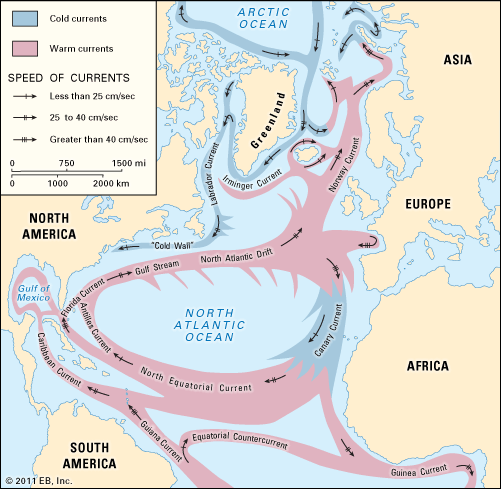
Equatorial Countercurrent
The Equatorial countercurrent is an eastward-flowing oceanic current located near the equator, positioned between and moving in opposition to the…
What is Equatorial countercurrent?
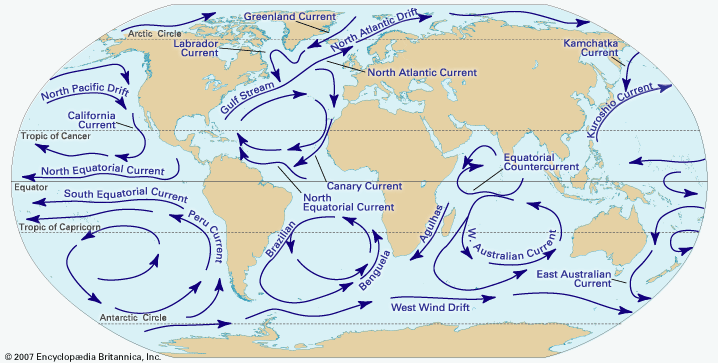
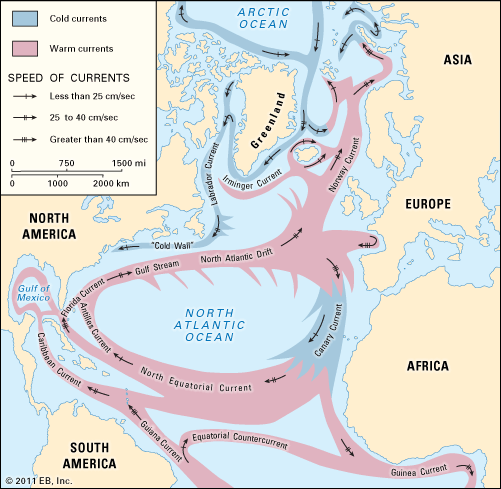
The Equatorial countercurrent is an eastward-flowing oceanic current located near the equator, positioned between and moving in opposition to the westward-flowing equatorial currents of the Atlantic, Pacific, and Indian oceans.1
Typically found between 3° and 10° N latitude, these currents arise because trade winds push massive volumes of water westward, elevating the sea level in the west. Within the doldrums—a region lacking strong, constant winds—this accumulated water flows eastward down the resulting slope.1
Key characteristics include:
- Pacific: The Pacific Equatorial Countercurrent is particularly strong and persists year-round.1
- Atlantic: The Atlantic Equatorial Countercurrent is most prominent off the coast of Ghana, where it is identified as the Guinea Current.1
- Indian: The Indian Equatorial Countercurrent is seasonal, flowing only during the northern winter and exclusively south of the equator.1
These systems are distinct from equatorial undercurrents, which are deeper, faster, and more concentrated flows.2
What are the doldrums and how do they influence ocean currents?
The doldrums are equatorial regions characterized by light winds and calm ocean conditions, situated within the intertropical convergence zone (ITCZ). This zone is a belt where the northeast and southeast trade winds meet, causing air to rise and frequently resulting in convective thunderstorms. Historically, sailors dreaded these areas because their ships were often becalmed, lacking the consistent winds needed for travel.34
The doldrums play a critical role in influencing global ocean circulation by facilitating the formation of the equatorial countercurrent. Outside the doldrums, the persistent trade winds push massive volumes of water westward, creating equatorial currents and raising the sea level in the western portions of the Atlantic, Pacific, and Indian oceans.12
Because the doldrums lack these strong, constant winds, the water that has piled up in the west is able to flow eastward down the resulting slope. This eastward movement creates the equatorial countercurrent, which flows in opposition to the westward-moving equatorial currents.12
How do trade winds drive the movement of surface ocean currents?
Trade winds are persistent, westward-blowing winds that serve as a primary driver of surface ocean circulation. Their influence on ocean currents is complex, involving direct frictional stress and the rotational effects of the Earth.6
The Mechanism of Wind-Driven Currents
When trade winds blow across the ocean surface, they exert wind stress, which sets the surface water in motion. This interaction occurs within the Ekman layer, a surface layer approximately 100 meters deep. Due to the Coriolis force—an apparent deflection caused by the Earth’s rotation—the surface water does not move directly in the direction of the wind. Instead, it is deflected at an angle of approximately 45° to the right in the Northern Hemisphere and to the left in the Southern Hemisphere.57
Ekman Transport and Gyres
The average movement of water within the Ekman layer, known as Ekman transport, occurs at a 90° angle to the wind direction. This transport is fundamental to the formation of subtropical gyres, which are large-scale, anticyclonic circulation patterns.589
- Convergence and Downwelling: Ekman transport can force surface water to converge, leading to downwelling, where surface water is pushed downward.5
- Upwelling: Conversely, where winds blow parallel to coastlines or diverge, Ekman transport can pull deeper, nutrient-rich water to the surface, a process known as upwelling.5
These wind-driven processes, combined with the Earth’s rotation, create the major current systems that redistribute heat across the globe.85
What is the difference between an equatorial countercurrent and an equatorial undercurrent?
The primary difference between an equatorial countercurrent and an equatorial undercurrent lies in their location, depth, and physical characteristics.
Equatorial Countercurrent
The equatorial countercurrent is a surface-level phenomenon. It flows eastward, in opposition to the westward-moving equatorial currents, and is typically found between 3° and 10° N latitude. Because the trade winds push large volumes of water westward, the sea level becomes higher in the western margins of the oceans; the countercurrent forms as this water flows downslope back toward the east within the doldrums, where strong, constant winds are absent. It is generally about 300 miles (480 km) wide.1214
Equatorial Undercurrent
In contrast, the equatorial undercurrent is a jetlike current located just below the surface, centered directly on the geographic equator. It flows eastward at depths of approximately 160 to 500 feet (49 to 152 m). This current is significantly larger and faster than the surface countercurrent, reaching widths of about 640 miles (1,030 km) and speeds exceeding 1 meter per second. It is driven by the pressure gradient created by the higher sea level in the western tropical ocean, which persists even as the surface layer is pushed westward by the trade winds.142
Sources
- Equatorial countercurrent — Encyclopædia Britannica
- Equatorial current — Encyclopædia Britannica
- Doldrums — Encyclopædia Britannica
- Intertropical convergence zone — Encyclopædia Britannica
- Trade wind — Encyclopædia Britannica
- V. Walfrid Ekman — Encyclopædia Britannica
- ocean current - Coriolis effect — Encyclopædia Britannica
- ocean current - The subtropical gyres — Encyclopædia Britannica
- ocean current - Geostrophic currents — Encyclopædia Britannica
- ocean current - Wind-driven circulation — Encyclopædia Britannica
- ocean current - Ekman layer — Encyclopædia Britannica
- Pacific Ocean - The trade winds — Encyclopædia Britannica
- subtropical gyre — Encyclopædia Britannica
- ocean current - Equatorial currents — Encyclopædia Britannica
Published on · 4 min read