Equatorial Current
North and South Equatorial Currents are both westward-flowing ocean currents driven primarily by trade winds, typically spanning about 600 miles in width.…
What is the difference between the North and South Equatorial Currents?
North and South Equatorial Currents are both westward-flowing ocean currents driven primarily by trade winds, typically spanning about 600 miles in width. While they share similar characteristics, they are distinguished by their geographic positioning, the specific wind systems that propel them, and the currents they feed.1
Key Differences
- Propelling Winds: The North Equatorial Currents are driven by the Northeast Trade Winds, while the South Equatorial Currents are propelled by the Southeast Trade Winds.1
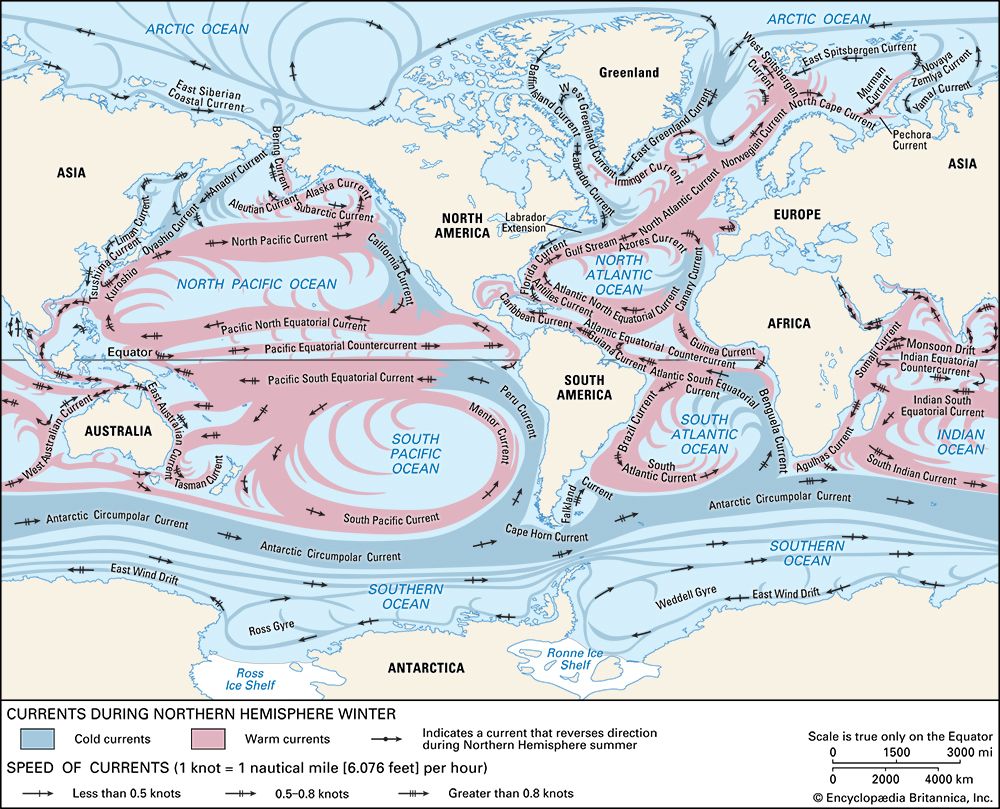
- Latitudinal Range: The North Equatorial Currents generally flow between latitudes 10° and 25° N, whereas the South Equatorial Currents typically occupy the region from the equator to 20° S.1
- Separation: These two systems are separated by an eastward-flowing [equatorial countercurrent], which typically lies between 3° and 10° N are separated by an eastward-flowing [equatorial countercurrent], which typically lies between 3° and 10° N.12
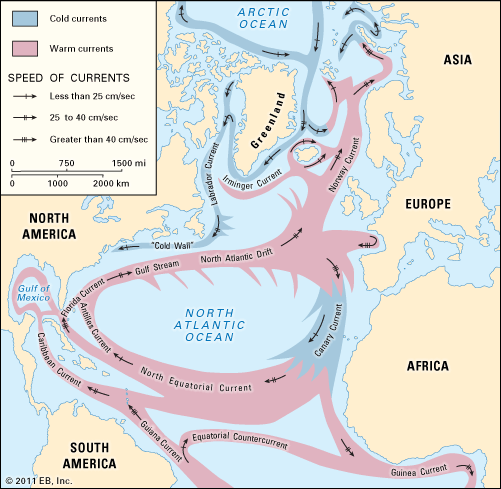
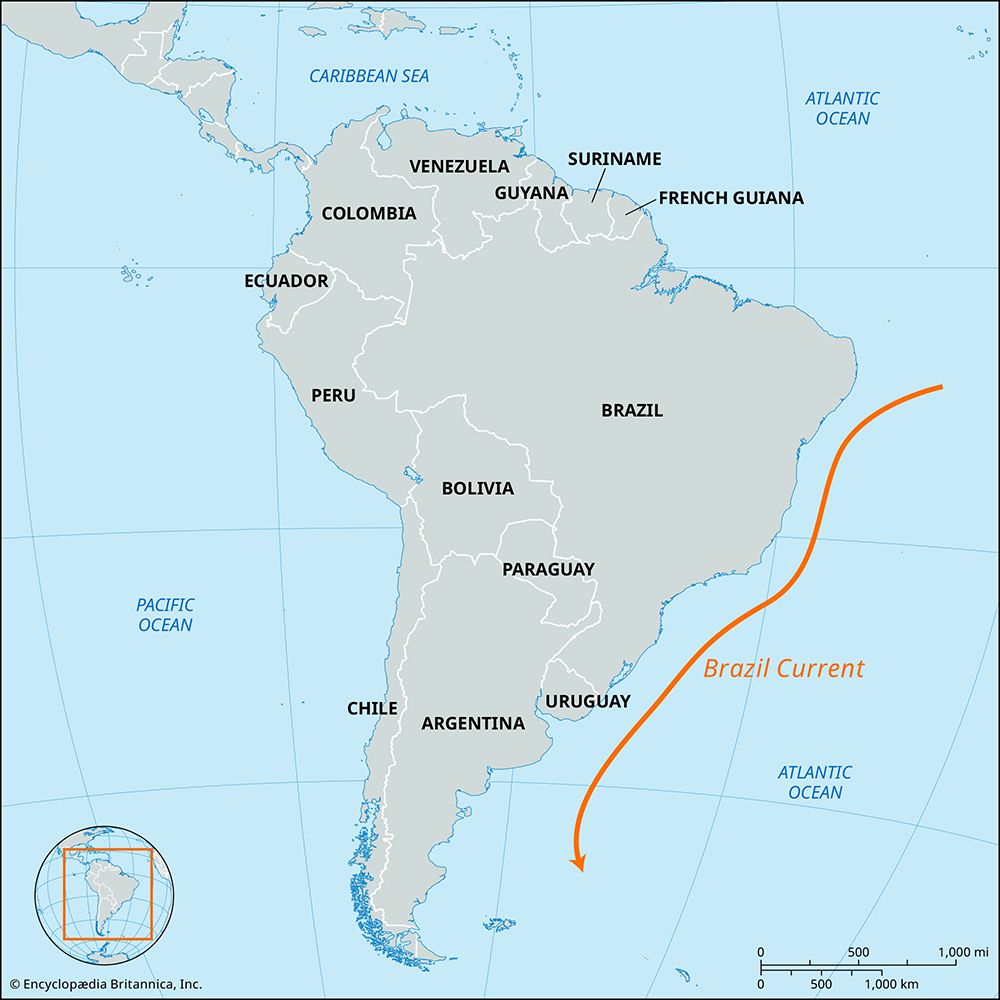
- Regional Flow Patterns: Upon reaching continental boundaries, these currents diverge into distinct paths. For example, the Atlantic North Equatorial Current eventually feeds the Gulf Stream, while the Atlantic South Equatorial Current contributes to the Brazil Current and the Guiana Current.1
What is the average speed and depth of equatorial currents?
Equatorial currents are primarily wind-driven systems that exhibit distinct characteristics in terms of their speed and depth.
Equatorial Currents
These westward-flowing systems, which include the North and South Equatorial Currents, typically operate within the following parameters:
- Speed: They generally travel at rates of 10 to 40 inches per second (25 to 100 cm per second).6
- Depth: These currents usually flow at depths of less than 1,650 feet (500 meters).6
Equatorial Undercurrents
In contrast to the surface currents, equatorial undercurrents are jetlike flows centered on the equator that move in the opposite (eastward) direction. Their characteristics include:
- Speed: They can reach speeds of up to 5 feet per second (1.5 meters per second).6
- Depth: These undercurrents are typically found at depths of 160 to 500 feet (49 to 152 meters), with the total system extending to approximately 1,000 feet (305 meters) deep.6
What are equatorial currents and where are they located in the world’s oceans?
Equatorial currents are large-scale, westward-flowing ocean currents driven primarily by trade winds. These systems are found in the tropical regions of the world’s oceans, typically spanning about 600 miles in width and flowing at depths of less than 1,650 feet.1
Global Distribution
- Pacific Ocean: The Pacific North Equatorial Current flows between 10° and 25° N, while the South Equatorial Current generally occupies the area between 5° N and 20° S.1
- Atlantic Ocean: The Atlantic North Equatorial Current is located between 10° and 20° N. The Atlantic South Equatorial Current flows between the equator and 20° S.1
- Indian Ocean: The circulation pattern differs here due to seasonal monsoons. While an Indian South Equatorial Current exists, the position typically held by a north equatorial current is occupied by the Monsoon Current.1
These currents are separated by an eastward-flowing [equatorial countercurrent], which is located primarily between 3° and 10° N.12
How do trade winds contribute to the formation of equatorial currents?
Trade winds are the primary drivers of equatorial currents, exerting wind stress on the ocean surface that induces westward-flowing movement across tropical regions.110
Mechanism of Formation
- Wind Stress: The Northeast Trade Winds and Southeast Trade Winds blow consistently from east to west across the tropical oceans. This persistent wind stress pushes the surface water, creating the westward-moving North and South Equatorial Currents.110
- Ekman Transport: As these winds move across the water, they induce Ekman transport, which causes a divergence of surface water at the equator. This process not only helps drive the currents but also leads to the upwelling of cooler water to the surface.10
- Pressure Gradients: The trade winds pile up water on the western margins of the ocean basins, creating a higher sea level in the west compared to the east. This creates a pressure gradient that, in the absence of the Coriolis force at the equator, allows for the formation of the eastward-flowing Equatorial Undercurrent beneath the surface.10
Sources
- Equatorial current — Encyclopædia Britannica
- Equatorial countercurrent — Encyclopædia Britannica
- Intertropical convergence zone — Encyclopædia Britannica
- subtropical gyre — Encyclopædia Britannica
- Trade wind — Encyclopædia Britannica
- ocean current — Encyclopædia Britannica
- ocean current - Distribution of ocean currents — Encyclopædia Britannica
- Indian Ocean - Surface currents — Encyclopædia Britannica
- Brazil Current — Encyclopædia Britannica
- ocean current - Equatorial currents — Encyclopædia Britannica
- ocean current - Coriolis effect — Encyclopædia Britannica
- ocean current - Wind-driven circulation — Encyclopædia Britannica
- ocean current - Geostrophic currents — Encyclopædia Britannica
Published on · 3 min read