Subtropical Gyre
Subtropical gyres are vast, anticyclonic ocean circulation systems that spiral around a central point, driven primarily by large-scale atmospheric wind…
What role do subtropical gyres play in ocean circulation and climate regulation?
Subtropical gyres are vast, anticyclonic ocean circulation systems that spiral around a central point, driven primarily by large-scale atmospheric wind fields and the Coriolis force.123
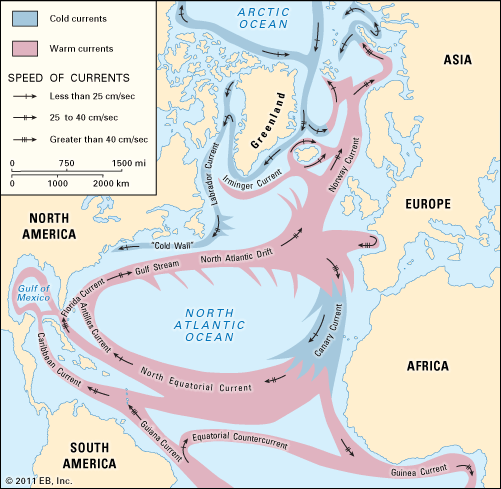
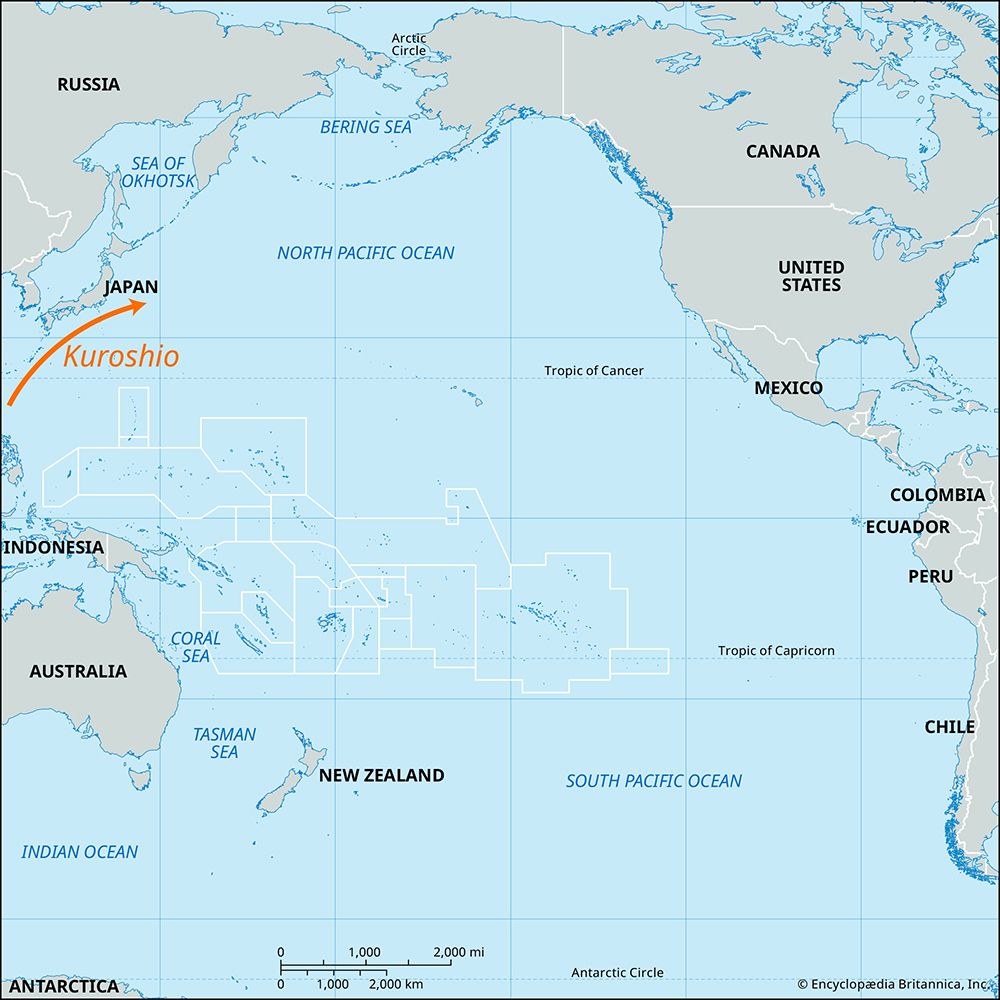
These gyres play a vital role in climate regulation by facilitating the poleward transfer of heat. Their western boundary currents—such as the Gulf Stream and the Kuroshio—act as powerful, jetlike conduits that transport excess thermal energy from low-latitude tropical regions toward higher latitudes.13
Additionally, the gyres influence vertical water movement. Within the Ekman layer, wind stress forces surface waters to converge and sink, contributing to the formation of deep water masses. While these wind-driven gyres dominate the upper 100 meters of the ocean, they work in tandem with the slower, density-driven thermohaline circulation to redistribute heat, nutrients, and materials across the global ocean, thereby moderating regional climates.4356
How do wind patterns and the Coriolis effect contribute to the formation of subtropical gyres?
Subtropical gyres are large-scale, anticyclonic ocean circulation systems formed by the interaction between global wind fields and the Earth’s rotation.17
The Role of Wind Patterns
Large-scale wind fields exert stress on the ocean surface, setting the upper 100 meters of water—the Ekman layer—into motion. Due to the Coriolis force, this surface water is directed at an angle to the wind, resulting in Ekman transport that moves water at an average of 90 degrees to the wind direction. Variations in this transport create zones of convergence, which force surface water downward in a process called downwelling. force surface water downward in a process called downwelling. This accumulation of less dense surface water creates a “hill” in sea level, which drives the anticyclonic geostrophic currents that define the gyre.47
The Coriolis Effect and Westward Intensification
The Coriolis force also dictates the structure of these gyres. Because the horizontal Coriolis force increases with latitude, the centers of subtropical gyres are shifted to the west. This “westward intensification” results in powerful, jetlike western boundary currents, such as the Gulf Stream, which transport heat toward the poles.17
How do subtropical gyres differ from other types of ocean currents or circulation patterns?
Subtropical gyres are distinct from other ocean circulation patterns primarily due to their anticyclonic nature, their specific atmospheric drivers, and their unique physical structure.
Key Differences from Other Patterns
- Circulation Direction and Pressure: Subtropical gyres are large, anticyclonic (clockwise in the Northern Hemisphere, counterclockwise in the Southern) systems that form beneath regions of high atmospheric pressure. In contrast, subpolar gyres are cyclonic systems that form beneath regions of low atmospheric pressure.185
- Vertical Water Movement: Within the Ekman layer of subtropical gyres, wind-driven transport causes surface water to converge and sink (downwelling). Conversely, subpolar gyres are characterized by surface water divergence and upwelling.9154
- Speed and Intensity: Subtropical gyres exhibit “westward intensification,” where the Coriolis force creates powerful, jetlike western boundary currents (e.g., the Gulf Stream) that can reach speeds of 2 to 4 meters per second. This is significantly faster than the slow, cool drift found in the interior and eastern boundaries of these same gyres, which rarely exceeds 10 centimeters per second.91
- Comparison to Thermohaline Circulation: While subtropical gyres are wind-driven and dominate the upper ocean, thermohaline circulation is driven by density differences (temperature and salinity). Thermohaline circulation is much slower—typically moving at about 1 centimeter per second—but it extends to the seafloor and operates on a global scale.10
How do subtropical gyres impact the transportation of marine organisms and their larvae?
Subtropical gyres play a critical role in the dispersal and distribution of marine organisms, particularly those with a bipartite life cycle. Many marine species, including fish, crabs, lobsters, and sea urchins, spend their larval phase drifting within the plankton, where they are transported over vast distances by ocean currents.611
The intensity and direction of these currents, such as the powerful western boundary currents like the Gulf Stream and the East Australian Current, act as primary vehicles for this dispersal. For example, these currents can relocate tropical larvae to higher latitudes, facilitating a tropical infusion into cold temperate coral reefs. The success of such recruitment—such as the migration of eels from the Caribbean to Europe—is often directly dependent on the strength and consistency of these major current systems.64
Furthermore, the length of an organism’s larval phase, which can range from minutes to hundreds of days, significantly influences how far it can be dispersed by the gyre’s circulation. By connecting distant habitats, these gyres are fundamental in determining the geographic range and population connectivity of diverse marine species.116
Sources
- ocean current - The subtropical gyres — Encyclopædia Britannica
- Climate - The Gulf Stream — Encyclopædia Britannica
- gyre — Encyclopædia Britannica
- subtropical gyre — Encyclopædia Britannica
- thermohaline circulation — Encyclopædia Britannica
- Marine ecosystem - Ocean currents — Encyclopædia Britannica
- ocean current - Ekman layer — Encyclopædia Britannica
- ocean current - Distribution of ocean currents — Encyclopædia Britannica
- subpolar gyre — Encyclopædia Britannica
- ocean current - The subpolar gyres — Encyclopædia Britannica
- Marine ecosystem - Distribution and dispersal — Encyclopædia Britannica
Published on · 3 min read