Erect-crested Penguin
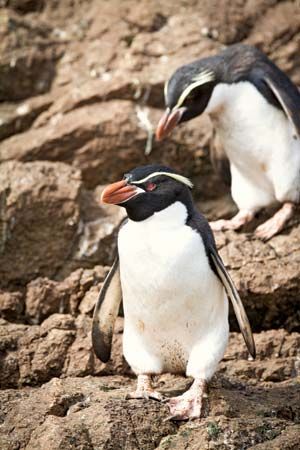
The erect-crested penguin (Eudyptes sclateri) has a limited breeding range, with populations restricted to the Antipodes Islands and Bounty Islands near New…
Where is the natural habitat of erect-crested penguins, and what is their conservation status?
The erect-crested penguin (Eudyptes sclateri) has a limited breeding range, with populations restricted to the Antipodes Islands and Bounty Islands near New Zealand. While individuals may be found along the coasts of Australia, New Zealand, and various islands in the Southern Ocean, these areas do not serve as breeding grounds.1
Regarding their conservation status, the International Union for Conservation of Nature (IUCN) has listed the erect-crested penguin as endangered since 2000 as endangered since 2000. Their population has experienced a significant decline since at least the late 1970s, and scientists have not yet identified the specific causes for this trend, though they have ruled out hunting and introduced predators as primary factors.1
Are there any cultural or historical references to erect-crested penguins in human society?
There is no evidence of significant cultural or historical references to the erect-crested penguin in human society. Because this species breeds in remote, isolated locations like the Antipodes Islands and Bounty Islands, it has historically had very limited interaction with humans.1
Unlike more accessible species that have appeared in folklore, literature, or indigenous traditions, the erect-crested penguin remains largely absent from the human cultural record. Scientific interest in the species is primarily focused on its biology and its concerning population decline, rather than historical or cultural significance.1
How does the erect-crested penguin’s breeding cycle differ from other penguin species?
The breeding cycle of the erect-crested penguin (Eudyptes sclateri) shares many fundamental similarities with other penguin species, yet it possesses distinct characteristics regarding nest construction and timing.
Breeding Cycle Comparison
- Timing and Colony Formation: Like most penguin species, erect-crested penguins begin their breeding season in the austral spring. They congregate in large, congested colonies along rocky shores in early September to begin courtship, which involves vocalizations and vertical head swinging. This timing is consistent with the general pattern of most penguins, which typically breed during the spring or summer months.13
- Egg Laying and Incubation: Erect-crested penguins typically lay two eggs in October: a smaller egg that is almost always lost and a larger egg that is successfully incubated. While most other penguin species also lay two eggs, the practice of laying a smaller, non-viable egg is a specific trait observed in several crested penguins.14
- Nest Construction: A notable difference lies in their nesting habits. While many penguins build structured nests, erect-crested penguins often do not construct nests at all, frequently laying their eggs directly on bare rock. In contrast, other species, such as the Snares penguin, actively excavate bowl-shaped nests into the ground, lining them with twigs and grasses.14
- Chick Rearing: Similar to other species, erect-crested penguin chicks are initially cared for by the father for two to three weeks before joining a crèche for protection while parents forage.13
What role do erect-crested penguins play in their ecosystem?
The erect-crested penguin (Eudyptes sclateri) functions as both a predator and a prey species within its sub-Antarctic ecosystem. While specific details regarding its feeding habits remain limited due to the remoteness of its habitat, the species is believed to subsist primarily on krill and fish.1
As a predator, the erect-crested penguin occupies a mid-level position in the marine food web, consuming smaller marine organisms. Conversely, it serves as a food source for larger predators:
- Marine Predators: In the ocean, adult erect-crested penguins are preyed upon by Hooker’s sea lions.1
- Terrestrial Predators: On land, the species’ eggs and chicks are vulnerable to predation by skuas and potentially mice.1
Because these penguins congregate in large, congested colonies on rocky shores to breed, they are integral to the local ecology of the Antipodes Islands and Bounty Islands. However, their role is currently under stress, as the species has faced a significant population decline since the late 1970s, leading to its classification as endangered.1
Sources
- Erect-crested penguin — Encyclopædia Britannica
- Rockhopper penguin — Encyclopædia Britannica
- penguin - Reproduction — Encyclopædia Britannica
- Snares penguin — Encyclopædia Britannica
- Royal penguin — Encyclopædia Britannica
Published on · 3 min read