Fiordland Penguin
The Fiordland penguin (Eudyptes pachyrhynchus) is native to New Zealand, primarily breeding on Stewart Island, Solander Island, and the western and southern…
Where is the natural habitat of Fiordland penguins, and what makes it unique?
The Fiordland penguin (Eudyptes pachyrhynchus) is native to New Zealand, primarily breeding on Stewart Island, Solander Island, and the western and southern coasts of the South Island. While they are occasionally sighted as far away as the North Island or Australia, their core habitat is concentrated in these southern regions.1
Their nesting habitat is particularly unique because, unlike many other penguin species that nest in open colonies, Fiordland penguins seek out sheltered, secluded locations. They build their nests in caves, within gaps between rocks, or beneath overhanging tree branches, ensuring that each nest remains out of sight from others.1
This species is currently listed as vulnerable on the IUCN Red List of Threatened Species, largely due to the high mortality of eggs and chicks caused by introduced terrestrial predators like stoats, ferrets, and cats, as well as habitat fragmentation.1
What are the distinctive physical characteristics of the Fiordland penguin?
The Fiordland penguin (Eudyptes pachyrhynchus) possesses several distinctive physical characteristics that help identify the species:
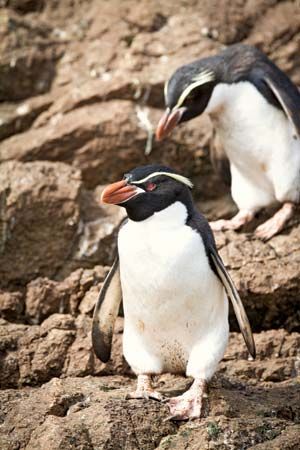
- Crested Appearance: The most notable feature is a thick stripe of pale yellow feather plumes, known as the superciliary stripe, which runs above each eye. These stripes extend from the bill to the rear of the head, with the terminal ends extending outward near the back of the head.2
- Facial Markings: The species is distinguished by a unique patch of bare skin located at the base of its bill.2
- Size and Build: Adults can reach up to 55 cm (about 22 inches) in length and weigh up to 4 kg (about 9 pounds), with males typically being slightly larger than females.2
- Plumage Coloration: The bird features blue-black feathers on its head, back, tail, and flippers, which contrast with the white feathers on its chest and underside.2
- Juvenile Characteristics: Juveniles are generally smaller than adults and possess gray-colored feathers on their chest and underparts, while chicks are covered in thick, downy gray feathers.2
How do Fiordland penguins interact with other marine species in their ecosystem?
Fiordland penguins interact with other marine species primarily through their roles as predators and, to a lesser extent, as prey within their ecosystem.
Dietary Interactions
As predators, Fiordland penguins subsist on a variety of marine life, including:
- Fish and fish larvae
- Crustaceans
- Cephalopods
- Krill (Euphausia)2
Predatory Interactions
While they are active hunters, Fiordland penguins also face threats from larger marine predators. In the ocean, both adults and juveniles are occasionally preyed upon by Hooker’s sea lions (Phocarctos hookeri). However, ecologists note that the overall impact of these sea lions on the total Fiordland penguin population is considered small.2
These interactions highlight the penguin’s position within the marine food web, where they function as both consumers of smaller organisms and a minor food source for larger marine mammals.
How does the Fiordland penguin’s breeding cycle differ from other penguin species?
The breeding cycle of the Fiordland penguin (Eudyptes pachyrhynchus) shares commonalities with other crested penguins but exhibits specific timing and nesting behaviors that distinguish it from many other species.
Nesting and Timing
Unlike some penguins that nest in open, exposed colonies, the Fiordland penguin prefers sheltered, secluded locations such as caves, rock gaps, or areas beneath overhanging tree branches, keeping their nests out of sight from others. In contrast, species like the erect-crested penguin often congregate in large, congested colonies on open rocky shores, sometimes laying eggs on bare rock without constructing a nest. The Snares penguin similarly nests in dense colonies, though it excavates bowl-shaped nests in the ground.254
Egg and Chick Development
A notable trait of the Fiordland penguin is the laying of two eggs in July: a smaller egg that almost always fails to hatch and a larger, more viable egg. This pattern is also observed in the Snares and erect-crested penguins. In all three species, if the smaller egg does hatch, the resulting chick often struggles to compete for food with its larger sibling and typically does not survive.245
Parental Care
Fiordland penguin parents share duties, with the male guarding the chick for the first few weeks while the mother hunts, followed by alternating care. This division of labor is standard among many penguins, though the specific duration of parental care and the formation of “crèches” (groups of older chicks) are adaptations shared by most members of the Eudyptes genus to ensure survival during the foraging period.245
Sources
- Fiordland National Park — Encyclopædia Britannica
- Fiordland penguin — Encyclopædia Britannica
- Falkland Islands - Land — Encyclopædia Britannica
- erect-crested penguin — Encyclopædia Britannica
- Snares penguin — Encyclopædia Britannica
- Magellanic penguin — Encyclopædia Britannica
- Bird - Nesting — Encyclopædia Britannica
Published on · 3 min read