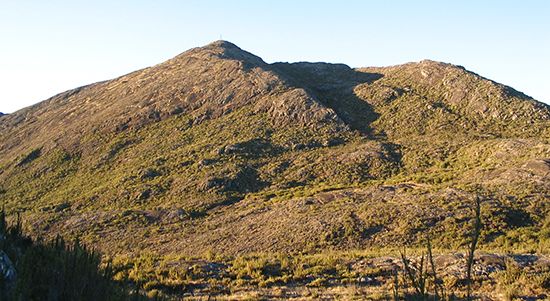
Espinhaço Mountains
The Espinhaço Mountains are a prominent mountain range located in the Brazilian states of Minas Gerais and Bahia. These peaks, which reach elevations between…
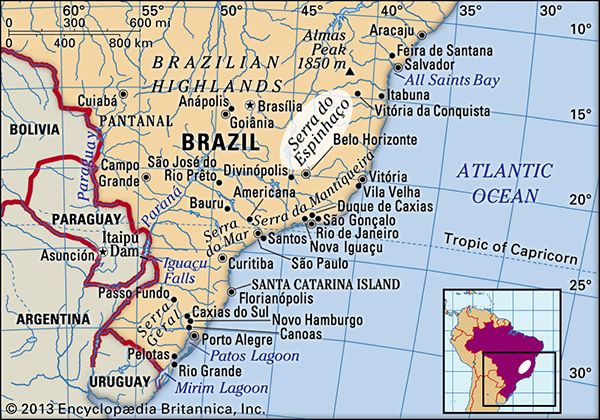
What is Espinhaço Mountains?
The Espinhaço Mountains are a prominent mountain range located in the Brazilian states of Minas Gerais and Bahia. These peaks, which reach elevations between 3,600 and 6,500 feet (1,100 and 2,000 meters), serve as a vital geographical divide between the tributaries of the São Francisco River and the streams flowing eastward toward the Atlantic Ocean.1
Historically significant for mining gold, diamonds, and semiprecious stones since the 18th century, the range remains economically essential today. It is a major global source of quartz crystals and contains vast deposits of high-grade iron ore and manganese.1
What is the significance of the Sao Francisco River?
The São Francisco River is a vital waterway in eastern South America and the largest river system located entirely within Brazil. Often referred to as the “river of national unity,” it has historically served as a crucial communication link between Brazil’s maritime and western regions, as well as between the northeast and the south.2
The river’s significance is defined by several key factors:
- Energy and Irrigation: The river is a major source of hydroelectric power for eastern and northeastern Brazil, with significant installations at the Paulo Afonso Falls and the Três Marias Reservoir. It also provides essential irrigation water for agriculture in the dry sertão region, supported by the vast Sobradinho Reservoir.32
- Transportation: While navigation is interrupted by falls and rapids, the river is navigable for shallow-draft vessels in two sections: a 1,000-mile stretch from Pirapora to the Juazeiro-Petrolina area, and a lower section extending to the Atlantic Ocean.324
- Economic Resources: The basin is rich in mineral deposits, including gold, iron, diamonds, and manganese, and supports diverse agricultural activities ranging from cotton and corn to livestock grazing.2
How does mining impact the environment in Brazil?
Mining in Brazil has significant and often devastating impacts on the environment, characterized by large-scale deforestation, water contamination, and catastrophic industrial failures.
Deforestation and Habitat Destruction
Mining operations frequently require the clearing of vast areas of forest to access mineral deposits. In regions like the Carajás, forests are further depleted to provide charcoal for iron smelting. This destruction of vegetation disrupts ecosystems and threatens biodiversity, often occurring on Indigenous lands where the rights of local communities are frequently violated.567
Water Contamination
Water pollution is a critical consequence of mining activities:
- Mercury Poisoning: During gold mining, mercury is used to extract gold from alluvial deposits. This toxic substance is released into rivers, contaminating fish—a primary food source for many Amazonian peoples—and rendering them unsafe to eat.65
- Toxic Tailings: Mining waste, or tailings, poses a severe threat to water systems. In 2019, the collapse of a dam at the Córrego do Feijão mine released billions of gallons of toxic sludge, which contaminated over 120 miles of the Paraopeba River and resulted in significant loss of life.8
Regulatory Challenges
While Brazil has established environmental agencies like IBAMA to enforce conservation laws, these bodies often face limitations in funding and staffing. Although the government uses satellite surveillance to monitor illegal activities, environmental safeguards are frequently bypassed, and penalties for violations are often insufficient to deter further damage.8
What unique plants and animals live in the Espinhaco region?
Sorry, the Britannica knowledge base does not contain information regarding the specific plants and animals that live in the Espinhaço Mountains.
While the provided sources detail the region’s geography, its role as a watershed divide, and its historical and economic significance regarding mineral wealth—such as gold, diamonds, iron ore, and quartz—they do not provide data on the local flora and fauna.
Sources
- Espinhaço Mountains — Encyclopædia Britannica
- Brazil - Rivers of Brazil — Encyclopædia Britannica
- São Francisco River — Encyclopædia Britannica
- Brazil - Shipping of Brazil — Encyclopædia Britannica
- Amazon River - Mining and energy — Encyclopædia Britannica
- Brazil - Conservation and ecology — Encyclopædia Britannica
- Status of the world’s tropical forests - Ranching and mining — Encyclopædia Britannica
- Amazon Rainforest: Top Questions — Encyclopædia Britannica
- Gold standard - Con 3: A gold standard and gold mining harm the environment and Indigenous communities. — Encyclopædia Britannica
- Brazil - Brazilian Highlands — Encyclopædia Britannica
- Serra do Mar — Encyclopædia Britannica
Published on · 3 min read