Fagradalsfjall Volcano
Fagradalsfjall is an active shield volcano located on the Reykjanes Peninsula in southwestern Iceland. Situated near the divergent boundary between the…
What is Fagradalsfjall volcano?
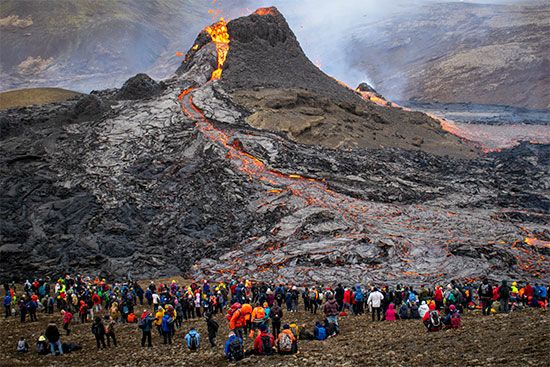
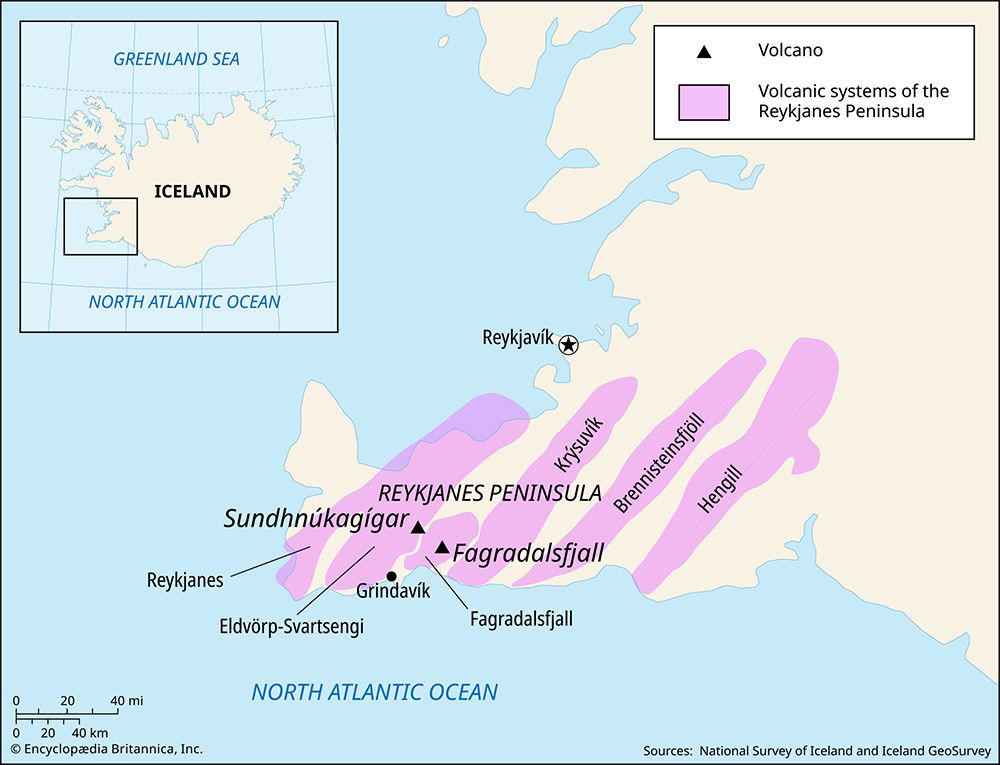
Fagradalsfjall is an active shield volcano located on the Reykjanes Peninsula in southwestern Iceland. Situated near the divergent boundary between the Eurasian and North American tectonic plates, it is part of a volcanic system characterized by various geological features, including ridges and mounds composed of basalt fragments.12
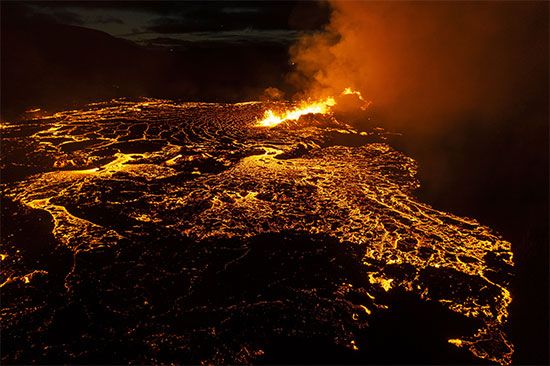
After remaining dormant for approximately 6,000 years, the volcano experienced a notable effusive volcanic eruption in 2021, which was the first such event on the peninsula in roughly 800 years. This eruption produced spectacular lava fountains and created extensive new lava fields in the Geldingadalir valley. Subsequent smaller eruptions occurred in 2022 and 2023.1
How do tectonic plates influence volcanic activity in Iceland?
Iceland’s volcanic activity is fundamentally driven by its location atop the Mid-Atlantic Ridge, a major accreting plate boundary where the North American and Eurasian plates are moving apart. While most of this global ridge system remains underwater, Iceland is a rare instance where the ridge is sufficiently elevated to emerge above sea level, allowing for subaerial volcanism.34
As these tectonic plates diverge, a gap is created that allows magma to well up from the mantle. This process is often intermittent; the crustal rocks are stretched until they fracture, leading to earthquake swarms and the rise of basaltic magma along these fissures. This mechanism results in characteristic Icelandic-type fissure eruptions, which have shaped the island’s landscape over millions of years. Consequently, the island serves as a unique, visible record of the ongoing development of a major plate boundary.543
What is the difference between a shield volcano and a stratovolcano?
Shield volcanoes and stratovolcanoes differ significantly in their formation, composition, and eruptive behavior.
Shield Volcanoes
Shield volcanoes are large, dome-shaped mountains characterized by gentle slopes that rarely exceed 6°. They are primarily composed of basalt, which produces fluid, low-viscosity lava that can travel long distances. These volcanoes are built over long periods by hundreds of thousands of effusive eruptions from summits and rift zones. A classic example is Mauna Loa in Hawaii.78
Stratovolcanoes
Stratovolcanoes, also known as composite volcanoes, are steep, cone-shaped mountains that can reach slopes of up to 35° near the summit. They are built by alternating layers of ash, pyroclastic material, and thick, viscous lava flows. Their composition typically ranges from basalt to rhyolite, with andesite being most common. Unlike the effusive nature of shield volcanoes, stratovolcanoes are often associated with moderately explosive eruptions and are frequently found above subduction zones.9810
What are the characteristics of an effusive volcanic eruption?
Effusive volcanic eruptions are characterized by the relatively gentle outpouring of molten magma onto the Earth’s surface, where it is then referred to as lava.1112
Key characteristics of these eruptions include:
- Magma Composition: The magma involved is typically basaltic, which has a relatively low silica content. This composition results in low viscosity, allowing the lava to flow easily across the landscape.1112
- Gas Content: Effusive eruptions involve magma with low gas content. Because the gas can escape relatively easily, the pressure does not build up to the point of violent fragmentation, which distinguishes these events from explosive eruptions.12
- Eruptive Style: These eruptions often occur along long, parallel fissures (Icelandic type) or from a volcano’s summit and radial fissures (Hawaiian type). They can produce extensive lava flows, such as pahoehoe or aa, and are responsible for building large shield volcanoes and lava plateaus.1112
Sources
- Fagradalsfjall volcano — Encyclopædia Britannica
- Fagradalsfjall volcano: Top Questions — Encyclopædia Britannica
- Europe - Iceland — Encyclopædia Britannica
- volcano - Rift volcanoes — Encyclopædia Britannica
- volcanism — Encyclopædia Britannica
- Arctic - Geology — Encyclopædia Britannica
- volcano - Shield volcanoes — Encyclopædia Britannica
- volcano - Stratovolcanoes — Encyclopædia Britannica
- volcano - Determinants of size and shape — Encyclopædia Britannica
- stratovolcano — Encyclopædia Britannica
- volcano - Lava flows — Encyclopædia Britannica
- volcano - Six types of eruptions — Encyclopædia Britannica
Published on · 3 min read