Euparkeria
Euparkeria is an extinct genus of reptile that lived during the Middle Triassic period, approximately 245 to 240 million years ago. Fossils of this creature…
What is Euparkeria and when did it live?
Euparkeria is an extinct genus of reptile that lived during the Middle Triassic period, approximately 245 to 240 million years ago. Fossils of this creature have been discovered in South Africa.12
Measuring about 1 meter (3 feet) in length, Euparkeria was a lightly built, carnivorous archosaur that likely moved on either all four limbs or its two hind limbs. It is closely related to the ancestors of dinosaurs, crocodiles, and birds, sharing key anatomical features such as socketed teeth and specific openings in the skull. Because of its primitive characteristics, it was once considered a strong candidate for the direct ancestor of dinosaurs, though modern research suggests it represents a basal member of the archosaur group.12
What was Euparkeria’s likely diet and habitat?
Euparkeria was a carnivore, a dietary habit common among the earliest archosaurs. Its status as a predator is evidenced by its long, sharp, and recurved teeth, which were set in sockets within the jawbone. Additionally, like many earlier reptiles and amphibians, Euparkeria possessed teeth on its palate, which likely assisted in securing prey.1
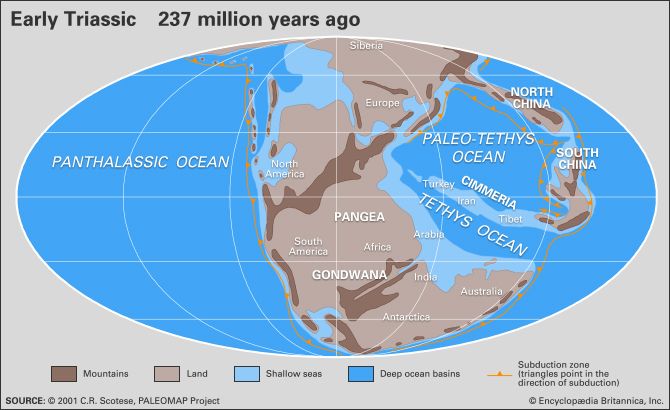
Regarding its habitat, Euparkeria lived during the Middle Triassic in what is now South Africa. During this time, the global environment was characterized by the presence of the supercontinent Pangea. While the Early and Middle Triassic were marked by widespread aridity, paleoclimatic evidence suggests that many regions, including those in southern Africa, experienced a monsoonal climate. This climate featured strong seasonal precipitation, which supported the development of riverine systems and alluvial environments where these reptiles thrived.13
How did the discovery of Euparkeria impact our understanding of archosaur origins?
The discovery of Euparkeria significantly advanced our understanding of archosaur evolution by providing a clear example of a basal, or primitive, member of the group. Historically, paleontologists struggled to identify the ancestors of dinosaurs, often grouping them with a poorly understood category of Triassic reptiles known as thecodontians (“socket-toothed reptiles”). Euparkeria helped clarify this by demonstrating the foundational anatomical features that define all archosaurs, including socketed teeth, a diapsid skull (featuring two large holes), and specific openings in the jaw and skull, such as the antorbital opening.12
While Euparkeria was once considered a primary candidate for the direct ancestor of dinosaurs, modern research has refined this view. It is now recognized as a basal archosaur that represents the ancestral stock from which later, more specialized groups—including dinosaurs, pterosaurs, and crocodilians—diverged. As more fossils have been discovered, the evolutionary gaps between these groups have narrowed, shifting the focus toward more dinosaur-like forms from the Middle and Late Triassic.2
What was the significance of Euparkeria in understanding reptile evolution?
Euparkeria is significant in the study of reptile evolution because it serves as a key example of a basal archosaur, the group that includes dinosaurs, pterosaurs, crocodilians, and birds. By exhibiting the foundational anatomical traits of this lineage, Euparkeria helped clarify the evolutionary relationships that were previously obscured by the vague classification of “thecodontians” or “socket-toothed reptiles.”12
The primary significance of Euparkeria lies in its possession of diagnostic archosaur features, including:
- Socketed teeth: Teeth set firmly in the jawbone rather than attached to the side or top.12
- Diapsid skull: A skull structure featuring two large openings behind the eye.12
- Antorbital opening: A distinct aperture located between the eye and the nasal opening.1
While once considered a direct ancestor of dinosaurs, Euparkeria is now understood as a primitive member of the archosaur stock. Its discovery provided a vital reference point for identifying the evolutionary transitions that eventually led to the emergence of true dinosaurs.2
Sources
- Euparkeria — Encyclopædia Britannica
- dinosaur - Dinosaur ancestors — Encyclopædia Britannica
- Triassic Period - Plants — Encyclopædia Britannica
- Triassic Period - Paleoclimate — Encyclopædia Britannica
- Permian Period - Emergence of important reptiles — Encyclopædia Britannica
Published on · 3 min read