Forest Fire
Forest fires are primarily categorized by their ignition source, which can be natural or human-induced. While natural events do occur, the vast majority of…
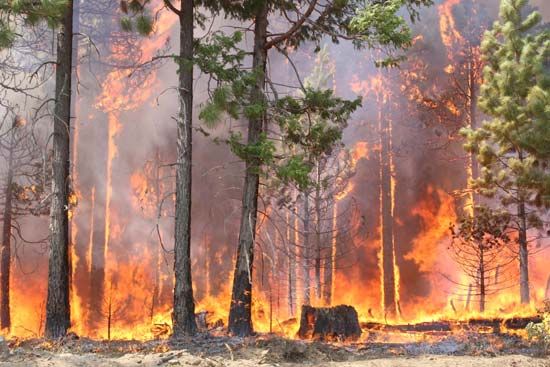
What are the main causes of forest fires, both natural and human-induced?
Forest fires are primarily categorized by their ignition source, which can be natural or human-induced. While natural events do occur, the vast majority of forest fires are caused by human activity.1
Human-Induced Causes
Well over 95 percent of all forest fires are attributed to human actions. These include:1
- Accidental ignitions: Common causes include escaped campfires, discarded cigarettes, and downed power lines.23
- Agricultural practices: In many regions, the intentional setting of fires to clear land for crops is a standard agricultural technique.1
- Arson: Fires are sometimes started deliberately.23
- Infrastructure failures: Lightning can strike power lines, causing a power fault or short circuit that subsequently ignites a fire.4
Natural Causes
Lightning strikes are the primary natural cause of forest fires, accounting for approximately 1 to 2 percent of all incidents. While a direct strike can ignite fuel, fires are also frequently caused by the long-duration continuing currents associated with lightning, which generate enough heat to ignite woody material.14
Regardless of the ignition source, environmental factors such as drought, heat, and wind significantly increase the risk and intensity of these fires by drying out vegetation and providing oxygen to the flames.23
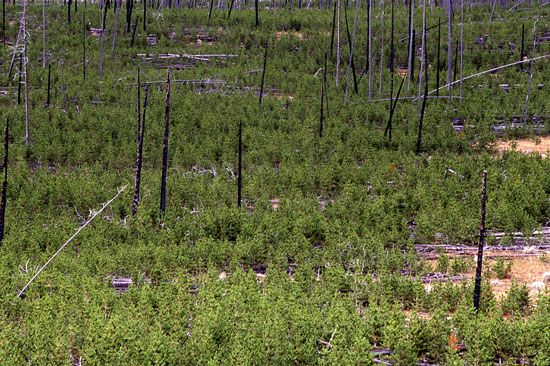
How do climate change and global warming contribute to the increased frequency and intensity of forest fires?
Anthropogenic climate change and global warming are significant drivers of the increased frequency and intensity of wildfires worldwide. These phenomena influence fire behavior primarily through rising global temperatures and shifts in precipitation patterns, which exacerbate the severity and duration of drought conditions.4
When drought occurs, vegetation dries out more rapidly and thoroughly, significantly increasing the volume of available fuel for potential fires. Furthermore, the rise in global temperatures has led to more frequent heat waves and prolonged dry spells, creating extreme fire-weather conditions. Research indicates that these climatic changes have had a measurable impact:
- Increased Frequency: The occurrence of the most extreme wildfire events more than doubled between 2000 and 2023.4
- Greater Intensity: Human-driven global warming has increased the likelihood of extreme fire-weather conditions—such as those that fueled the 2019–20 Australian bushfires—by at least 30 percent since 1900.4
- Expanded Impact: Annual tree cover loss resulting from wildfires grew by more than 3 million hectares between 2001 and 2023.4
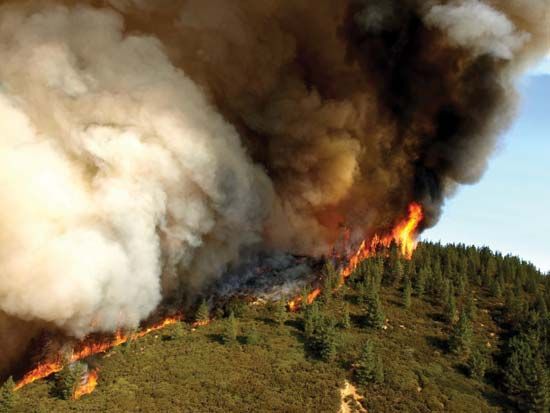
What technologies are used to detect and monitor forest fires?
To detect and monitor forest fires, forestry organizations employ a variety of technologies ranging from traditional observation methods to advanced aerial and space-based systems.
Detection Systems
- Tower Lookouts: Historically the mainstay of detection, these towers are positioned on hilltops. Observers use binoculars, maps, and direction scales to identify smoke and determine its compass bearing. By using cross-bearings from two or more towers, the precise location of a fire can be mapped.
- Aerial Surveillance: Aircraft function as mobile fire towers, allowing for reconnaissance of known fires and the detection of new ones, particularly in remote or inaccessible areas.
- Satellite Technology: Satellites provide a rapid and highly precise means of collecting data for fire detection, location, and appraisal.
Advanced Monitoring Tools
Modern aerial and satellite surveillance have been significantly enhanced by technological developments that improve efficiency and accuracy, including:
- Remote-control television
- High-resolution photography
- Heat-sensing devices
- Radar
These tools allow for more effective monitoring, especially in regions with advanced fire control programs. Once a fire is detected, this information is communicated to control bases via radio or telephone to initiate suppression efforts.2
What are some of the most effective methods for preventing and controlling forest fires?
Effective forest fire management relies on a two-pronged approach: prevention and control. Preventing fires focuses on reducing both risk and hazard, while control involves strategic suppression and the use of fire as a management tool.2
Fire Prevention
- Risk Reduction: Since over 95 percent of forest fires are human-caused, public education, law enforcement, and activity management are essential to minimize the chance of ignition.2
- Hazard Reduction: This involves compartmentalizing forests with firebreaks—strips of land cleared of vegetation or maintained with low-flammability ground cover—to limit fire spread. Additionally, managers reduce fuel buildup (such as dead branches and litter) to prevent high-intensity fires.2
Fire Control and Suppression
- Suppression Strategy: The goal is to break the “fire triangle” of fuel, temperature, and oxygen. This is achieved by removing combustible material, cooling the fire with water or chemicals, and smothering it.2
- Tactical Tools: Professional crews use hand tools, heavy machinery like bulldozers to create firebreaks, and aerial support to drop water or retardants.2
- Prescribed Burning: Intentionally applying fire under controlled conditions is a vital management technique. It reduces fuel loads, restores fire-adapted ecosystems, and can be used to create backfires that consume fuel before an oncoming wildfire arrives.25
Sources
- Wildfire: Top Questions — Encyclopædia Britannica
- forestry - Fire prevention and control — Encyclopædia Britannica
- thunderstorm - Lightning damage — Encyclopædia Britannica
- Wildfire — Encyclopædia Britannica
- prescribed fire — Encyclopædia Britannica
Published on · 4 min read