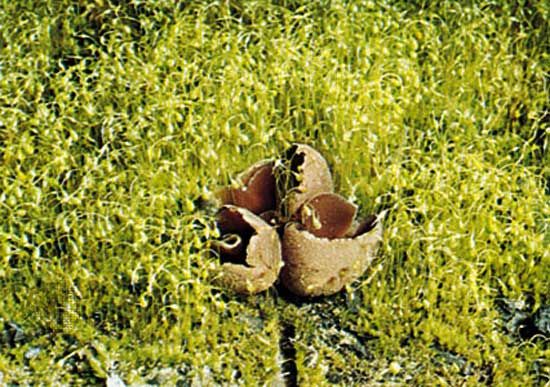
Extinguisher Moss
Extinguisher moss refers to any plant within the genus Encalypta, which belongs to the subclass Bryidae. These mosses typically grow in large tufts on…
What is Extinguisher moss?
Extinguisher moss refers to any plant within the genus Encalypta, which belongs to the subclass Bryidae. These mosses typically grow in large tufts on limestone rocks, walls, and ledges.1
They are small plants, generally measuring 1 to 3 cm (0.4 to 1.2 inches) in height. Their most distinctive feature is the calyptra—a hoodlike covering over the spore case—which resembles a candle snuffer or an extinguisher. This structure extends below the capsule, and in the species E. ciliata, the calyptra is notably fringed. Of the 34 known species in this genus, approximately 8 are native to North America.1
What is the function of a calyptra in mosses?
In mosses, the calyptra serves as a protective structure for the developing sporophyte.13
Its primary functions include:
- Protection: It shields the young sporangium (spore-producing structure) from physical injury and desiccation (drying out) as it matures.4
- Developmental Origin: The calyptra is formed from the lower cells of the archegonium—the female sex organ—which divide to create a sheath around the growing embryo.13
As the sporophyte continues to enlarge and develop, it remains dependent on the gametophyte for water, minerals, and nutrients gametophyte](https://www.britannica.com/science/gametophyte) for water, minerals, and nutrients. Once the sporangium is mature, the calyptra is typically shed, allowing the operculum (the lid of the capsule) to fall off and initiate the release of spores.34
How do mosses reproduce using spores?
Mosses reproduce through a complex life cycle that alternates between a sexual phase and an asexual, spore-producing phase. The leafy green plants we recognize as mosses are the gametophytes, which produce sex organs called antheridia (male) and archegonia (female). Fertilization typically requires moisture, such as rain or heavy dew, to allow the biflagellate sperm to swim to the archegonia.64
Following fertilization, a sporophyte develops, remaining attached to and partially dependent on the gametophyte for nutrients. The distal end of the sporophyte forms a capsule (sporangium), where meiosis produces spores.64
Spores are released from the capsule through various specialized mechanisms:
- Peristome teeth: In many mosses, the operculum (lid) falls off, exposing a ring of teeth that respond to moisture by pulsating, which shakes the spores into the air.64
- Pressure discharge: In peat moss, the drying capsule builds internal pressure that eventually ejects the operculum and shoots spores into the air.47
- Slits: Some species release spores through longitudinal slits in the capsule wall.4
Once released, a spore may germinate to form a protonema, a filamentous structure that eventually gives rise to new leafy gametophores.64
What are some other types of moss found in North America?
North America is home to a diverse array of moss species, many of which are widely distributed across the continent. Some notable examples include:
- Hair-cap moss (genus Polytrichum): Often found in peat bogs and acidic soil, these mosses can form large mats or tussocks. The species P. commune is particularly widespread in North America.8
- Tree moss (genus Climacium): These mosses resemble miniature evergreen trees. Common North American species include the American tree moss (C. americanum) and the European tree moss (C. dendroides), while C. kindbergii is typically found in swampy, wet environments.9
- Fern moss (genus Thuidium): Known for their fernlike branching patterns, these mosses grow on soil, rocks, and logs. Several species are native to North America.10
- Peat moss (genus Sphagnum): These mosses are essential components of bog ecosystems and are well-known for their ability to retain significant amounts of water.11
Other genera found in North America include cord moss (Funaria), cushion moss (Leucobryum), and water moss (Fontinalis).12
Sources
- extinguisher moss — Encyclopædia Britannica
- screw moss — Encyclopædia Britannica
- bryophyte - Reproduction and life cycle — Encyclopædia Britannica
- bryophyte - Form and function — Encyclopædia Britannica
- Plant - Division Bryophyta — Encyclopædia Britannica
- Plant reproductive system - Mosses — Encyclopædia Britannica
- peat moss — Encyclopædia Britannica
- hair-cap moss — Encyclopædia Britannica
- tree moss — Encyclopædia Britannica
- fern moss — Encyclopædia Britannica
- list of mosses — Encyclopædia Britannica
- peat moss — Merriam-Webster
- pleurocarpous — Merriam-Webster
- acrocarpous — Merriam-Webster
Published on · 3 min read