Fairy Bluebird
Fairy bluebirds are not migratory birds. They are resident species confined to semi-deciduous forests across [Asia].
Are fairy bluebirds migratory birds, and if so, what are their migration patterns?
Fairy bluebirds are not migratory birds. They are resident species confined to semi-deciduous forests across [Asia].1
The blue-backed, or Asian, fairy bluebird (Irena puella) is found in the wetter regions of India, the Himalayas, southwestern China, and Southeast Asia, while the Philippine fairy bluebird (I. cyanogaster) is restricted to various islands in the Philippines, including Luzon, Leyte, and Mindanao. Because they are non-migratory, they remain within their forest habitats throughout the year, where they feed on insects, nectar, and fruit.1
How many species of fairy bluebirds are there, and how do they differ?
There are two recognized species of fairy bluebirds within the genus Irena, both belonging to the family Irenidae. While they share a similar physical profile—measuring 27 cm (11 inches) in length with short legs, small feet, slender bills, and long tail coverts that nearly hide the tail—they are distinguished primarily by their geographic distribution.1
- Blue-backed (Asian) fairy bluebird (Irena puella): This species is found across the wetter regions of India, the Himalayas, southwestern China, and Southeast Asia. It is known for a distinct double-whistle call.1
- Philippine fairy bluebird (I. cyanogaster): This species is restricted to various islands in the Philippines, including Luzon, Polillo, Leyte, Samar, Mindanao, Dinagat, and Basilan.1
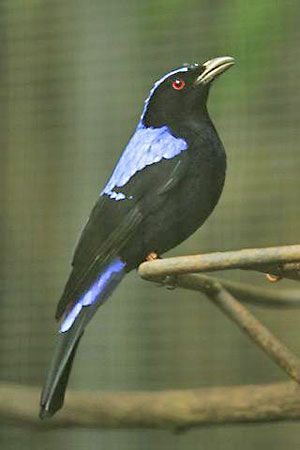
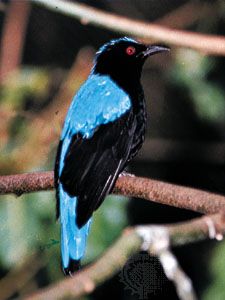
Both species exhibit sexual dimorphism, with males displaying brilliant blue and black plumage and females appearing a duller turquoise; both sexes possess bright red eyes. They inhabit semi-deciduous forests and share a diet consisting of insects, nectar, and fruit, particularly figs.1
What are the distinctive physical characteristics of fairy bluebirds?
Fairy bluebirds (genus Irena) are characterized by several distinctive physical traits that define their appearance and anatomy:
- Size and Build: These birds reach a length of 27 cm (11 inches) and possess a compact build featuring short legs, small feet, and slender bills.1
- Plumage: They exhibit striking sexual dimorphism. Males are noted for their brilliant blue and black coloration, while females display a duller turquoise hue.1
- Tail Structure: A unique feature of the genus is the presence of very long upper and lower tail coverts, which are so extensive that they almost entirely conceal the tail.1
- Eyes: Both sexes are easily identified by their bright red eyes.1
These birds are members of the family Irenidae, though their exact taxonomic classification remains a subject of debate among researchers, with some grouping them alongside leafbirds, ioras, or even orioles and bulbuls1.
Where can fairy bluebirds be found in their natural habitat?
Fairy bluebirds are exclusively found in the semi-deciduous forests of Asia. Their specific geographic distribution depends on the species:
- Blue-backed (Asian) fairy bluebird (Irena puella): This species inhabits the wetter regions of India, the Himalayas, southwestern China, and Southeast Asia.1
- Philippine fairy bluebird (I. cyanogaster): This species is restricted to islands within the Philippines, specifically Luzon, Polillo, Leyte, Samar, Mindanao, Dinagat, and Basilan.1
These birds are highly adapted to these forest environments, where they forage for insects, nectar, and fruit, particularly figs.1
Sources
- Fairy bluebird — Encyclopædia Britannica
Published on · 2 min read