Irenidae
Irenidae is a family of songbirds within the order Passeriformes that consists of approximately 14 species of small, brightly colored birds native to the…
What is Irenidae?
Irenidae is a family of songbirds within the order Passeriformes that consists of approximately 14 species of small, brightly colored birds native to the forests and farms of Southeast Asia.12
The family is generally considered to include three primary groups:12
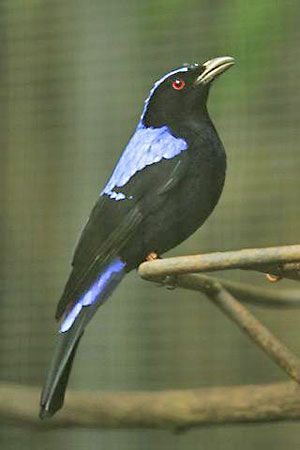
- Fairy bluebirds (genus Irena): Notable for their striking blue and black plumage and long tail coverts.12
- Leafbirds (genus Chloropsis): Often categorized separately as Chloropseidae by some authors.12
- Ioras (genus Aegithina): Small birds known for their musical calls.12
These birds typically range from 13 to 27 cm in length and possess slightly downcurved bills, short legs, and rounded wings. They feed on insects, nectar, fruit, and buds. The classification of this family is a subject of debate; some experts group these birds with the bulbul family (Pycnonotidae) or the Old World orioles (Oriolidae).12
What are the main differences between leafbirds, ioras, and fairy bluebirds?
While leafbirds, ioras, and fairy bluebirds are all members of the family Irenidae, they are distinguished by their specific genera and physical characteristics.
Key Distinctions
- Fairy Bluebirds (Genus Irena): These birds are the largest of the group, reaching up to 27 cm in length. They are characterized by striking blue and black plumage in males and duller turquoise in females, with both sexes possessing bright red eyes. A defining feature is their very long upper and lower tail coverts, which almost entirely conceal the tail. They are typically found in semi-deciduous forests and are known for loud calls and a distinct double whistle.21
- Leafbirds (Genus Chloropsis): These birds are often categorized separately as the family Chloropseidae by some authorities. While they share the general family traits of downcurved bills, short legs, and rounded wings, they are distinct from the fairy bluebird in their specific plumage patterns and smaller size range.21
- Ioras (Genus Aegithina): These are the smallest members of the group. Like the others, they are noted for their musical whistles and flutelike calls, as well as striking aerial displays during courtship.2
Taxonomic classification remains a subject of debate, with some experts grouping these birds with bulbuls or orioles rather than keeping them in a single family.21
Why is the classification of the Irenidae family often debated by scientists?
The classification of the Irenidae family is a subject of scientific debate primarily because of the morphological similarities these birds share with other avian groups, leading to varying taxonomic interpretations.21
The uncertainty stems from the following factors:
- Shared Physical Traits: Members of the Irenidae family, such as the leafbirds, ioras, and fairy bluebirds, exhibit characteristics—including a specific hairy patch on the nape—that suggest a close relationship to the bulbul family (Pycnonotidae).2
- Alternative Groupings: Because of these shared traits, some researchers argue that all or most of these birds should be classified within the bulbul family.1
- Split Classifications: Other authorities propose splitting the group entirely. In these systems, the fairy bluebirds are sometimes placed with the Old World orioles (family Oriolidae), while the leafbirds and ioras are assigned to a separate family known as Chloropseidae.21
How do fairy bluebirds use their bright colors for survival in the forest?
Fairy bluebirds (genus Irena) utilize their striking coloration primarily as a reproductive signal to attract mates and facilitate species recognition. In these birds, the male displays brilliant blue and black plumage, while the female exhibits a duller turquoise, a common pattern among vertebrates where bright colors serve to arouse potential partners.51
These colors function as an adaptive tool for social interaction. To maximize efficiency, such courtship coloration is often enhanced by specific postures or movements that make the bird more conspicuous to others of its species. While these bright colors are essential for communication, many animals—including various bird species—have evolved mechanisms to conceal such vibrant displays when they are not actively courting, helping them balance the need for reproductive advertisement with the necessity of remaining hidden from predators. By restricting these visual signals to social or reproductive contexts, the birds can effectively manage the risks associated with being highly visible in their forest habitats.56
Sources
- Fairy bluebird — Encyclopædia Britannica
- Irenidae — Encyclopædia Britannica
- Ciconiiform - Plumage and coloration — Encyclopædia Britannica
- Iora — Encyclopædia Britannica
- coloration - Reproductive signals — Encyclopædia Britannica
- coloration - Optical functions: combination of concealing and advertising coloration — Encyclopædia Britannica
Published on · 3 min read