Finfoot
Finfoots belong to the family Heliornithidae. Contrary to their superficial resemblance to cormorants, they are classified within the order Gruiformes, which…
What is the taxonomic classification of finfoots within the bird family?
Finfoots belong to the family Heliornithidae. Contrary to their superficial resemblance to cormorants, they are classified within the order Gruiformes, which also includes cranes.12
This family consists of three species of medium-sized, semiaquatic birds known for the lobes on their feet, which facilitate both swimming and movement through dense vegetation. The three species are:1
- American finfoot (or sungrebe, Heliornis fulica)1
- African finfoot (Podica senegalensis)1
- Masked finfoot (or Asiatic finfoot, Heliopais personata)1
These birds are characterized by their shy, secluded nature and are typically found in tropical regions near quiet rivers and overhanging banks.1
Are there any cultural or historical references to finfoots in human societies?
There is no significant evidence of cultural or historical references to finfoots in human societies. Because these birds are characterized as shy, scarce, and highly secluded, they have historically remained largely unnoticed by humans, which explains the lack of traditional folklore or cultural significance surrounding them.1
While the American finfoot is also known as the sungrebe, this name is a descriptive term related to its appearance rather than a reflection of deep-seated cultural mythology. Their elusive nature and preference for dense, overhanging riverbanks mean they have not played a prominent role in the historical or symbolic life of the regions they inhabit, such as the Congo basin or Southeast Asia1.13
How many species of finfoot exist, and what are their distinguishing features?
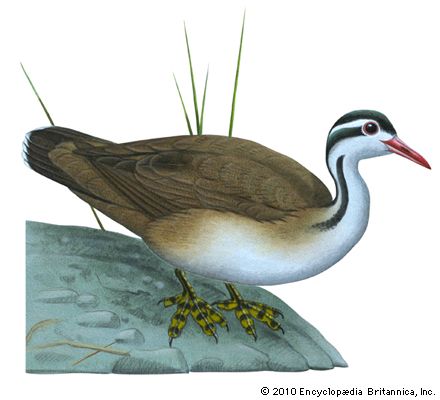
There are three species of finfoot (family Heliornithidae), all of which are medium-sized, semiaquatic birds characterized by lobes on their feet that assist in swimming and navigating dense vegetation. Generally, they feature a long, thin neck, a small head, a strong tapered bill, and brown-and-white plumage.
The three species are distinguished by the following features:
- American finfoot (sungrebe, Heliornis fulica): The smallest species, reaching about 30 cm in length. It possesses a red bill, an olive body, and black-banded yellow toes. Notably, the male carries its chicks in specialized skin pouches under its wings.
- African finfoot (Podica senegalensis): The largest species, measuring 46–53 cm. It is identified by its bright red feet and a slate-gray neck marked with an ill-defined whitish stripe.
- Masked finfoot (Asiatic finfoot, Heliopais personata): Found in Central and Southeast Asia, this species has bright green feet. The sexes can be distinguished by the color of the iris: yellow in females and brown in males.
What are the unique adaptations of finfoots that help them survive in their habitat?
Finfoots possess several specialized adaptations that allow them to thrive in their secluded, semiaquatic environments:
- Lobe-footed locomotion: The most defining feature of the finfoot is the presence of lobes on its feet. These structures serve a dual purpose: they act as efficient paddles for swimming in quiet rivers and provide the necessary grip for clambering over fallen trunks and branches in dense forest and scrubland.
- Physical build: Their long, thin necks and small heads allow them to navigate through thick, overhanging vegetation near riverbanks. Their strong, tapered bills are well-adapted for capturing a varied diet consisting of frogs, worms, crustaceans, and insects.
- Behavioral seclusion: Finfoots are shy and scarce, spending most of their time half-submerged in shady, quiet waters. This secretive behavior acts as a primary defense mechanism against predators.
- Parental care: In the case of the American finfoot, the male possesses specialized skin pouches under its wings. This unique adaptation allows the parent to carry helpless chicks away from the nest, even while flying, ensuring their safety in a challenging habitat.
Sources
- Finfoot — Encyclopædia Britannica
- Heliornithidae — Merriam-Webster
- finfoot — Merriam-Webster
- ostariophysan - Swimming — Encyclopædia Britannica
- fish - Locomotion — Encyclopædia Britannica
Published on · 3 min read