Fairy Wren
A fairy wren is any of the 27 species of songbird belonging to the family Maluridae. While they are sometimes associated with the warbler family, they are…
What is Fairy wren?
A fairy wren is any of the 27 species of songbird belonging to the family Maluridae. While they are sometimes associated with the warbler family, they are distinct from the true wren family (Troglodytidae), which are primarily found in the Western Hemisphere.12
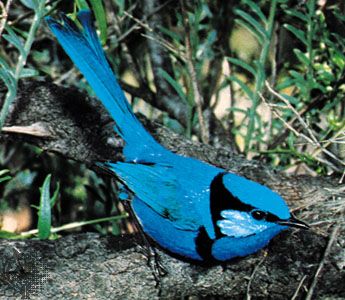
These birds are native to Australia and are typically about 13 cm (5 inches) long. A notable characteristic of the genus Malurus is the sexual dimorphism in their plumage: males are often brilliantly colored, frequently featuring blue foreparts with black markings, while females are typically a drab brown. They are also known for their narrow tails, which they characteristically carry cocked upward.13
A well-known species is the bluecap (M. cyaneus), often found in eastern Australian gardens, while other species, such as the splendid fairy wren, prefer to avoid human-settled areas.1
How do male and female fairy wrens differ in appearance?
Fairy wrens exhibit significant sexual dimorphism, meaning males and females differ noticeably in their plumage. In the genus Malurus, males are typically characterized by their brilliant, vibrant coloration, often featuring striking blue foreparts accented with black markings. In contrast, females are generally drably colored, typically appearing in shades of brown.12
Both sexes share similar physical proportions, measuring approximately 13 cm (5 inches) in length, and are known for their narrow tails, which are characteristically carried in a cocked-up position.2
What makes the Maluridae family unique among songbirds?
The Maluridae family, commonly known as fairy wrens or wren-warblers, is unique among songbirds for several distinct physical and behavioral traits:
- Distinctive Posture: These small-bodied birds (ranging from 7.5 to 25 cm) are characterized by their habit of carrying their long tails cocked upward over their backs.2
- Morphological Variety: While many species exhibit bright, contrasting patterns of red, shiny blue, black, and white, others are more subdued. Depending on the species, the sexes may appear identical or significantly different in plumage.2
- Specialized Anatomy: The family includes the emu-wrens (Stipiturus), which possess highly specialized tails consisting of only six loose-barbed shafts.2
- Vocal Ability: Many members of the Maluridae family are noted for being skilled singers and mimics.2
- Dietary Habits: They are primarily insectivorous, feeding on a variety of insects and other invertebrates.2
Native to the Australo-Papuan region, these birds inhabit diverse environments, including forests, scrublands, and heaths. They are distinct from the true wren family (Troglodytidae) found in the Western Hemisphere.24
How do fairy wrens interact with their environment in Australia?
Fairy wrens interact with their Australian environment in diverse ways depending on the species and their specific habitat preferences. These songbirds are found across various landscapes, ranging from gardens and orchards to more remote, unsettled regions.
For instance, the bluecap (M. cyaneus) is a familiar sight in the gardens and orchards of eastern Australia, where it has adapted to human-settled areas. In contrast, other species, such as the splendid fairy wren found in Western Australia, actively avoid human-settled environments, preferring more secluded natural habitats. These birds are generally recognized as members of the family Maluridae, which are distinct from the true wren family found in the Western Hemisphere.wren](https://www.britannica.com/animal/wren) family found in the Western Hemisphere.12
Sources
- fairy wren — Merriam-Webster
- Fairy wren — Encyclopædia Britannica
- Wren — Encyclopædia Britannica
- Passeriform - Annotated classification — Encyclopædia Britannica
- Passeriform - Evolution and paleontology — Encyclopædia Britannica
Published on · 2 min read