Fedchenko Glacier
The Fedchenko Glacier is an extensive valley glacier located in the Pamirs mountain range of central Tajikistan. It holds the distinction of being the…
What is Fedchenko Glacier?
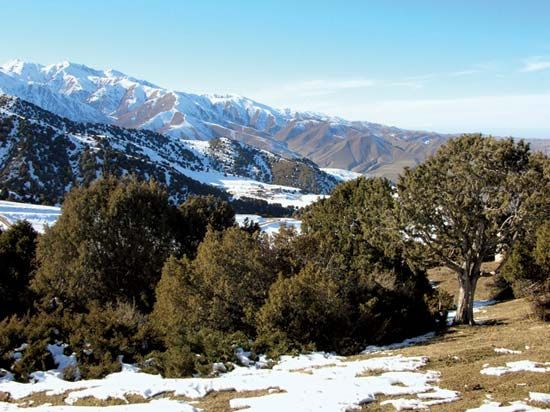
The Fedchenko Glacier is an extensive valley glacier located in the Pamirs mountain range of central Tajikistan. It holds the distinction of being the largest glacier in the world situated outside of the polar regions.1
Spanning approximately 45 miles (70 km) in length and covering about 350 square miles (900 square km), the glacier flows north from the ice field of Independence Peak. It is fed by dozens of tributary glaciers and serves as the source of meltwater for the Surkhob River and the Amu Daryaob River and the Amu Darya.1
Discovered in 1878, the glacier was named after the Russian explorer A.P. Fedchenko. It has long been a site of scientific interest, hosting various meteorological stations and undergoing significant exploration, most notably during a 1928 Soviet expedition.1
How do glaciers form and move?
Glaciers form and move through complex physical processes driven by climate, gravity, and the unique properties of ice.
Formation of Glacier Ice
Glaciers originate from the accumulation of snow that survives melting seasons, eventually transforming into firn and then dense glacier ice. This transformation involves:2
- Densification: Snow crystals lose their intricate shapes through evaporation and condensation, packing more tightly together.2
- Recrystallization: Under the weight of overlying snow, ice grains grow and reorient to minimize stress.2
- Air Exclusion: Once density reaches approximately 830–840 kg/m³, air spaces are sealed off, creating impermeable ice.2
Mechanisms of Movement
Glaciers move primarily under the influence of gravity, utilizing two main mechanisms:3
- Internal Deformation: Driven by the weight of the ice and the surface slope, ice crystals undergo slow creep or plastic deformation. When the ice cannot adjust rapidly enough, it may experience brittle failure, resulting in crevasses.43
- Basal Sliding: Glaciers that reach the pressure-melting point at their base can slide over their beds. This process is often facilitated by meltwater, which acts as a lubricant, and the regelation process, where ice melts and refreezes around bedrock obstacles.543
What are the differences between polar and valley glaciers?
The distinction between polar and valley glaciers is based on different classification criteria: valley glaciers are categorized by their topographic relationship to the landscape, while polar glaciers are defined by their thermal condition.783
Valley Glaciers
Valley glaciers are a type of mountain glacier confined by the surrounding terrain. They typically originate in high-altitude areas like cirques or ice caps and flow downward through mountain valleys. Their movement is strictly directed by the high relief of the landscape, often resembling a river of ice. Because they are constrained by valley walls, they are generally longer than they are wide.739
Polar Glaciers
Polar glaciers are defined by their temperature rather than their shape. A polar glacier remains below the freezing point throughout its entire mass for the entire year. Because of this subfreezing temperature, these glaciers often flow more slowly than temperate glaciers and are frequently frozen to their beds.810
In summary, while a valley glacier describes a glacier’s physical path through a mountain range, a polar glacier describes the internal thermal state of the ice. It is possible for a glacier to be both, depending on its location and temperature profile.78
How does climate change affect mountain glaciers?
Climate change significantly impacts mountain glaciers by altering their mass balance, which is the equilibrium between accumulation (snowfall) and ablation (melting and runoff). When the climate warms, glaciers experience a negative mass balance, leading to shrinkage and retreat.1213
The effects of climate change on these glaciers include:
- Increased Melting: Rising temperatures and changes in precipitation patterns directly influence the rate of ablation. As glaciers thin, their flow rates change, and the terminus often retreats.13
- Sea-Level Rise: The retreat of mountain glaciers is a major contributor to global sea-level rise, accounting for approximately 50 percent of current observed increases.14
- Hydrologic Changes: Glaciers act as natural reservoirs that regulate streamflow. Climate-driven changes in melt rates can disrupt this stability, affecting water availability and sediment transport in downstream regions.15
- Dynamic Response: While glaciers respond to climate shifts, this response is not instantaneous. There is a time lag—typically 10 to 100 years for mountain glaciers—between a climatic change and the resulting adjustment at the glacier’s terminus.13
It is important to note that while climate is a primary driver, some glaciers, such as certain tidewater glaciers, may advance or retreat due to internal physical instabilities independent of climatic variation.16
Sources
- Fedchenko Glacier — Encyclopædia Britannica
- glacier - Transformation of snow to ice — Encyclopædia Britannica
- glacier - Flow of mountain glaciers — Encyclopædia Britannica
- glacier - Glacier flow — Encyclopædia Britannica
- glacial landform - Glacial erosion — Encyclopædia Britannica
- glacial landform - Glacial deposition — Encyclopædia Britannica
- valley glacier — Merriam-Webster
- glacier - Classification of mountain glaciers — Encyclopædia Britannica
- glacier - Mass balance — Encyclopædia Britannica
- glacial landform - Types of glaciers — Encyclopædia Britannica
- glacier - Main types of glaciers — Encyclopædia Britannica
- iceberg - Impacts on ice sheets and sea level — Encyclopædia Britannica
- Thwaites Glacier — Encyclopædia Britannica
- glacier - Response of glaciers to climatic change — Encyclopædia Britannica
- glacier - Glacier hydrology — Encyclopædia Britannica
- glacier: Top Questions — Encyclopædia Britannica
- glacier - Mass balance of mountain glaciers — Encyclopædia Britannica
- glacier - Tidewater glaciers — Encyclopædia Britannica
Published on · 3 min read