Fer-de-lance
The provided search results identify the fer-de-lance as a large, extremely venomous pit viper (Bothrops atrox) native to Central and South America.
What role does the fer-de-lance play in its ecosystem?
The provided search results identify the fer-de-lance as a large, extremely venomous pit viper (Bothrops atrox) native to Central and South America.1
However, the current knowledge base does not contain specific information regarding the ecological role this species plays within its environment.
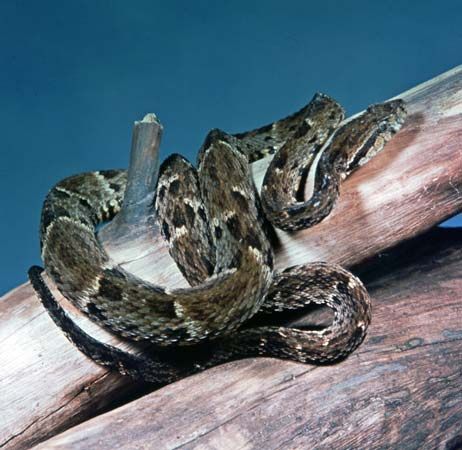
What are some of the other common names for the fer-de-lance snake?
The term fer-de-lance (French for “lance head”) is often used as a collective name for various venomous pit vipers within the genus Bothrops and the Asian genus Trimeresurus. Because the name is applied broadly, it is associated with several specific regional names:13
- Barba amarilla: A Spanish name meaning “yellow chin,” commonly used for the fer-de-lance.1
- Terciopelo: A name frequently applied to B. asper.1
- Common lancehead: Often used to refer to B. atrox.1
- Martinique lancehead: The original namesake, referring specifically to B. lanceolatus.1
- Other regional variants: Depending on the specific species and location, related snakes are also known by names such as the jararaca (B. jararaca), the wutu or urutu (B. alternatus), and the jumping viper or tommygoff (B. nummifera).1
The name is sometimes used interchangeably with other pit vipers, reflecting the diversity of these snakes across tropical America and Asia.1
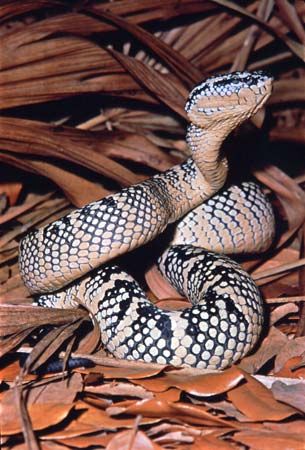
Where is the fer-de-lance snake typically found in the wild?
The fer-de-lance is not restricted to a single location; rather, the name is applied to several species of pit vipers found across diverse environments in tropical America and tropical Asia.1
These snakes are highly adaptable and inhabit a wide range of settings, including:
- Tropical Regions: They are found throughout the tropical landscapes of Central and South America, as well as parts of Asia.1
- Diverse Habitats: Their range encompasses varied environments, extending from dense forests to cultivated agricultural lands.1
- Specific Locales: Certain species are associated with specific islands or countries. For example, the original namesake, the Martinique lancehead, is found on the island of Martinique in the West Indies. Other species, such as the jararaca, are abundant in the grassy regions of Brazil, while the Okinawa habu is found on the Ryukyu Islands, where it is often encountered in human dwellings.1
What are the distinguishing physical characteristics of the fer-de-lance snake?
The fer-de-lance, a collective name for various pit vipers within the genera Bothrops and Trimeresurus, is defined by several distinct physical characteristics.13
Key Physical Features
- Sensory Pits: As a pit viper, the snake is distinguished by a small, temperature-sensitive sensory pit located on each side of the head, positioned midway between the eye and the nostril. These organs detect infrared radiation, allowing the snake to perceive heat images of warm-blooded prey.13
- Head Shape: They possess a broad, triangular-shaped head.1
- Size: These snakes typically range from 1.2 to 2 meters (4 to 7 feet) in length, though specific species vary in size.1
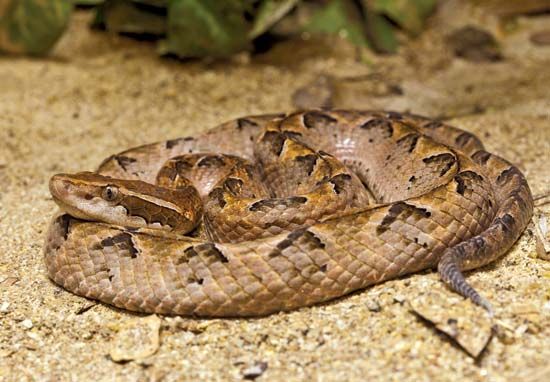
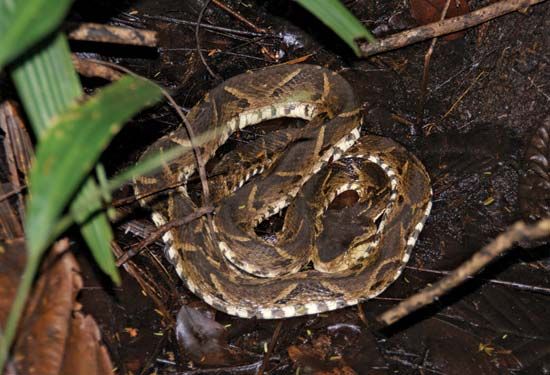
- Coloration and Markings: Their bodies are generally gray or brown. They are often marked by a series of black-edged diamonds, which are frequently bordered by a lighter color.1
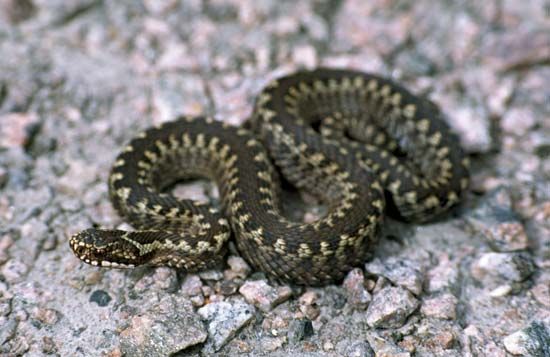
Because the name “fer-de-lance” is applied to multiple species, appearance can vary; for instance, some species exhibit bold blotches or wavy longitudinal bands rather than diamond patterns. Like other members of the viper family, they are equipped with long, hollow, venom-injecting fangs that fold back against the roof of the mouth when not in use.13
Sources
- fer-de-lance — Merriam-Webster
- fer-de-lance — Merriam-Webster
- fer-de-lance — Encyclopædia Britannica
- viper — Encyclopædia Britannica
- Bothrops — Merriam-Webster
Published on · 3 min read