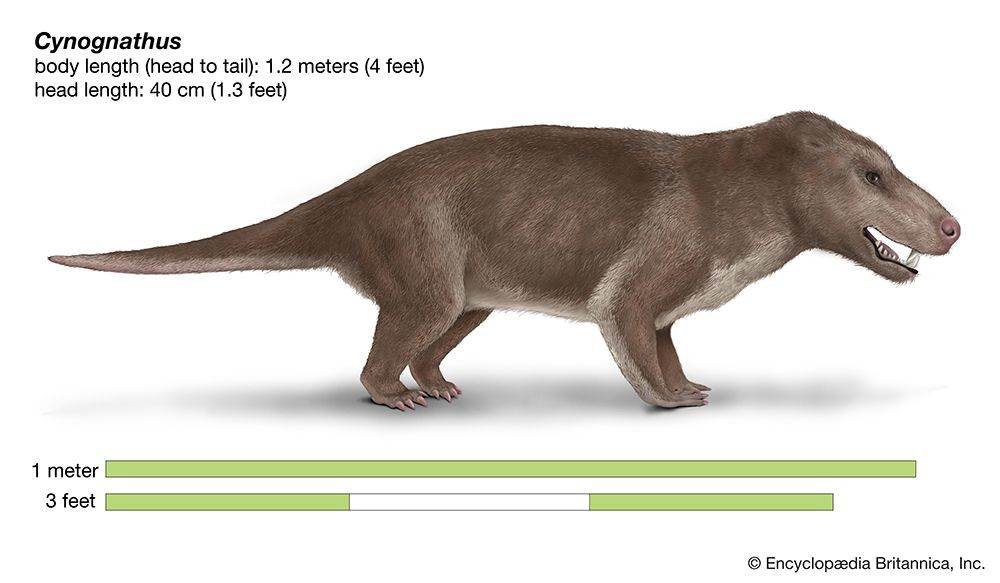
Tritylodont
The term "tritylodont" refers specifically to members of the genus Tritylodon, which were extinct cynodont therapsids—relatives of mammals—that lived during…
What are some of the most well-known tritylodont species?
The term “tritylodont” refers specifically to members of the genus Tritylodon, which were extinct cynodont therapsids—relatives of mammals—that lived during the Late Triassic and Early Jurassic periods.12
While the term is often used to describe this group, the scientific classification focuses on the genus Tritylodon itself. These animals are notable for their specialized dentition, featuring a distinct gap between their anterior incisors and complex cheek teeth, which contained longitudinal rows of cusps. Although they shared many skeletal similarities with early mammals, their jaw structure remained distinct, retaining multiple bones rather than the single dentary bone found in true mammals. Their lifestyle is believed to have been similar to that of later rodents and multituberculates.1
When did tritylodonts live and what was their geographical distribution?
Tritylodonts were cynodont therapsids that lived during the Late Triassic and Early Jurassic periods, approximately 208 million to 200 million years ago.1
Regarding their geographical distribution, fossil evidence indicates that these animals inhabited regions across southern Africa, North America, and Europe. While they shared many skeletal features with mammals, they were a specialized group that likely existed alongside some of the earliest true mammals.12
How were tritylodonts first discovered and by whom?
The provided search results do not contain information regarding the specific discovery of tritylodonts or the individuals responsible for their initial identification.
Sorry, the Britannica knowledge base does not contain this information.
How did tritylodonts survive the end-Triassic extinction event?
The end-Triassic extinction event, which occurred approximately 201 million years ago, resulted in the loss of a significant portion of marine and terrestrial species. However, fossil evidence indicates that tritylodonts and other terrestrial vertebrate groups, including mammals, dinosaurs, pterosaurs, crocodiles, turtles, and fishes, were little affected by this transition.1
While the specific mechanisms that allowed tritylodonts to survive this period are not explicitly detailed in the available records, their resilience is consistent with the broader observation that many terrestrial vertebrate lineages successfully navigated the boundary. Following the extinction, the opening of various ecological niches on land is widely considered to have facilitated the subsequent dominance of dinosaurs. Tritylodonts continued to exist well after this event, with the last known members of the family Tritylodontidae surviving until approximately 125 million years ago.14
Sources
- tritylodont — Encyclopædia Britannica
- tritylodont — Merriam-Webster
- Tritylodon — Merriam-Webster
- cynodont — Encyclopædia Britannica
- Triassic Period - Permian-Triassic extinctions — Encyclopædia Britannica
- end-Triassic extinction — Encyclopædia Britannica
- Jurassic Period - Protists and invertebrates — Encyclopædia Britannica
- Triassic Period - Fishes and marine reptiles — Encyclopædia Britannica
Published on · 2 min read