Tree Snake
Tree snakes are a diverse group of arboreal serpents, primarily belonging to the family Colubridae, that have evolved specific physical and behavioral…
What are the defining characteristics of tree snakes?
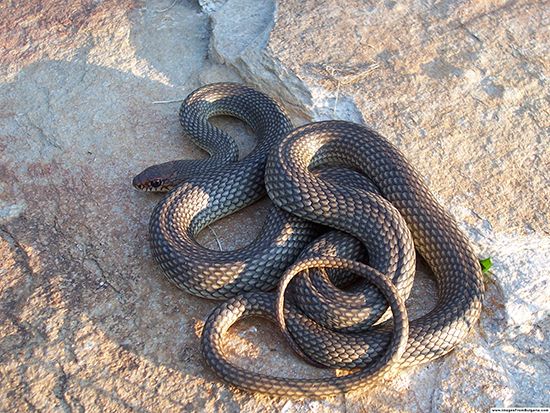
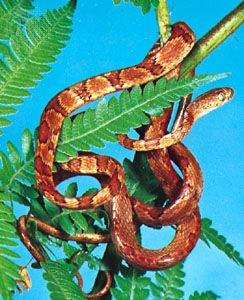
Tree snakes are a diverse group of arboreal serpents, primarily belonging to the family Colubridae, that have evolved specific physical and behavioral adaptations for life in trees and foliage.1
Physical Characteristics
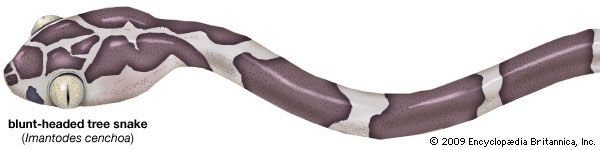
- Body Shape: Most tree snakes possess long, slender bodies, which facilitate climbing and movement through branches. Some species, such as those in the genus Imantodes, are exceptionally thin and can stiffen their bodies to bridge gaps between branches like an I-beam.2314
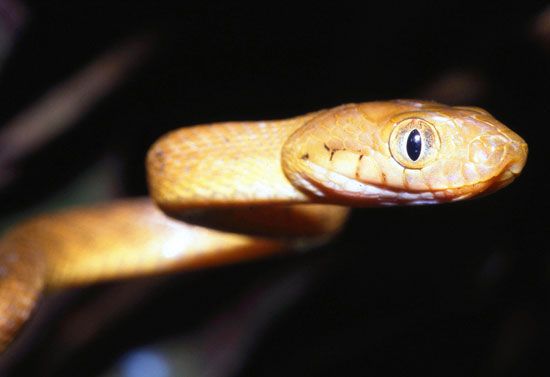
- Head and Eyes: Many species have broad or distinct heads. Those that hunt at night, like the brown tree snake, often feature large eyes with vertical pupils to improve nocturnal vision.12
- Locomotion: To navigate their environment, these snakes often utilize prehensile tails for grasping supports.43
Behavior and Ecology
- Diet: They are primarily predators of arboreal animals, including birds, lizards, and frogs.12
- Camouflage: Many species rely on protective coloration to blend into their surroundings, aiding in both hunting and avoiding predators.5
What are some common species of tree snakes found around the world?
Tree snakes are a diverse group of arboreal serpents found across various tropical and subtropical regions. While the term is often applied broadly to many climbing species, several distinct genera and species are commonly recognized:
Common Colubrid Tree Snakes
- Brown Tree Snake (Boiga irregularis): Native to regions from New Guinea to northern Australia, this slender, mildly venomous snake is well-known for its role as an invasive species in Guam.2
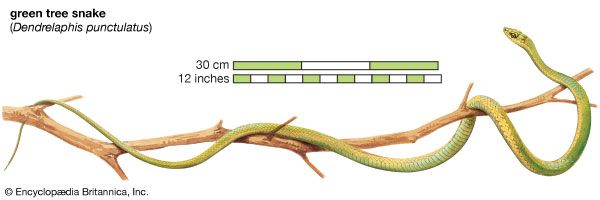
- Green Tree Snake (Dendrelaphis punctulatus): A common Australian species characterized by a tiny head and thin body, often found in the northern and eastern regions of the continent.5
- Vine Snakes: These include several genera such as Ahaetulla (Asian), Oxybelis (New World), and Thelotornis (African). They are noted for their extremely slender bodies and specialized vision.1
- Other Genera: The genus Imantodes is known for its exceptionally thin body, which it can stiffen like an I-beam to bridge gaps between branches. Other groups include Leptophis (parrotsnakes) and Dendrophis (found from Southeast Asia to Australia).5
Arboreal Boas
While many tree snakes are colubrids, some members of the family Boidae are also strongly arboreal:
- Emerald Tree Boa (Corallus caninus): A striking green snake of tropical South America that uses its sizable teeth to capture birds.7
How have tree snakes adapted to their arboreal lifestyle?
Tree snakes have evolved a suite of specialized anatomical and behavioral adaptations that allow them to thrive in arboreal environments. These adaptations focus on movement, stability, and survival within complex, three-dimensional habitats.
Structural Adaptations for Climbing
- Prehensile Tails: Many arboreal snakes, including boas and pythons, possess prehensile tails. These function as a “fifth limb,” capable of supporting the animal’s weight and providing stability while navigating aerial supports.38
- Skeletal Specialization: Slender vine snakes exhibit unique skeletal modifications, including deepened and strengthened vertebrae. Combined with reduced body weight, these features allow them to extend a significant portion of their body horizontally to bridge gaps between branches, acting much like an I-beam.3
Camouflage and Defense
- Protective Coloration: Many arboreal snakes utilize green or disruptive color patterns to blend into their surroundings. This camouflage helps them remain hidden from both predators and potential prey.910
- Warning Displays: Some species use bright colors on their undersides as a defensive mechanism, exposing these patterns when threatened to signal danger to potential predators.9
Sensory and Hunting Adaptations
- Infrared Detection: Certain arboreal snakes, such as pit vipers and some boas, possess heat-sensitive infrared receptors on their heads. These organs enable them to accurately strike at warm-blooded prey in total darkness.11
- Chemoreception: Like other snakes, they rely heavily on the Jacobson’s organ to detect chemical cues in their environment, using their forked tongues to transfer scent particles to the roof of the mouth.11
Are all tree snakes venomous, and if not, how do non-venomous species catch their prey?
Not all tree snakes are venomous. The term “tree snake” is a broad, informal classification applied to many different species of arboreal serpents, primarily within the family Colubridae, which includes both venomous and non-venomous varieties.1
For those that do not rely on venom, the most common method for capturing and killing prey is constriction. In this process, the snake strikes and secures the prey with its teeth, then rapidly wraps its body in a series of coils around the animal. These coils are tightened until the prey can no longer breathe, leading to death by suffocation.12
Conversely, many other tree snakes are rear-fanged, meaning they possess specialized teeth at the back of the mouth that can deliver venom to immobilize prey, such as birds, lizards, or frogs. Whether venomous or non-venomous, these snakes rely on highly developed sensory tools, such as the Jacobson’s organ, to track and identify their food in complex arboreal environments.112
Sources
- tree snake — Encyclopædia Britannica
- brown tree snake — Encyclopædia Britannica
- reptile - Clinging and climbing — Encyclopædia Britannica
- Locomotion - Arboreal amphibians and reptiles — Encyclopædia Britannica
- vine snake — Encyclopædia Britannica
- What eats snakes? — Encyclopædia Britannica
- boa — Encyclopædia Britannica
- Tail — Encyclopædia Britannica
- reptile - Display of colour — Encyclopædia Britannica
- reptile - Chemoreception — Encyclopædia Britannica
- snake - Coloration — Encyclopædia Britannica
- snake - Specializations for securing food — Encyclopædia Britannica
- Black-and-yellow mangrove snake: Top Questions — Encyclopædia Britannica
Published on · 4 min read