Pit Viper
Pit vipers (subfamily Crotalinae) are a group of venomous snakes distinguished by several key physical and behavioral traits:
What are the defining characteristics of pit vipers?
Pit vipers (subfamily Crotalinae) are a group of venomous snakes distinguished by several key physical and behavioral traits:
- Heat-Sensing Pit Organs: The defining characteristic is a temperature-sensitive pit located on each side of the head between the eye and the nostril. These organs detect infrared radiation, allowing the snake to “see” heat images of warm-blooded prey and accurately aim its strike, even in total darkness.123
- Venomous Fangs: Like other vipers, they possess a pair of long, hollow, venom-injecting fangs attached to movable bones in the upper jaw. These fangs fold back against the roof of the mouth when not in use.2
- General Morphology: They typically have vertical pupils and keeled scales. They are found in diverse environments, ranging from deserts to rainforests, and may be terrestrial, arboreal, or aquatic.21
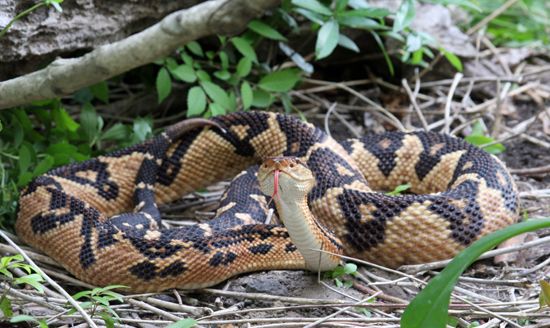
- Reproduction: While the bushmaster is an egg-layer, most pit vipers are viviparous, meaning they give birth to live young.12
Common examples of this group include rattlesnakes, copperheads, and moccasins and moccasins.12
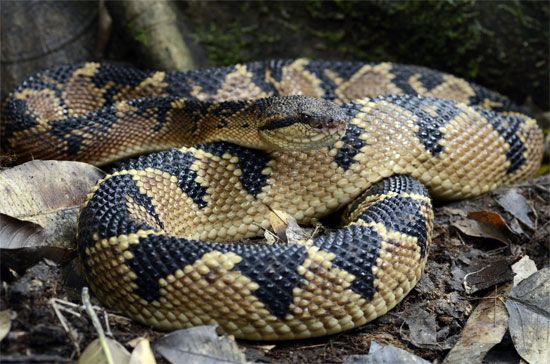
How do pit vipers’ venom and fangs work?
Pit vipers utilize a specialized biological system to hunt and subdue their prey, relying on a combination of precise sensory input and mechanical delivery of toxins.
Fangs and Delivery
Pit vipers are equipped with a pair of long, hollow, venom-injecting fangs. These fangs are attached to movable bones in the upper jaw, known as the maxillaries. When the snake is not hunting, these fangs fold back against the roof of the mouth, allowing the snake to close its jaws completely. During a strike, the jaw opens, and the fangs rotate forward to pierce the prey, acting like hypodermic needles to inject venom produced in specialized glands.124
Venom Function
The venom of pit vipers is a complex mixture of toxic enzymes and proteins. While the specific composition varies by species, these secretions primarily serve to kill or paralyze prey and often function as digestive fluids. The venom can contain various toxins, including:
- Hemotoxins: These affect the blood and circulatory system, often destroying blood vessel linings or interfering with coagulation, which can lead to internal hemorrhaging or circulatory collapse.4
- Cytotoxins: These cause direct destruction of cells and tissues at the site of the bite.4
- Myotoxins: These cause damage to muscle tissue.4
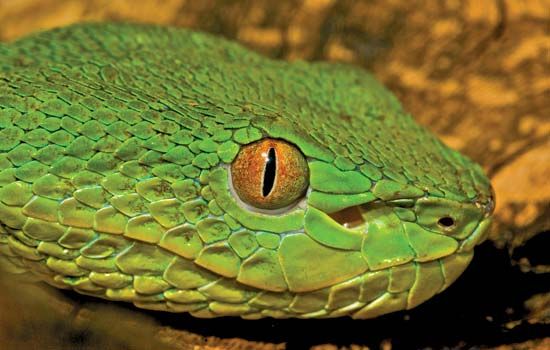
How do pit vipers use their heat-sensing pits to hunt?
Pit vipers utilize their specialized heat-sensing pits to enhance their hunting precision, particularly when operating in low-light or nocturnal environments. These organs, located on each side of the head between the eye and the nostril, consist of two chambers separated by a thin membrane that is densely supplied with nerve fibers and blood vessels.3
This structure functions as an infrared receptor capable of detecting temperature differences as small as 0.6 °C (1.1 °F). While the snake may initially identify the presence of nearby prey through ground vibrations, sight, or smell, the pit organs serve a critical role in the final stages of the hunt. By sensing the heat signature of warm-blooded animals like mammals and birds, the pits allow the snake to confirm the prey’s identity and accurately direct its strike, even in total darkness.3
What are some common species of pit vipers found around the world?
Pit vipers (subfamily Crotalinae) are a diverse group of venomous snakes found primarily in the New World, inhabiting environments ranging from deserts to rainforests. They are characterized by their heat-sensing pit organs and specialized fangs.12
Common species and groups of pit vipers include:
- Rattlesnakes: Comprising 33 species, these are perhaps the most well-known pit vipers, identified by the segmented rattle at the tip of their tails. Common North American species include the timber rattlesnake, the eastern diamondback, and the western diamondback.5
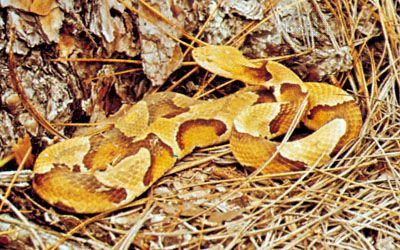
- Copperheads: These are well-known pit vipers belonging to the genus Agkistrodon.12
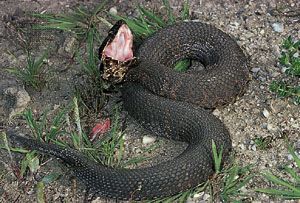
- Moccasins: Also of the genus Agkistrodon, these are aquatic pit vipers, such as the water moccasin (cottonmouth) and the Mexican moccasin.26
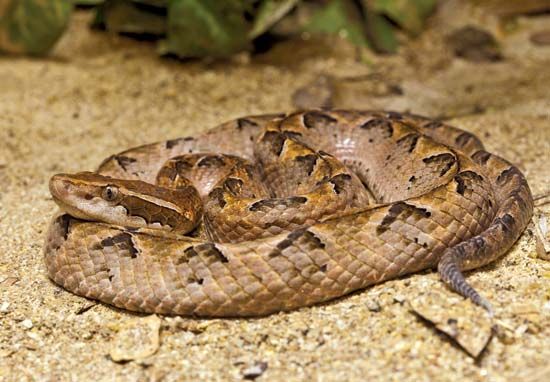
- Fer-de-lance: These snakes belong to the genera Bothrops and Trimeresurus and are notable members of the subfamily.12
- Bushmaster: The bushmaster (Lachesis muta) is the largest pit viper, capable of reaching lengths over 3 meters.12
Sources
- pit viper — Encyclopædia Britannica
- viper — Encyclopædia Britannica
- reptile - Chemoreception — Encyclopædia Britannica
- Venom — Encyclopædia Britannica
- black-tailed rattlesnake — Encyclopædia Britannica
- rattlesnake — Encyclopædia Britannica
- moccasin — Encyclopædia Britannica
Published on · 3 min read