Feral Cats of the Last Frontier
"Feral Cats of the Last Frontier" is an article published by Britannica that explores the challenges surrounding feral cat populations in Alaska.
What is Feral Cats of the Last Frontier?
“Feral Cats of the Last Frontier” is an article published by Britannica that explores the challenges surrounding feral cat populations in Alaska.1
The article highlights that while feral cats are common throughout the United States, Alaska faces a unique hurdle: an antiquated state administrative rule that prohibits releasing animals into the wild, which effectively outlaws trap-neuter-return (TNR) programs. TNR is widely considered the most effective and humane method for controlling feral populations, as it prevents reproduction and allows cats to live out their lives in their established territories.1
The piece details efforts by organizations like Mojo’s Hope to advocate for regulatory or statutory changes that would permit TNR, thereby reducing the number of cats euthanized in shelters. It also discusses the environmental challenges these animals face in Alaska’s harsh climate and the importance of humane, science-based population management.1
What is the ‘vacuum effect’ in animal population control?
The “vacuum effect” is a phenomenon observed in animal population control, particularly concerning feral cats. It occurs when members of a colony are removed or killed, leaving their established territory vacant. This void attracts new cats to the area, while the remaining survivors continue to breed, ultimately rendering lethal control methods ineffective and counterproductive for long-term population reduction.2
In contrast, programs like trap-neuter-return (TNR) allow cats to remain in their established territories, where they maintain their boundaries and prevent new cats from moving in. Over time, this approach leads to a natural and humane decrease in the population.2
How do animal shelters manage stray versus feral cats?
Animal shelters distinguish between stray and feral cats based on their socialization levels, which dictates how they are managed. Stray cats are typically abandoned or lost pets that are socialized to humans and can often be re-homed. In contrast, feral cats are undomesticated and generally not amenable to living with humans.1
Shelters manage these populations through different approaches:
- Socialized Cats: Shelters prioritize finding homes or fosters for friendly, adoptable cats.1
- Feral Cats: Because feral cats are not adoptable, they often face euthanasia in shelters that lack alternative programs. To address this, many organizations advocate for trap-neuter-return (TNR) programs. In TNR, cats are trapped, neutered, vaccinated, and ear-tipped before being returned to their original territory. This method is considered more humane and effective than lethal control, which triggers the “vacuum effect”—a process where new cats move into vacated territories and survivors continue to breed.1
Some shelters or rescue groups manage feral colonies on private land when TNR is restricted by local regulations, though this is less effective for large-scale population reduction than community-wide TNR.1
What are the main differences between a stray cat and a feral cat?
The primary difference between a stray cat and a feral cat lies in their socialization to humans. While the terms are sometimes used interchangeably, they represent distinct behavioral states:
- Stray Cats: These are typically lost or abandoned pets. Because they were once socialized to humans, they are often amenable to being re-homed or adopted into a domestic environment.3
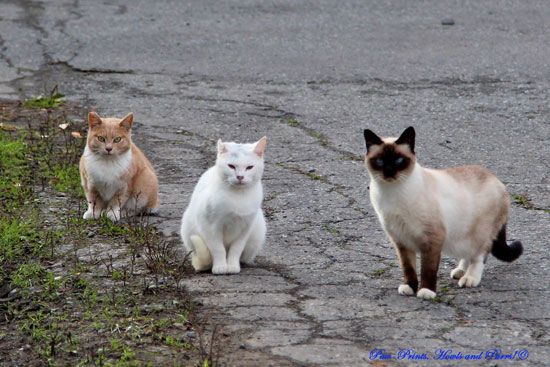
- Feral Cats: These are undomesticated cats that have either been born in the wild or have reverted to a wild state after being abandoned. Truly feral cats are not socialized to humans and will never be amenable to living in a home.3
Feral cats often form groups known as colonies, where they establish and defend specific territories. Because they are not adoptable, they are frequently euthanized in shelters unless they are managed through trap-neuter-return (TNR) programs. TNR is considered the most effective and humane method for population control, as it stabilizes the colony and prevents the “vacuum effect,” where new cats move into a territory after others have been removed.3
Sources
- Feral Cats of the Last Frontier — Encyclopædia Britannica
- metapopulation — Encyclopædia Britannica
- cat - Behavior — Encyclopædia Britannica
Published on · 3 min read