Why Do Dogs Wag Their Tails?
Dogs primarily wag their tails as a complex form of communication, allowing them to express emotions such as happiness, excitement, nervousness, or agitation…
Why do dogs wag their tails?
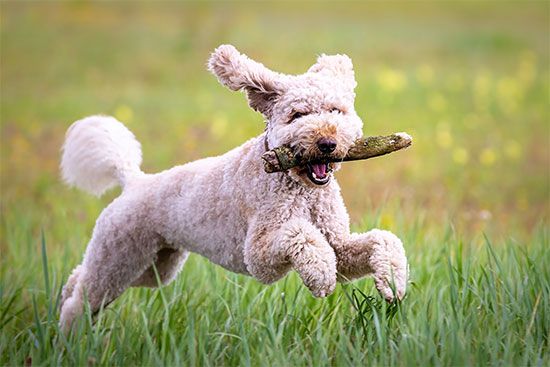
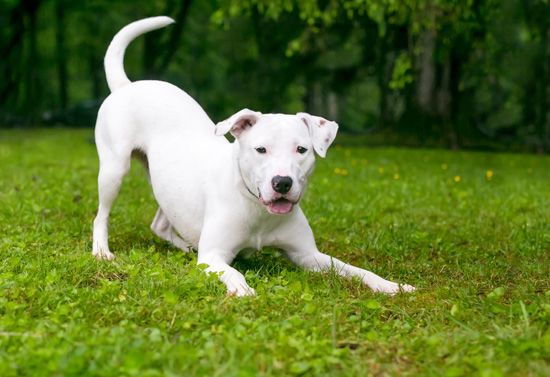
Dogs primarily wag their tails as a complex form of communication, allowing them to express emotions such as happiness, excitement, nervousness, or agitation to humans and other dogs.12
The meaning behind a wag often depends on the motion and posture:
- Friendliness: A loose, sweeping wag typically signals that a dog is happy or excited.12
- Aggression: A dog may hold its tail high and wag only the tip when feeling aggressive.1
- Submission or Fear: A low, stiff wag often indicates that a dog is scared or submissive.12
From a biological perspective, this behavior is shaped by both genetics and environment. Puppies begin wagging around six or seven weeks old as they interact with littermates and humans. Evolutionarily, the behavior likely originated in wolves as a way to promote social cooperation and pack survival. Scientists study this behavior through four levels of analysis: causation, ontogeny, function, and evolutionary history.123
How do other animals use their tails to communicate?
While many animals use their tails primarily for locomotion, balance, or defense, several species utilize them as sophisticated tools for communication.
Feline Communication
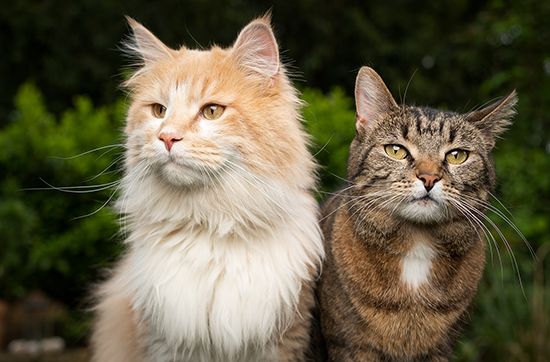
Cats use their tails to convey a wide range of emotional states through specific positions and movements:
- Greeting: A tail held high generally signals a friendly, confident, and happy state.42
- Aggression or Irritation: A tail bent into an upside-down “U” shape, often accompanied by an arched back, is used to appear larger and more ferocious. Swishing or lashing the tail indicates anger or predatory intent, while a twitching tail tip can signal mild irritation or that the cat is on guard.42
- Fear or Submission: A tail tucked between the hind legs or held close to the ground indicates insecurity, fear, or defeat.42
- Sexual Signaling: A female in heat may hold her tail to one side as an invitation.4
Other Uses
While communication is vital, tails serve diverse evolutionary purposes across the animal kingdom, such as attracting mates through colorful plumage in birds like peacocks, or acting as a grasping limb for some monkeys and squirrels.5
What are some other ways dogs express their emotions?
Beyond tail wagging, dogs utilize a sophisticated range of physical and vocal signals to express their emotions and communicate with both humans and other dogs. These behaviors are rooted in their ancestry as social, pack-dwelling wolves.17
Physical Communication
Dogs rely heavily on body language to convey their internal state:
- Posture and Facial Expressions: A dog’s overall body stance and the position of its ears and face are key indicators of its mood.17
- Scent Marking: Dogs possess scent-producing glands and use urine, feces, and paw prints to leave information for others. These markers can reveal a dog’s sex, age, and emotional state to other dogs.7
Vocal Communication
Dogs use their voices to express specific needs and feelings:
- Barking: Generally used to show excitement or to communicate with others.7
- Growling: Indicates that a dog is angry and potentially ready to fight.7
- Whining or Whimpering: Typically signals distress, such as when a dog is hungry, cold, or in pain.7
By observing these combined signals—posture, scent, and vocalization—one can better understand a dog’s complex social interactions.7
How did wolves use their tails differently than modern dogs?
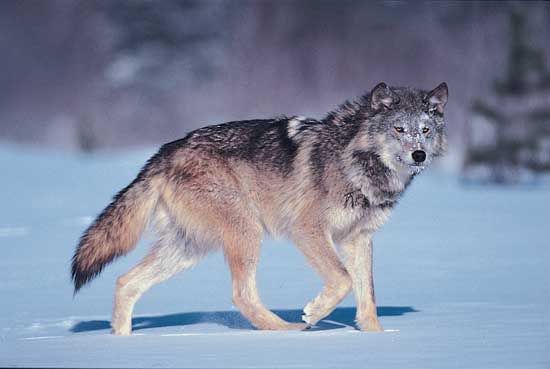
While modern dogs and wolves share a common ancestry and use similar visual signals—including tail position and movement—to communicate, the context and refinement of these behaviors differ due to domestication.289
Both species utilize tail positioning as part of a broader system of communication that includes facial expressions and body posture. In both groups, tail movement serves as a vital social signal during interactions, such as when strangers meet on neutral ground.8910
However, the primary difference lies in the evolution of these behaviors. In dogs, tail wagging has become a highly nuanced tool for social interaction, heavily influenced by environmental factors and human reinforcement. While wolves also use tail position to signal status and intent within their dominance hierarchy, their communication is strictly geared toward survival and pack cohesion in the wild. Domestic dogs have adapted these ancestral signals to facilitate social cooperation not just with other canines, but specifically with humans, often responding to human cues in ways that wild wolves do not.2891
Sources
- 16 Questions About Pets Answered - Why does my dog wag its tail when it’s happy to see me? — Encyclopædia Britannica
- Why do dogs wag their tails? — Encyclopædia Britannica
- Animal behaviour - Ecological and ethological approaches to the study of behaviour — Encyclopædia Britannica
- Why Do Animals Have Tails? — Encyclopædia Britannica
- cat - Body language and communication — Encyclopædia Britannica
- 16 Questions About Pets Answered - How does a cat’s tail help keep the animal balanced? — Encyclopædia Britannica
- 16 Questions About Pets Answered - Why do dogs bark? — Encyclopædia Britannica
- dog - Wolves — Encyclopædia Britannica
- gray wolf - Pack behaviour — Encyclopædia Britannica
- dog - Territory and range — Encyclopædia Britannica
Published on · 3 min read