Flesh Fly
Flesh flies, members of the family Sarcophagidae, are distinguished by several key physical and behavioral traits:
What are the distinguishing characteristics of flesh flies?
Flesh flies, members of the family Sarcophagidae, are distinguished by several key physical and behavioral traits:
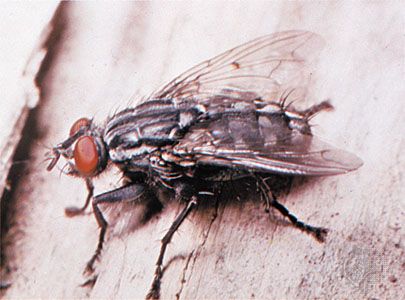
- Appearance: They are similar in size and shape to the common house fly but are easily identified by three blackish longitudinal stripes on their gray thorax and a distinct checkered pattern of light and dark gray on their abdomen.12
- Reproduction: A notable characteristic of many species is that they are viviparous, meaning the female deposits live larvae rather than eggs.12
- Diet and Habitat: While the family is widespread, most species are tropical. They are primarily scavengers, with larvae typically developing in carrion or open wounds. However, the family is ecologically diverse; some species are insect parasites that target grasshoppers, bees, or wasps, while others may develop in plant tissues like those of the pitcher plant.1
- Interaction with Humans: Some species, such as Wohlfahrtia vigil, can be parasitic to mammals and may deposit their young on the skin of infants.1
Where are flesh flies typically found, and what environments do they prefer?
Flesh flies are found globally, though the family is most heavily concentrated in tropical regions. While they are widespread, their specific environmental preferences are dictated by their diverse life cycles and feeding habits.1
Because many species are scavengers, they are frequently found in environments where carrion or decaying organic matter is present, as these serve as primary sites for larval development. Other species are specialized parasites that inhabit environments where their hosts are found, such as areas populated by grasshoppers, bees, or wasps. Some species have adapted to unique ecological niches, such as the interior of pitcher plants. Additionally, certain species, such as Wohlfahrtia vigil, are found in cooler regions like North America, where they may interact with mammals.1
How do flesh flies differ from other similar fly species, like blow flies?
Flesh flies (family Sarcophagidae) and blow flies (family Calliphoridae) are both common flies that play significant roles in decomposition, but they possess distinct physical and reproductive characteristics.
Physical Differences
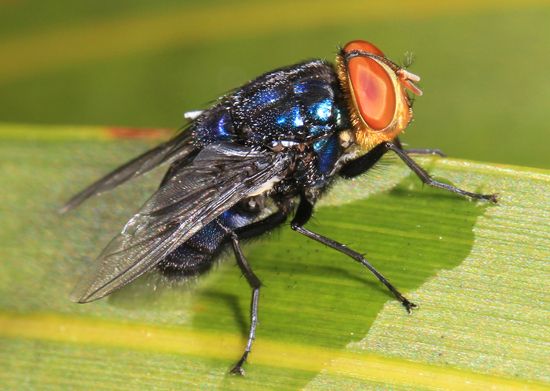
- Appearance: Flesh flies are typically large, gray, and black, characterized by three blackish longitudinal stripes on their gray thorax and a checkered pattern of light and dark gray on their abdomen. In contrast, many blow flies are distinguished by their metallic blue, green, or black coloration.125
- Bristles: Blow flies are known for being bristly, with a precise arrangement of bristles on the thorax known as chaetotaxy, which is a key method for their identification.5
Reproductive and Behavioral Differences
- Egg vs. Larva: A major distinction is that many flesh fly species are viviparous, meaning the female deposits live larvae rather than eggs. Blow flies, however, typically lay eggs on carrion or decaying organic matter.125
- Larval Habits: While both families include scavengers that feed on carrion, their ecological roles vary. Flesh flies have diverse larval habits, ranging from scavenging in carrion to acting as parasites of insects (such as grasshoppers, bees, or wasps) or even mammals. Blow fly larvae are primarily scavengers on decaying matter, though some species can cause myiasis (infestation of living tissue) in humans and livestock.125
What is the difference between oviparous and viviparous reproduction in flies?
The primary difference between oviparous and viviparous reproduction in flies lies in where the embryo develops and how the offspring are delivered.
Oviparous Reproduction
In oviparous species, the female deposits eggs into the environment, typically in or near a food source suitable for the larvae, such as decaying organic material or plant tissue. The embryo develops outside the mother’s body, relying on the nutrients stored within the egg until it hatches into a larva. This is the most common reproductive strategy among flies, including houseflies and blow flies.89
Viviparous Reproduction
In viviparous species, the female retains the developing young within her body and eventually delivers them as live larvae. This process can vary in complexity:110
- Internal Development: The egg is hatched internally, and the larva is nourished within the mother’s body, sometimes through glandular secretions from the uterine lining.1110
- Direct Larval Birth: In some highly specialized groups, such as tsetse flies and certain parasitic flies, a single egg is produced at a time and hatched internally. The larva is retained and nourished in a womb-like structure until it is fully mature and ready to pupate immediately upon being expelled.10
While some insects are ovoviviparous—meaning the egg hatches within the mother’s body but the embryo relies primarily on its own yolk for nutrition—true viviparity in flies often involves the mother providing additional nourishment to the developing larvae.11912
Sources
- flesh fly — Encyclopædia Britannica
- Diptera - Annotated classification — Encyclopædia Britannica
- flesh fly — Merriam-Webster
- Diptera: Top Questions — Encyclopædia Britannica
- Diptera - Larvae — Encyclopædia Britannica
- blow fly — Encyclopædia Britannica
- Diptera - General features — Encyclopædia Britannica
- Diptera - Eggs — Encyclopædia Britannica
- Animal reproductive system - Provisions for the developing embryo — Encyclopædia Britannica
- viviparous — Merriam-Webster
- Animal reproductive system - Provisions for the developing embryo — Encyclopædia Britannica
- ovoviviparous — Merriam-Webster
Published on · 3 min read