Fire Ant
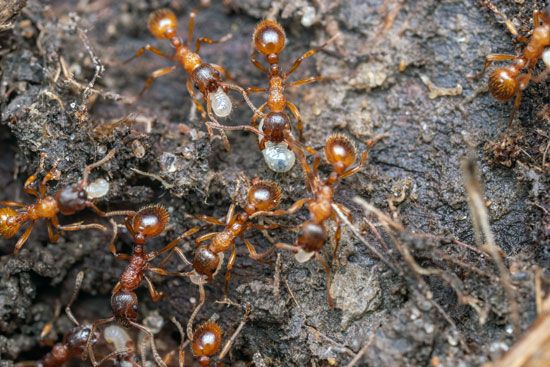
Fire ants communicate within their colonies primarily through two methods: chemical secretions and stridulation.
How do fire ants communicate with each other within their colonies?
Fire ants communicate within their colonies primarily through two methods: chemical secretions and stridulation.1
- Chemical Communication: As social insects, fire ants rely heavily on pheromones to exchange information. They use these chemical signals for various social functions, including marking foraging trails, recruiting nestmates for defense, attracting mates, and distinguishing between colony members and outsiders. Because they possess multiple glands, they can produce a variety of chemical compounds to serve these specific needs.123
- Stridulation: This involves the production of sound by rubbing or drumming one body part against another. This mechanism allows ants to create vibrations that can be sensed by other members of the colony.12
These communication strategies are essential for the survival and organization of the colony, allowing fire ants to coordinate complex behaviors such as foraging and responding to threats.12
What is the social structure of a fire ant colony, and how does it function?
Fire ant colonies are highly organized social insect societies characterized by a complex caste system and a strict division of labour.72
Colony Composition
A typical colony consists of one or more queens, winged males and females, and three distinct types of workers.7
- Queens: The fertile females responsible for reproduction. A colony may contain one or multiple queens.7
- Reproductives: Winged males and females (alates) that emerge for mating flights to establish new colonies.78
- Workers: Sterile females that perform the essential tasks of the society. They are often differentiated into subcastes based on their specific roles, such as foraging, nest maintenance, or defense.9710
Functional Organization
The colony functions as an integrated unit where individuals cannot survive independently. The queen focuses exclusively on egg-laying, while the workers manage the daily operations of the nest, including feeding and tending to the brood, constructing and repairing the soil mound, and defending the colony against threats.972
Young fire ants, whose stingers and exoskeletons are not yet fully developed, often play dead when threatened, while adult workers exhibit aggressive defensive behaviors. This sophisticated social structure allows fire ants to thrive in diverse environments and survive extreme conditions.7
Where are fire ants typically found, and how have they spread to different parts of the world?
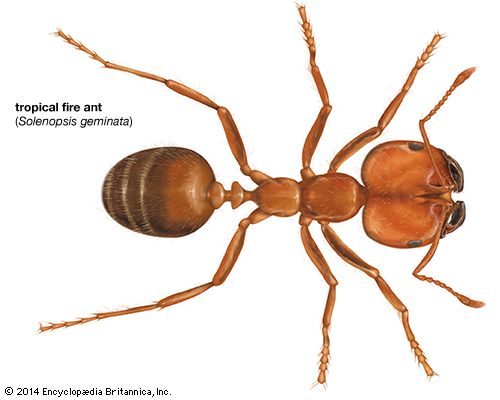
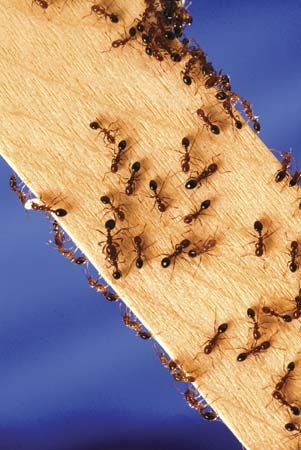
Fire ants, belonging to the genus Solenopsis, are naturally found in tropical regions such as Central and South America, as well as in certain temperate areas like North America. certain temperate areas like North America.2
While these ants are native to South America, specific species—most notably the red imported fire ant (Solenopsis invicta)—have spread to other parts of the world, including the southeastern United States, through accidental human introduction. These ants are considered significant agricultural pests in their introduced ranges, where they build large soil mounds that can disrupt farming and damage crops.212
It is important to note that the term “fire ant” is sometimes applied to unrelated species, such as the European Myrmica rubra or the Pogonomyrmex barbatus of the southwestern United States, which have also been introduced to various regions outside their native habitats.2
How did fire ants get their name, and what makes their sting unique?
Fire ants earned their name due to the intense, burning sensation caused by their sting, which is often described as sharp and sudden. This unique reaction is a result of the venom they inject, which is potent enough to be rated 1.2 on the Schmidt sting pain index.22
The experience of the sting has been famously characterized by entomologist Justin O. Schmidt as being “sharp, sudden, mildly alarming,” comparing the sensation to the static shock one feels when “walking across a shag carpet and reaching for the light switch.” While the name is most commonly associated with the red imported fire ant, it is also applied to various other species—such as the European Myrmica rubra or certain weaver ants—that are either red in appearance or capable of delivering similarly painful stings or bites.2
Sources
- termite - Communication — Encyclopædia Britannica
- fire ant — Encyclopædia Britannica
- Animal communication - Signal production — Encyclopædia Britannica
- Chemoreception - Defensive tastes — Encyclopædia Britannica
- Chemoreception - Pheromones — Encyclopædia Britannica
- Hymenoptera - Chemical — Encyclopædia Britannica
- Hymenoptera - Social forms — Encyclopædia Britannica
- Caste — Encyclopædia Britannica
- social insect — Encyclopædia Britannica
- Reproductive behaviour - Insects — Encyclopædia Britannica
- termite - Colony organization — Encyclopædia Britannica
- imported fire ant — Merriam-Webster
Published on · 3 min read