Hymenoptera
In social Hymenoptera—a group including ants, bees, and wasps—colonies are organized into specialized castes defined by distinct anatomical, physiological…
What are the different castes in social hymenopteran colonies, and what are their roles?
In social Hymenoptera—a group including ants, bees, and wasps—colonies are organized into specialized castes defined by distinct anatomical, physiological, and behavioral roles.12
Primary Castes
- Queen: The fertile female responsible for reproduction. In most advanced species, the queen rarely leaves the nest and focuses exclusively on egg-laying.13
- Workers: Typically sterile females that perform the essential labor of the colony. Their roles include nest construction, feeding and tending to the brood, and foraging for food. As workers age, they may transition from internal tasks (like brood care) to external tasks (like foraging).1324
- Soldiers: A specialized subcaste found in some ant and termite species, morphologically adapted for colony defense.124
Additional Roles and Variations
- Males: Often referred to as drones, they play no part in nest maintenance or defense. They are produced in limited numbers and exist primarily for mating.3
- Subcastes: Some species exhibit further division of labor. For example, certain ants produce minor workers for foraging and major workers (or “supersoldiers”) for defense or handling large food resources. Some ants also utilize repletes, workers that serve as living storage vessels for sugary secretions.15
What is the economic importance of hymenopteran insects to humans?
The order Hymenoptera is arguably the most beneficial insect group to humans, providing essential services that support global agriculture and ecosystem stability.7
Agricultural and Economic Contributions
- Pollination: Hymenopterans, particularly bees, are the primary pollinators for a vast array of wild and cultivated plants. In the United States alone, managed western honeybee colonies contribute over $15 billion annually in crop value, supporting the production of fruits, nuts, and vegetables.87910
- Commercial Products: Humans have long valued honey as a sweetener and medicinal resource, and beeswax remains a vital commodity in cosmetics, candles, and industrial coatings. Stingless bees are also kept for honey production, a practice known as meliponiculture.9111213
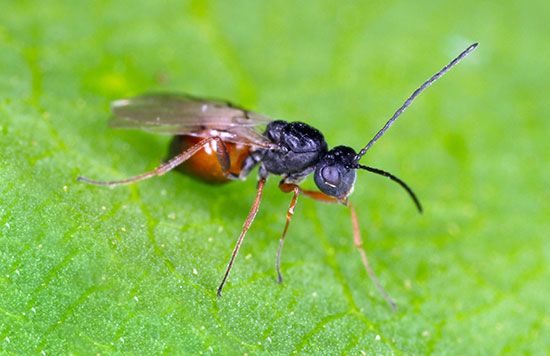
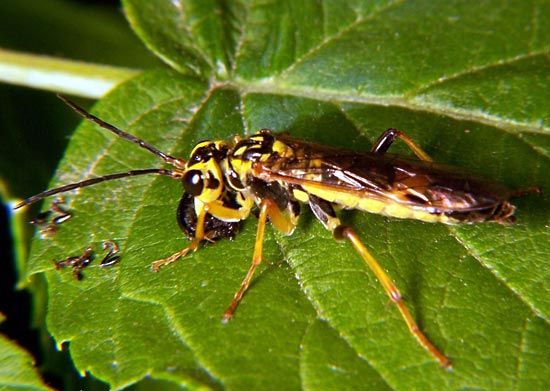
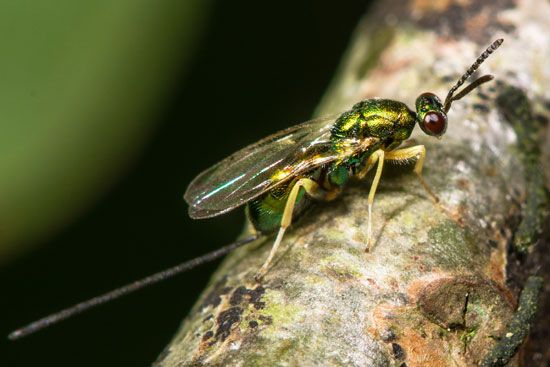
- Biological Control: Many parasitic wasps act as natural agents of biological control, regulating populations of destructive agricultural pests such as wood-boring beetles, scale insects, and various crop-damaging larvae.11148
While some species, such as certain sawflies and ants, are considered economic pests, the overall contribution of the order to food security and biodiversity is profound.117
How do hymenopteran insects pollinate plants, and why is this important?
Hymenopteran insects—a group including bees, wasps, and ants—are the primary pollinators of flowering plants, a role they have performed since the two groups coevolved.15
How They Pollinate
Hymenopterans facilitate pollination by transferring pollen from the male anthers to the female stigma of a flower. They are often attracted to flowers by visual cues, such as specific colors or ultraviolet patterns, and by rewards like nectar.1617
Specific mechanisms include:
- Foraging: As bees move between flowers to feed on nectar or pollen, they inadvertently pick up and deposit pollen grains on their bodies.16
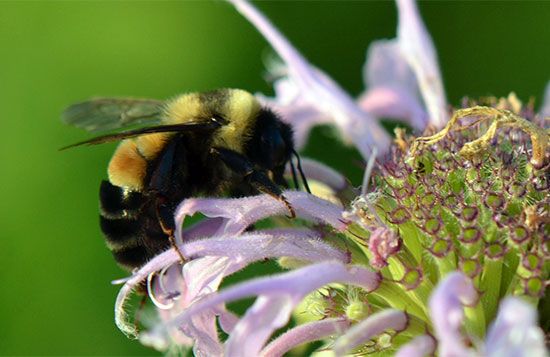
- Buzz Pollination (Sonication): Certain bees, such as bumblebees, vibrate their flight muscles at specific frequencies to release pollen from specialized anthers that do not open easily.8
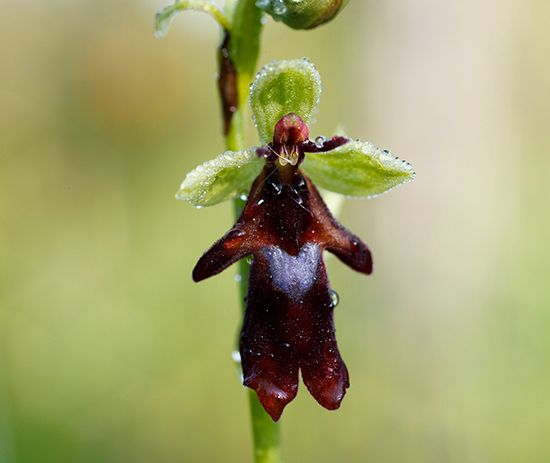
- Deception: Some plants, like the bee orchid, mimic the appearance and scent of female insects to lure males into “pseudocopulation,” during which the insect picks up or deposits pollen.168
- Mutualism: In some cases, such as with gall wasps and figs, the insect and plant have developed an intimate, exclusive relationship where the insect’s life cycle is entirely dependent on the plant.18
Why It Is Important
Pollination is essential for the sexual reproduction of approximately 300,000 species of flowering plants. This process is critical for:12
- Ecosystem Stability: By enabling plant reproduction, hymenopterans support the biodiversity of entire ecosystems, providing food and shelter for countless other species.19
- Human Agriculture: Many fruit and vegetable crops depend on these insects for production. In the United States, bee-pollinated crops are valued at billions of dollars annually, and their decline threatens global food security and availability.2019
How many species of hymenopteran insects are there, and what are some common examples?
The order Hymenoptera is the third-largest order of insects, with more than 150,000 species described to date. These insects are found in most habitats worldwide, with the exception of polar regions, and are particularly abundant in tropical and subtropical environments.1321
The order is divided into two suborders: Symphyta, which includes sawflies and horntails, and Apocrita, which encompasses the vast majority of species, including ants, bees, and wasps.13
Common examples of hymenopteran insects include:
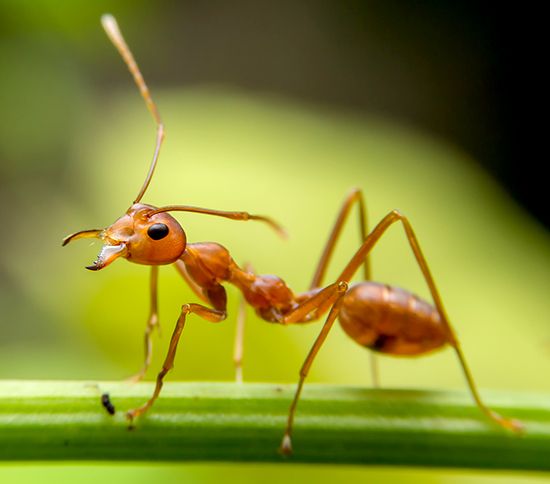
- Ants: Such as carpenter ants, fire ants, and leafcutter ants.21
- Bees: Including western honeybees, bumblebees, and mason bees.21
- Wasps: Ranging from paper wasps and hornets to parasitic forms like ichneumon wasps and fig wasps.1321
- Sawflies: Members of the suborder Symphyta that are known for their plant-feeding larvae.1321
Sources
- Caste — Encyclopædia Britannica
- Hymenoptera - Social forms — Encyclopædia Britannica
- social insect — Encyclopædia Britannica
- Animal social behavior - Social interactions involving cooperative breeding and eusociality — Encyclopædia Britannica
- Hymenoptera - General features — Encyclopædia Britannica
- Hymenoptera - Size range and diversity of structure — Encyclopædia Britannica
- western honeybee - Importance — Encyclopædia Britannica
- Why are bees important? — Encyclopædia Britannica
- Hymenoptera - Economic importance — Encyclopædia Britannica
- Biological control — Encyclopædia Britannica
- Beekeeping - Beeswax — Encyclopædia Britannica
- Hymenoptera - Ecology — Encyclopædia Britannica
- Hymenoptera — Encyclopædia Britannica
- stingless bee — Encyclopædia Britannica
- major types of pollinators — Encyclopædia Britannica
- colony collapse disorder - History of CCD and its economic impact — Encyclopædia Britannica
- angiosperm - Pollination — Encyclopædia Britannica
- plant - Flowers — Encyclopædia Britannica
- pollination - Evolution of insect pollination — Encyclopædia Britannica
- Botanical Sex: 9 Alluring Adaptations — Encyclopædia Britannica
- list of ants, bees, and wasps — Encyclopædia Britannica
Published on · 4 min read