Firn
Firn is a unique material in glaciology because it represents the critical intermediate stage between snow and glacial ice. Its physical properties are…
What are some of the physical properties of firn that make it unique in glaciology?
Firn is a unique material in glaciology because it represents the critical intermediate stage between snow and glacial ice. Its physical properties are defined by several key characteristics:1
- Composition and Density: Firn is partially compacted, granular snow. Its density typically ranges from 0.4 to 0.84 grams per cubic centimeter (or 400 to 840 kilograms per cubic meter). Unlike fully formed glacial ice, firn remains permeable to air and water.12
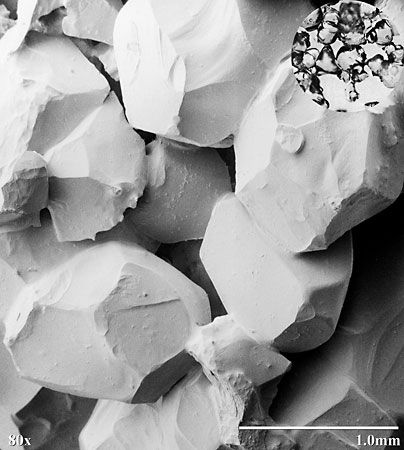
- Grain Structure: The individual grains of firn range from 0.5 to 5 mm in size. These grains form through processes such as recrystallization, localized melting, and the crushing of snowflakes under the pressure of overlying snow.1
- Stratification: Annual layers of firn are often identifiable by thin films of dust or ash that accumulate on the surface during summer months.1
- Transition Point: The transition from firn to glacial ice occurs when the density reaches approximately 830–840 kilograms per cubic meter, at which point the air spaces between grains are sealed off, rendering the material impermeable.2
What is the process of firnification and how long does it typically take?
Firnification is the process by which snow is transformed into firn and eventually into glacial ice. This transformation involves several physical mechanisms, including the compaction of snow under the weight of overlying layers, the recrystallization of ice grains, localized melting, and the crushing of intricate snowflake shapes. As snowpacks settle, grains undergo rounding and sintering—where they develop connecting “necks” of ice—which increases the density of the material.123
The time required for this process varies drastically depending on the local environment, specifically temperature and wetness. In warm, wet regions, such as Washington state, the transformation can occur rapidly, taking only three or four years and requiring less than 10 meters of burial. Conversely, in cold, dry environments like the high plateaus of Antarctica, the process is much slower, potentially taking several thousand years and requiring burial to depths of approximately 150 meters.3
How does firn differ from snow and glacier ice in terms of density and structure?
In glaciology, snow, firn, and glacier ice represent a continuum of densification. Their differences in density and structure are summarized below:
Material
Density
Structural Characteristics
Snow
50–250 kg/m³
Composed of intricate, delicate crystals (plates, needles, or stars) that are highly porous and permeable to air and water.
Firn
0.4–0.84 g/cm³ (approx. 300–840 kg/m³)
Partially compacted, granular snow with grain sizes of 0.5–5 mm. It remains permeable to fluids until it reaches the transition threshold.
Glacier Ice
840 kg/m³ (up to 917 kg/m³)
An aggregate of interlocking, irregularly shaped crystals. It is impermeable to air and water because the air spaces between grains have been sealed off.
The transition from snow to firn occurs as snow survives a melting season, while the shift to glacier ice is marked by the loss of permeability once the density exceeds approximately 830–840 kg/m³.21
How does the accumulation of firn contribute to the mass balance of glaciers and ice sheets?
The accumulation of firn is a critical component of a glacier’s mass balance, which represents the net difference between the mass gained (accumulation) and the mass lost (ablation).
Because firn is the intermediate stage between snow and glacier ice, its presence indicates that a portion of the annual snowfall has survived the summer melt season. This survival is essential for the long-term growth and maintenance of a glacier. The accumulation area, where firn is found, is defined as the region where annual gain exceeds loss, keeping the glacier’s mass balance positive.52
The transformation of snow into firn and eventually into impermeable glacier ice effectively “locks” the accumulated mass into the glacier structure. This process is vital for the glacier’s ability to flow and transport mass from high-altitude accumulation zones to lower-altitude ablation zones. By converting seasonal snowfall into a denser, more permanent state, firn ensures that the glacier can sustain its size against the constant forces of melting, runoff, and calving.51
Sources
- firn — Encyclopædia Britannica
- glacier - Transformation of snow to ice — Encyclopædia Britannica
- iceberg - Iceberg structure — Encyclopædia Britannica
- firnification — Merriam-Webster
- glacier - Mass balance — Encyclopædia Britannica
- glacier - Mass balance of mountain glaciers — Encyclopædia Britannica
Published on · 3 min read