Glacier
Glaciers shape the landscape primarily through two erosional processes: abrasion and plucking (or quarrying).
How do glaciers shape the landscape as they move?
Glaciers shape the landscape primarily through two erosional processes: abrasion and plucking (or quarrying).12
- Abrasion: As a glacier moves, it acts like a sheet of sandpaper. Rock debris embedded in the ice at the glacier’s base grinds against the underlying bedrock, creating features ranging from microscopic scratches to deep gouges. This process effectively smooths and sculpts the terrain over time.13
- Plucking: This involves the removal of larger chunks of rock from the glacier bed. As ice flows around bedrock obstacles, pressure changes and stress gradients can fracture the rock, allowing the glacier to “pluck” or quarry these pieces away.1
These mechanisms create distinct landforms, such as U-shaped valleys and deep fjords, which are carved by the immense weight and movement of the ice. Other features include drumlins (streamlined hills), eskers (sinuous ridges of sediment), and moraines (ridges of till deposited at glacier margins). Additionally, the combination of erosion and deposition can drastically alter drainage patterns, leading to the formation of numerous lakes.45
What is glacial ice made of, and how is it different from regular ice?
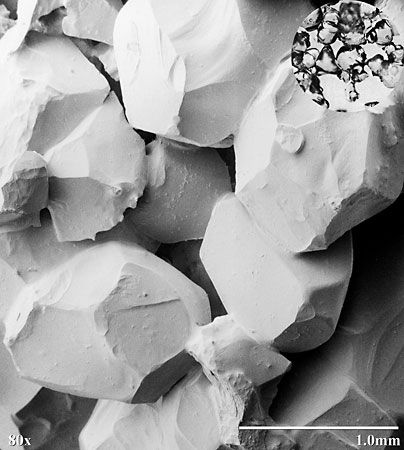
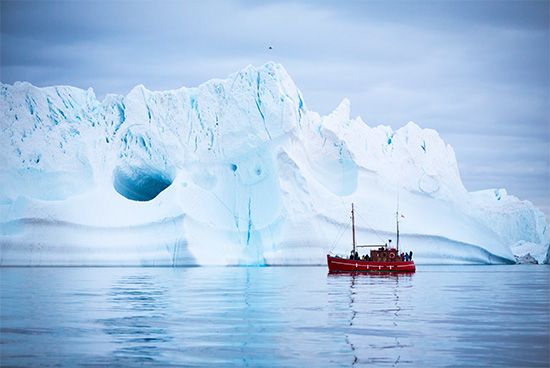
Glacial ice is not simply frozen water; it is an aggregate of interlocking ice crystals formed through the long-term compaction and recrystallization of snow. Unlike “regular” ice that may form quickly from freezing water, glacial ice undergoes a multi-stage transformation process.8910
The Transformation Process
- Snow to Firn: Initially, snow crystals settle and lose their intricate shapes through evaporation and condensation, becoming rounded grains. As this snow survives melting seasons, it becomes firn—a dense, granular intermediate stage.810
- Densification: Under the weight of overlying layers, firn is compressed. Air spaces between grains are gradually squeezed out or sealed off.810
- Glacial Ice: Once the density reaches approximately 830–840 kilograms per cubic meter, the material becomes impermeable to air and water, marking its transition into true glacial ice. At great depths, remaining air bubbles are absorbed into the ice crystal lattice, resulting in clear, dense ice.81011
Key Differences
- Formation: Glacial ice originates on land from solid precipitation, whereas other forms of ice, such as ice floes, form from the freezing of seawater.9
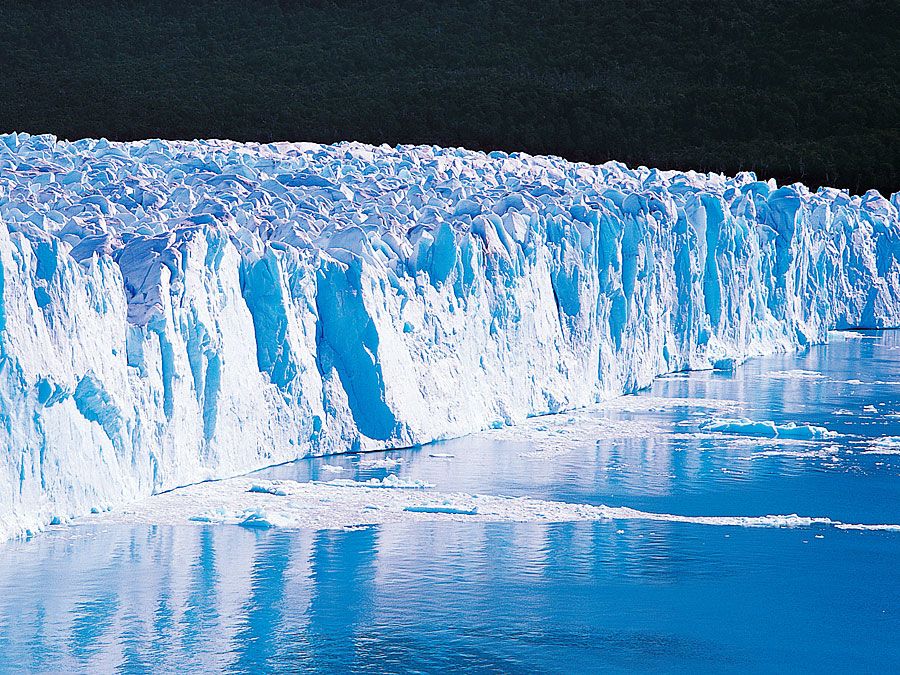
- Structure and Appearance: Because high pressure removes air bubbles, glacial ice is often denser and can appear blue, as the dense crystal structure absorbs longer wavelengths of light (red and yellow) and scatters shorter blue wavelengths.11
- Composition: Glacial ice acts as a historical record, trapping gases and particulate matter in its structure, which scientists use to study Earth’s environmental history.12
How are glaciers affected by climate change?
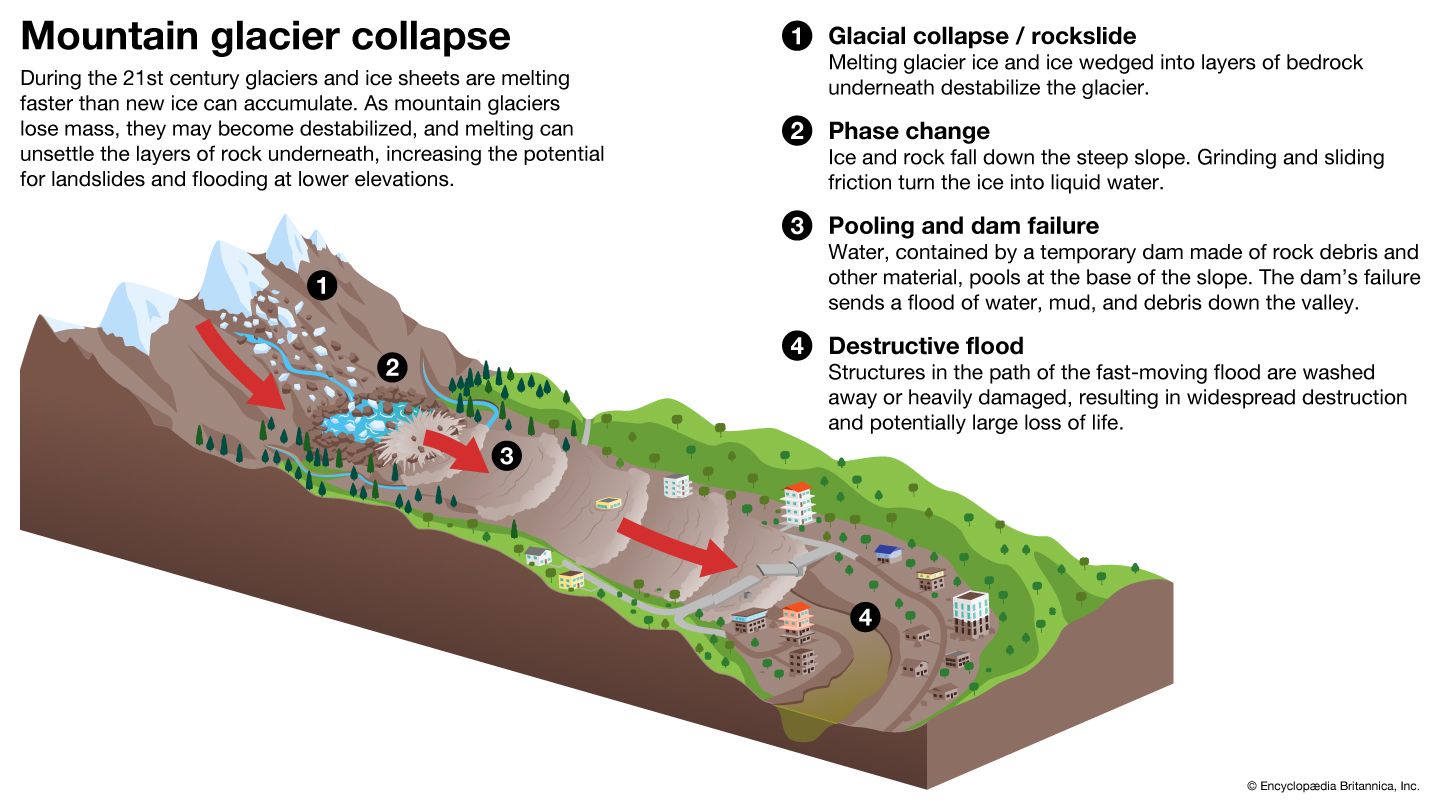
Glaciers are highly sensitive indicators of climate change, responding dynamically to shifts in local temperature and precipitation. Their health is determined by their mass balance—the difference between accumulation (gains from snowfall) and ablation (losses from melting, runoff, and iceberg calving).161718
Impacts of a Warming Climate
When the climate warms, glaciers are affected through several key mechanisms:
- Negative Mass Balance: Rising temperatures increase surface melting and reduce snowfall, leading to a negative mass balance. As glaciers shrink, their termini often retreat.1618
- The Albedo Feedback Loop: This is a critical self-reinforcing process. As snow and ice melt, they expose darker surfaces (such as older ice or meltwater ponds) that have a lower albedo. These darker surfaces absorb more solar radiation, which accelerates further melting and reduces the glacier’s size.1920
- Sea Level Rise: The melting of mountain glaciers and ice sheets in Greenland and Antarctica is a primary driver of global sea level rise. This process accounts for roughly 55 percent of the observed increase in sea levels, with the remainder largely attributed to the thermal expansion of warming ocean water.21
- Hydrological Changes: Glaciers act as natural reservoirs. While they typically regulate streamflow, climate-driven changes in melt rates can disrupt these patterns, affecting water availability in downstream regions.20
While glaciers have naturally fluctuated throughout Earth’s history, the current acceleration in ice loss is closely linked to the buildup of greenhouse gases and the resulting rise in global temperatures.2122
How do glaciers contribute to sea level rise?
Glaciers and ice sheets contribute to sea level rise primarily by transferring water stored on land into the oceans17. This process accounts for approximately 55 percent of the observed increase in global sea levels.1617
The contribution occurs through several mechanisms:
- Surface Melting and Runoff: As global temperatures rise, increased melting on the surface of glaciers and ice sheets creates meltwater that flows into the sea.1725
- Iceberg Calving: Glaciers and ice shelves that extend into the ocean experience “calving,” where large chunks of ice break off and enter the water. While the melting of ice that is already floating (such as ice shelves) does not directly raise sea levels, the loss of these structures can accelerate the flow of grounded ice from the land into the ocean, which does contribute to the rise.262725
- Mass Balance Shifts: Sea level rise occurs when the loss of ice through melting and calving exceeds the gains from annual snowfall.2625
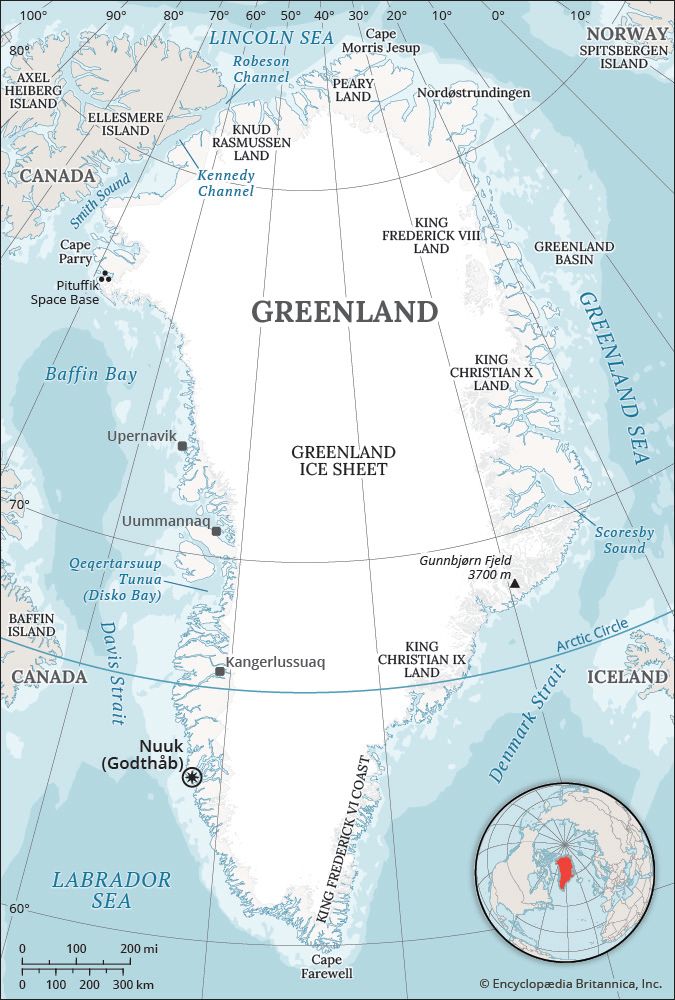
Currently, the retreat of mountain glaciers and the Greenland Ice Sheet are significant drivers of this trend.2617
Sources
- glacial landform - Glacial erosion — Encyclopædia Britannica
- fjord — Encyclopædia Britannica
- glacial landform - P-forms and glacial grooves — Encyclopædia Britannica
- Quaternary - Landforms — Encyclopædia Britannica
- erosion — Encyclopædia Britannica
- hydrologic sciences - The movement of glaciers — Encyclopædia Britannica
- glacial landform - Small-scale features of glacial erosion — Encyclopædia Britannica
- glacier - Transformation of snow to ice — Encyclopædia Britannica
- firn — Encyclopædia Britannica
- Why are icebergs blue? — Encyclopædia Britannica
- blue ice — Merriam-Webster
- What’s the Difference Between a Glacier and an Ice Floe? — Encyclopædia Britannica
- snow ice — Merriam-Webster
- Why does ice float on water? — Encyclopædia Britannica
- hydrosphere - Ice — Encyclopædia Britannica
- iceberg - Impacts on ice sheets and sea level — Encyclopædia Britannica
- sea level rise — Encyclopædia Britannica
- glacier - Response of glaciers to climatic change — Encyclopædia Britannica
- glacier - Mass balance — Encyclopædia Britannica
- Climate change - Glacial and interglacial cycles of the Pleistocene — Encyclopædia Britannica
- Geoengineering - Raising ground-level albedo — Encyclopædia Britannica
- sea ice - Interactions with the oceans , atmosphere , and climate — Encyclopædia Britannica
- glacier - Glacier hydrology — Encyclopædia Britannica
- glacier - Glaciers and climate — Encyclopædia Britannica
- sea level rise: Top Questions — Encyclopædia Britannica
- glacier - Glaciers and sea level — Encyclopædia Britannica
- iceberg - Antarctic icebergs — Encyclopædia Britannica
- sea level — Encyclopædia Britannica
Published on · 4 min read