Flat Bug
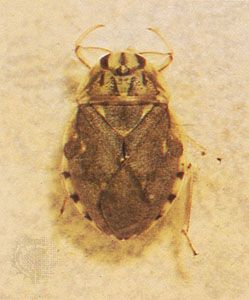
A flat bug is any of approximately 1,000 species of small, dark-colored insects belonging to the family Aradidae within the order Heteroptera.
What is flat bug?
A flat bug is any of approximately 1,000 species of small, dark-colored insects belonging to the family Aradidae within the order Heteroptera.12
These insects are typically found in secluded environments, such as under stones, within crevices of dead or dying trees, or beneath loose bark. Ranging in size from 3 to 11 mm (0.12 to 0.43 inch), they feed primarily on fungi and sap found in decaying wood. While they possess well-developed wings, these remain quite small in size. Flat bugs are found in all zoogeographic regions and generally remain in their obscure habitats unless environmental conditions become unsatisfactory.12
What are some other types of insects in the order Heteroptera?
The suborder Heteroptera, commonly known as true bugs, encompasses over 40,000 species characterized by their piercing-sucking mouthparts and an X-shaped wing pattern at rest. These insects are categorized by their diverse ecological habits, including water-dwelling, surface-swimming, and terrestrial lifestyles.45
Below are some notable types of insects within this suborder:
- Water-dwelling: Water boatmen, backswimmers, water scorpions, giant water bugs, and creeping water bugs.45
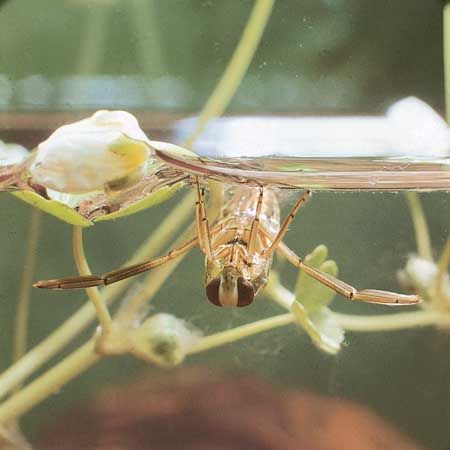
- Surface-swimming and shore-dwelling: Water striders, marsh treaders, water treaders, shore bugs, and velvet water bugs.45
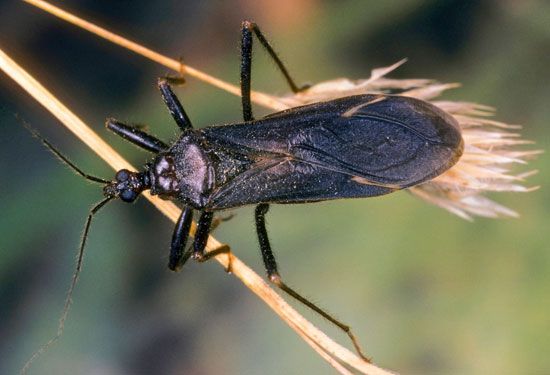
- Terrestrial: Assassin bugs, bedbugs, plant bugs, stink bugs, lace bugs, ambush bugs, stilt bugs, and red bugs.45
While some species are considered agricultural pests, others are beneficial predators that help control pest populations, and some are known to carry diseases.5
How do flat bugs survive in decaying wood?
Flat bugs (family Aradidae) are uniquely adapted to survive in the confined spaces of decaying wood due to their extremely flattened, thin body shape, which allows them to easily navigate and reside within tight crevices, under loose bark, and in the narrow gaps of dead or dying trees.1
Their survival is further supported by their specialized diet; they feed directly on the fungi and sap present within this decaying organic matter, which provides them with necessary nutrients in these secluded environments.1
What are the main differences between terrestrial and aquatic bugs?
The primary differences between terrestrial and aquatic bugs in the order Heteroptera center on their respiratory strategies, physical adaptations for movement, and habitat preferences.
Respiratory Adaptations
- Aquatic Bugs: These insects have evolved various methods to obtain oxygen while submerged. Some, like water scorpions, use a long, caudal breathing siphon to reach the surface. Others, such as water boatmen and backswimmers, carry air stores in chambers formed by their wings or dense body hairs. A few specialized species can even extract dissolved oxygen directly from the water.3
- Terrestrial Bugs: These insects rely on a standard tracheal system with spiracles—pores that open and close to regulate gas exchange while preventing water loss, which is a critical survival challenge in dry environments.7
Physical and Behavioral Differences
- Movement: Semiaquatic bugs, such as water striders, are adapted to walk on the water’s surface film using long, thin legs that distribute their weight. In contrast, terrestrial bugs are adapted for life on land, often utilizing crevices, foliage, or soil, with some species like cydnids capable of burrowing.3
- Habitat: Aquatic species benefit from the insulating properties of water, which protects them from extreme temperature fluctuations. Terrestrial species occupy a wider variety of niches, ranging from exposed surfaces like flowers to protected areas under logs or loose bark.3
Sources
- flat bug — Encyclopædia Britannica
- spider - Distinguishing taxonomic features — Encyclopædia Britannica
- heteropteran - Habitats — Encyclopædia Britannica
- list of true bugs — Encyclopædia Britannica
- heteropteran — Encyclopædia Britannica
- heteropteran - Distinguishing taxonomic features — Encyclopædia Britannica
- Respiratory system - Trachea — Encyclopædia Britannica
Published on · 2 min read