Flint Ridge Cave System
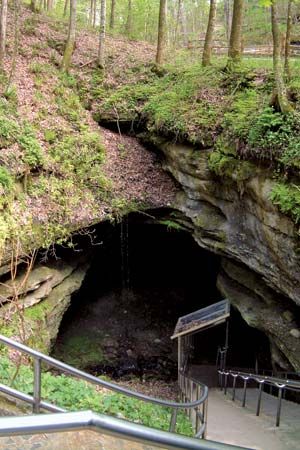
The Flint Ridge Cave System, located within Mammoth Cave National Park, is a critical component of a vast karst landscape. Hydrologically, the system…
What role does the Flint Ridge Cave System play in the local ecosystem and hydrology?
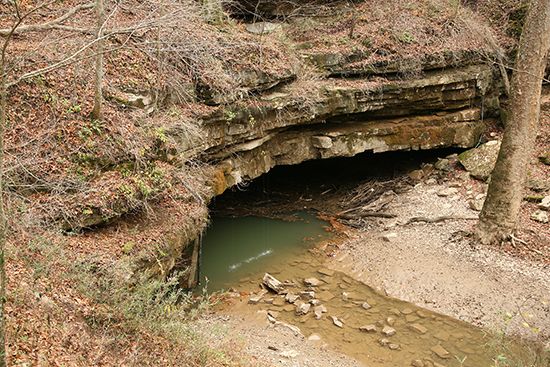
The Flint Ridge Cave System, located within Mammoth Cave National Park, is a critical component of a vast karst landscape. Hydrologically, the system functions through the dissolution of limestone by acidic groundwater, which creates complex underground conduits that serve as integrated drainage networks for the region. This process involves the movement of water through fractures that eventually enlarge into passages, allowing for the rapid transport of water and sediment through the subsurface.1234
Ecologically, the cave system supports a specialized environment characterized by high humidity and stable temperatures. This dark, subterranean habitat is home to unique species that have evolved specifically for life underground, including eyeless fish, eyeless crayfish, and cave crickets. The system also contains fungi and serves as a vital part of the broader park ecosystem, which includes diverse surface wildlife such as bats, which often bridge the gap between surface and cave environments.2
How does the Flint Ridge Cave System connect to the larger Mammoth Cave system?
The Flint Ridge Cave System is not a separate entity from the larger Mammoth Cave system; rather, it is a major component of the world’s longest continuous cave network. Between 1972 and 1983, explorers discovered physical connections between the Flint Ridge, Mammoth, and Roppel cave systems.12
These discoveries confirmed that the various caverns within Mammoth Cave National Park are part of a single, massive, multilevel subterranean complex. Today, this integrated system features at least 400 miles (650 km) of mapped passages, all formed by the ongoing dissolution of limestone by acidic groundwater. The Flint Ridge portion, which includes the historic Floyd Collins’ Crystal Cave, serves as a primary gateway to this vast underground wilderness.12
What is the history of human interaction with the Flint Ridge Cave System?
Human interaction with the Flint Ridge Cave System spans thousands of years, ranging from ancient indigenous presence to modern exploration and tourism. Archaeological evidence confirms that humans have utilized these caverns for millennia, as evidenced by artifacts such as a human footprint impression estimated to be more than 3,000 years old.1
In the modern era, the system gained prominence through the efforts of Floyd Collins, who discovered Crystal Cave in 1917. Collins spent years attempting to develop the site into a tourist attraction. His legacy became a national sensation in 1925 when he became trapped while exploring the nearby Sand Cave; the subsequent, ultimately unsuccessful, rescue attempt drew widespread media attention.1
Following these events, the integration of the cave into the broader Mammoth Cave National Park infrastructure facilitated its preservation and study. Between 1972 and 1983, explorers successfully linked the Flint Ridge, Mammoth, and Roppel cave systems, revealing a massive, interconnected network that now stands as the longest continuous cave system in the world.12
What types of rock formations can be found in the Flint Ridge Cave System?
The Flint Ridge Cave System is primarily formed within limestone bedrock, which has been dissolved by acidic groundwater over time. The plateau above the system is capped by layers of resistant sandstone and shale, which protect the underlying limestone caverns.1
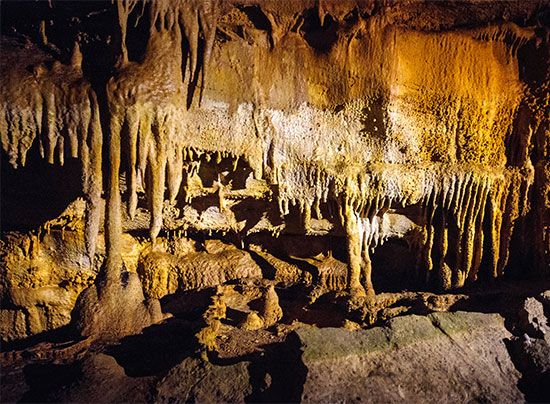
Within these caverns, various speleothems—secondary mineral deposits—create diverse formations. Key types found in the system include:
- Stalactites and Stalagmites: Icicle-like features that hang from the ceiling or rise from the floor, formed by the deposition of calcium carbonate from dripping water.15
- Sulfate Mineral Formations: The system is noted for its extensive sulfate mineral deposits, which thrive in the drier sections of the cave.15
- Other Features: While not explicitly detailed for every section, the broader environment of such solution caves often includes flowstone and other crystalline structures resulting from the precipitation of minerals.156
These formations are the result of a “calcite pump” process, where water infiltrating through soil absorbs carbon dioxide to form carbonic acid, which then dissolves the limestone and redeposits it as decorative mineral structures within the cave atmosphere.56
Sources
- Flint Ridge Cave System — Encyclopædia Britannica
- Mammoth Cave National Park — Encyclopædia Britannica
- cave — Encyclopædia Britannica
- cave - Initiation phase — Encyclopædia Britannica
- cave - Depositional materials and features — Encyclopædia Britannica
- cave deposit — Encyclopædia Britannica
Published on · 3 min read