Lewis and Clark Caverns
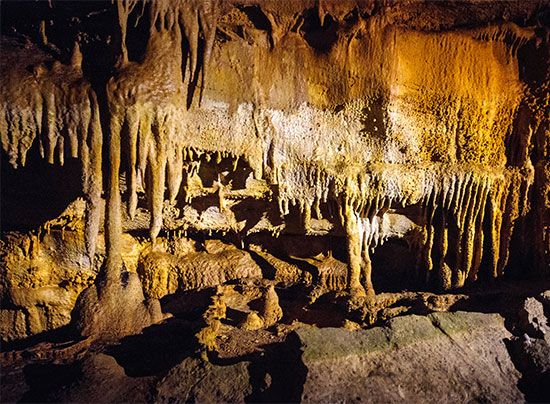
Lewis and Clark Caverns are located in Jefferson County in southwestern Montana, approximately 47 miles east of Butte.
Where are the Lewis and Clark Caverns located in Montana, and how did they get their name?
Lewis and Clark Caverns are located in Jefferson County in southwestern Montana, approximately 47 miles east of Butte.1
Although the site is named after the famous explorers Meriwether Lewis and William Clark, they were actually unaware of the cave’s existence despite passing through the area twice during their expedition. The name was applied later, likely to honor the explorers, even though the cave was discovered by hunters at the turn of the 20th century. Initially, the site was developed and promoted by prospector Dan Morrison as “Limespur Cave,” and it was also known as “Morrison Cave” before eventually being designated as the centerpiece of Montana’s first state park in 1937.12
How were the Lewis and Clark Caverns discovered, and when did they become a state park?
The Lewis and Clark Caverns were discovered at the turn of the 20th century by local hunters. Following its discovery, a prospector named Dan Morrison began developing the site, promoting it as “Limespur Cave” to compete with Mammoth Cave in Kentucky. Ownership of the land was later contested in a legal battle between Morrison and the Northern Pacific Railway, which resulted in the federal government taking control of the property. After years of development and legal disputes, the land was transferred to the state, and in 1937, the site became the centerpiece of Montana’s first state park.1
What is the significance of the Lewis and Clark Caverns in Native American history?
The provided search results do not contain information regarding the significance of the Lewis and Clark Caverns in Native American history. The available documentation focuses on the site’s discovery by hunters at the turn of the 20th century, its development by Dan Morrison, and its subsequent establishment as a state park in 1937.1
How are limestone caves formed?
Limestone caves are primarily formed through the chemical dissolution of limestone or dolomite bedrock by water rich in carbonic acid.3
The Formation Process
The process begins when rainwater infiltrates the soil and absorbs carbon dioxide, creating a dilute solution of carbonic acid. As this acidic water reaches the underlying limestone bedrock, it reacts with the calcium carbonate and dissolves it.43
- Initiation Phase: Because limestone is largely impermeable, water initially moves through small mechanical fractures, such as joints and bedding-plane partings. Over thousands of years, this slow seepage gradually enlarges these fractures into small, pencil-sized conduits.5
- Conduit Development: Once these openings reach a threshold size (about 5 to 10 millimetres), water flow transitions from slow percolation to turbulent pipe-like flow. This increased velocity allows the water to transport sediment and dissolve the rock more rapidly, eventually carving out larger cave systems.56
- Surface Features: This underground dissolution often leads to the formation of sinkholes, which are depressions on the Earth’s surface caused by the collapse of a cavern roof or the gradual subsidence of soil into widening bedrock cracks.7
Sources
- Lewis and Clark Caverns — Encyclopædia Britannica
- Lewis and Clark Caverns — Merriam-Webster
- stalactite and stalagmite — Encyclopædia Britannica
- cave - Depositional materials and features — Encyclopædia Britannica
- carbonic acid — Encyclopædia Britannica
- cave - Fluviokarst — Encyclopædia Britannica
- sinkhole — Encyclopædia Britannica
- cave - Initiation phase — Encyclopædia Britannica
Published on · 2 min read