Silk Floss Tree
The silk floss tree (Ceiba speciosa), formerly known as Chorisia speciosa, is a thorny, semi-deciduous flowering tree belonging to the mallow family…
What is silk floss tree?
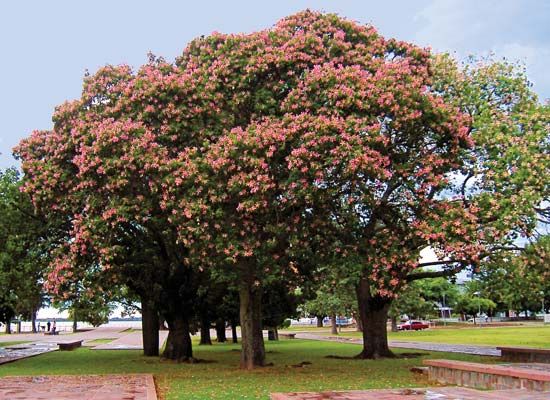
The silk floss tree (Ceiba speciosa), formerly known as Chorisia speciosa, is a thorny, semi-deciduous flowering tree belonging to the mallow family (Malvaceae). Native to South America, it is widely cultivated as an ornamental plant.1
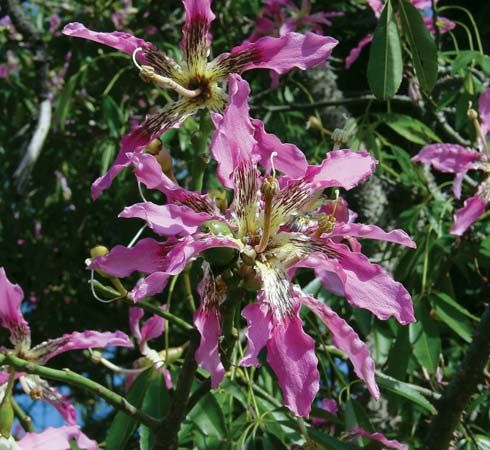
The tree typically reaches heights of about 15 meters (50 feet). Its trunk, which transitions from green in youth to gray at maturity, is often swollen and covered in large, conical thorns. The plant features palmately compound leaves and produces large, showy flowers with pink to purple petals. Its fruit is a capsule containing black seeds surrounded by white, cottonlike fibres. These fibers are a form of vegetable silk often used in upholstery.1
Why does the silk floss tree have thorns on its trunk?
While the silk floss tree is well-known for the large, conical thorns that stud its trunk, the provided scientific literature does not explicitly state the evolutionary or biological purpose for these specific structures. In many plant species, such thorns serve as a defense mechanism against herbivores, but this specific detail is not documented in the available records for Ceiba speciosa.1
How is the vegetable silk from the seeds harvested and used?
The vegetable silk produced by the silk floss tree (Ceiba speciosa) is a cottony, fibrous material found within the tree’s fruit capsules, where it surrounds the seeds. While specific harvesting methods for Ceiba speciosa are not detailed in the provided records, the process for similar trees in the same family—such as the kapok—typically involves gathering the pods, breaking them open with mallets, and manually separating the seeds from the fibers by stirring them in a basket, which allows the heavier seeds to fall to the bottom.231
Because these fibers are brittle and inelastic, they are generally unsuitable for spinning into textiles. Instead, the vegetable silk is primarily utilized as a stuffing or padding material for upholstery, cushions, and mattresses. Similar seed flosses are also valued for their buoyancy and moisture resistance, having historically been used in water-safety equipment like life preservers.14523
What other plants belong to the mallow family?
The mallow family (Malvaceae) is a diverse group of flowering plants that includes many economically significant species used for fibers, food, and ornamentation.6
Economically Important Members
The family is widely recognized for its utility in various industries:
- Fiber and Wood Products: This category includes cotton, balsa, kapok, white jute, and kenaf.6
- Food Crops: Notable members include cacao, okra, durian, and kola nut.6
- Ornamentals: Many species are grown for their attractive flowers, such as hibiscus, hollyhock, linden, and the silk-floss tree.6
Diverse Mallow Varieties
Beyond these major crops, the family encompasses a wide range of plants often referred to as “mallows,” including:
- Marsh mallow (Althea officinalis), historically used for confections.7
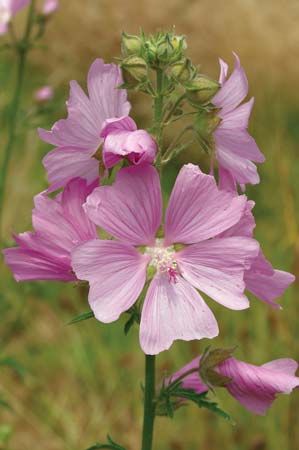
- Musk mallow (Abelmoschus moschatus and Malva moschata), valued for fragrance and ornamental use.67
- Globe mallows (Sphaeralcea species) and poppy mallow (Callirhoe involucrata).7
- Tree mallow (Lavatera arborea) and wax mallow (Malvaviscus arboreus).7
Sources
- silk floss tree — Encyclopædia Britannica
- vegetable silk — Merriam-Webster
- kapok — Encyclopædia Britannica
- milkweed floss — Encyclopædia Britannica
- bombax cotton — Encyclopædia Britannica
- list of economically important members of the family Malvaceae — Encyclopædia Britannica
- Malvales — Encyclopædia Britannica
- mallow — Encyclopædia Britannica
Published on · 2 min read