Flounder
Flounder are not a single species but a diverse group of flatfishes belonging to the families Achiropsettidae, Pleuronectidae, Paralichthyidae, and Bothidae.…
What are the different species of flounder and where are they commonly found?
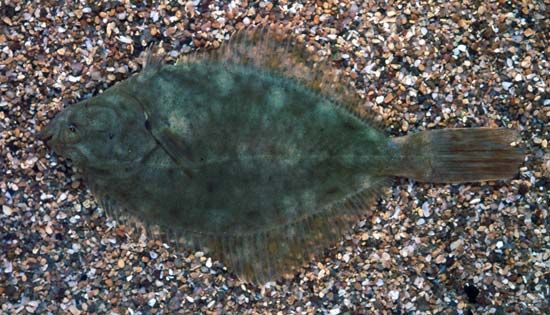
Flounder are not a single species but a diverse group of flatfishes belonging to the families Achiropsettidae, Pleuronectidae, Paralichthyidae, and Bothidae. These fish are morphogenetically unique, as they begin life bilaterally symmetrical before one eye migrates to the top side as they mature into bottom-dwelling adults.1
Common Species and Distribution
Flounder species are categorized by which side of their body features their eyes and coloration.1
- Right-sided Flounders (Family Pleuronectidae):
- Left-sided Flounders (Families Bothidae and Paralichthyidae):
- Summer flounder (Paralichthys dentatus): Inhabits the American Atlantic coast from Maine to Florida.12
- Southern flounder (Paralichthys lethostigmus): Found along the south Atlantic and Gulf coasts of the U.S..3
- Peacock flounder (Bothus lunatus): A tropical American Atlantic species.1
- Brill (Scophthalmus rhombus): A commercial species in Europe.1
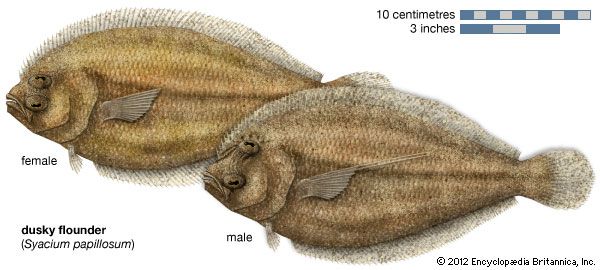
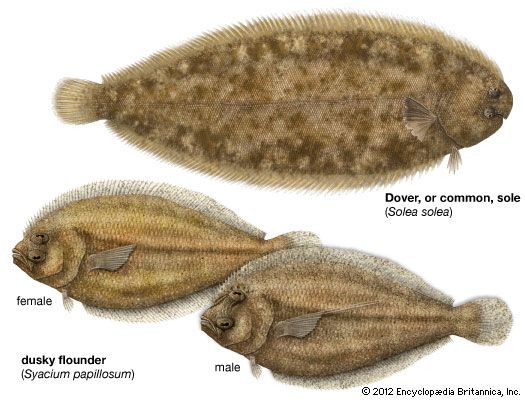
- Dusky flounder (Syacium papillosum): Found in the tropical western Atlantic.1
- California halibut (Paralichthys californicus): Found along the western coast of North America from Washington to Baja California.4
What do flounder typically eat and how do they hunt their prey?
Flounder are carnivorous bottom-dwellers that primarily feed on crustaceans, small fish, and other bottom-dwelling invertebrates.56
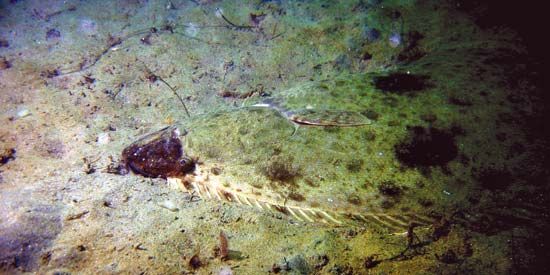
To hunt their prey, flounder utilize a “sit-and-wait” strategy. They typically lie on the ocean floor, often burying themselves in sand or mud so that only their eyes are visible. These eyes can be moved independently and raised or lowered to scan their surroundings. While waiting, they rely on their remarkable ability to change color and pattern to match the surface beneath them, providing effective camouflage that conceals them from both potential prey and predators.651
Once a target ventures too close, the flounder remains motionless until the opportune moment, at which point it literally leaps off the bottom to pursue and capture its prey.6
How important are flounder in commercial fishing and cuisine?
Flounder are highly significant in both commercial fishing and global cuisine. As a member of the flatfish group, they are recognized as one of the most commercially important ocean fish, alongside species like salmon, cod, and tuna.1
Commercial Importance
Various species of flounder are harvested globally to meet the high demand for seafood, which serves as a vital source of protein for the world’s population. Key commercial species include:1
- European flounder (Platichthys flesus): A significant food and sport fish in Europe.3
- Winter flounder (Pseudopleuronectes americanus): A prominent American Atlantic food fish.3
- Summer flounder (Paralichthys dentatus): Widely utilized as a food source along the U.S. Atlantic coast.310
- Brill (Scophthalmus rhombus): A relatively large species that supports commercial fisheries in Europe.3
Culinary Use
Flounder is valued for its lean, versatile flesh. In culinary traditions worldwide, these fish are prepared in numerous ways, including poaching, sautéing, broiling, baking, and deep-frying. Because they are lean, they are often paired with milder seasonings and sauces to complement their delicate flavor.1
How do flounder’s eyes migrate during their development?
The development of a flounder is a remarkable biological process. When first hatched, the larvae are bilaterally symmetrical, possessing an eye on each side of the head, and they swim near the sea surface.111
After a few days, the fish begins to lean to one side, triggering a period of rapid metamorphosis. During this phase, the eye on the downward-facing side migrates across the head to join the other eye on what eventually becomes the top side of the fish.111
This migration is accompanied by significant structural changes, including complex adjustments to the bones, nerves, and muscles of the skull. As the fish matures, the underside loses its pigmentation, and the adult settles onto the ocean floor to live a benthic existence with its eyed side facing upward. Depending on the family, this final orientation results in the eyes and coloring being located on either the right or left side of the body.11112
Sources
- flounder — Encyclopædia Britannica
- southern flounder — Merriam-Webster
- summer flounder — Merriam-Webster
- halibut — Encyclopædia Britannica
- Did you know? — Merriam-Webster
- pleuronectiform - Feeding behaviour — Encyclopædia Britannica
- coloration - Background matching — Encyclopædia Britannica
- coloration - Disruptive coloration — Encyclopædia Britannica
- perciform - Feeding behaviour — Encyclopædia Britannica
- seafood — Encyclopædia Britannica
- pleuronectiform — Encyclopædia Britannica
- pleuronectiform - Reproduction — Encyclopædia Britannica
Published on · 3 min read