Fruitworm Beetle
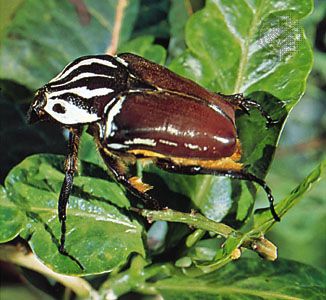
A fruitworm beetle refers to any of several insect genera within the family Byfuridae (order Coleoptera) characterized by larvae that feed on fruit.
What is fruitworm beetle?
A fruitworm beetle refers to any of several insect genera within the family Byfuridae (order Coleoptera) characterized by larvae that feed on fruit.1
These insects are typically small, hairy, and oval-shaped. A well-known example is the raspberry fruitworm (Byturus rubi), which features a small, pale larva covered in fine hairs that attacks raspberry fruit. The adult beetle, which measures approximately 4 mm (0.16 inch) in length and ranges in color from reddish yellow to black, feeds on the leaves and flowers of blackberry and raspberry plants.1
What are the different stages in the life cycle of a beetle?
Beetles undergo a process known as complete metamorphosis, which consists of four distinct developmental stages: egg, larva, pupa, and adult.5
- Egg: Most female beetles lay eggs, which serve as the starting point of the life cycle.5
- Larva: After hatching, the larva feeds and grows. Because its skin (cuticle) does not stretch, the larva must undergo molting—shedding its old skin and forming a new, larger one—typically three to five times until it reaches maturity. Larval forms vary significantly depending on the species and their environment, ranging from slender, predatory types to soft-bodied wood borers or C-shaped root feeders. Some species exhibit hypermetamorphosis, where the larva takes on different forms during its various instars.567
- Pupa: Following a nonfeeding prepupal stage, the insect enters the pupal stage. The pupa forms beneath the final larval skin and resembles the adult, though it is soft, pale, and has folded wings.5
- Adult: The adult emerges when the pupal skin is shed. Its wings stretch to full size, and its outer skeleton hardens and gains color.5
How do farmers use biological controls to manage insect pests?
Farmers use biological control as an environmentally sound strategy to manage insect pests by utilizing their natural enemies, such as predators, parasites, and disease-causing organisms. This approach is a cornerstone of integrated pest management, which seeks to minimize the use of chemical pesticides by combining various ecologically harmonious methods.89103
Common biological control techniques include:
- Introduction of Natural Enemies: Farmers may import and release predators or parasites that target specific pests. A classic success story is the use of the vedalia beetle to control the cottony cushion scale in citrus orchards.811
- Microbial Agents: Pathogens like the soil-dwelling bacterium Bacillus thuringiensis (Bt) are used to infect and kill specific insect larvae. Bt can be applied as a spray or integrated into crops through genetic engineering.812
- Cultural and Mechanical Methods: This includes breeding pest-resistant crop varieties, using pheromone-baited traps to disrupt mating, and managing postharvest residues to inhibit pest proliferation.1039
- Sterile-Insect Technique: Releasing sterilized male insects into the wild population can effectively reduce future generations of pests like fruit flies.9
While highly effective, these methods require careful consideration to avoid introducing invasive species that could disrupt local ecosystems.8
What are some other common insects that damage fruit crops?
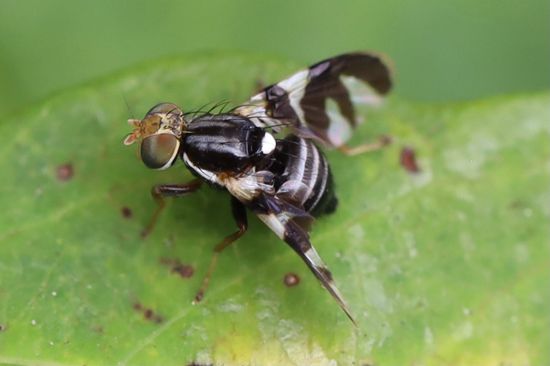
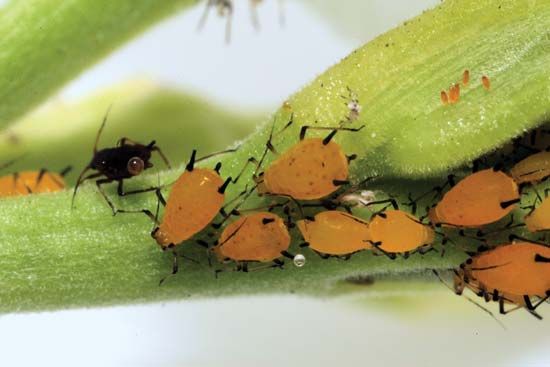
Beyond the fruit fly, several other insects are significant pests that damage fruit crops. These include various species of aphids, which are sap-sucking insects that can stunt growth, deform leaves and buds, and transmit viral diseases to fruit-bearing plants.14
Notable examples of aphids that impact fruit production include:
- Apple Aphid (Aphis pomi): Feeds on apple trees and produces honeydew that encourages the growth of sooty mold.14
- Rosy Apple Aphid (Dysaphis plantaginea): Known for deforming fruit, often resulting in small, misshapen specimens referred to as “aphis apples.”14
- Woolly Apple Aphid (Eriosoma lanigerum): Infests the roots of apple trees, which can lead to stunted growth or the death of the tree.14
- Green Peach Aphid (Myzus persicae): A serious pest that transmits numerous plant mosaic diseases.14
Additionally, the grape phylloxera is a well-known pest that specifically targets grapevines. Because these pests can cause extensive economic losses, farmers often employ a combination of insecticides, biological controls, and the selection of resistant plant varieties to manage their populations.141516
Sources
- fruitworm beetle — Encyclopædia Britannica
- Coleoptera - Pupae — Encyclopædia Britannica
- Agricultural technology - Biological controls — Encyclopædia Britannica
- list of beetles — Encyclopædia Britannica
- Coleoptera - General features — Encyclopædia Britannica
- Coleoptera - Larval features — Encyclopædia Britannica
- Coleoptera - Larvae — Encyclopædia Britannica
- Biological control — Encyclopædia Britannica
- Integrated pest management — Encyclopædia Britannica
- Pest — Encyclopædia Britannica
- Bacillus thuringiensis — Encyclopædia Britannica
- insect - Ecological factors — Encyclopædia Britannica
- insect - Commercial significance — Encyclopædia Britannica
- Fruit fly — Encyclopædia Britannica
- aphid — Encyclopædia Britannica
- Fruit farming - Pest control and preservation — Encyclopædia Britannica
Published on · 3 min read