Fruit Fly
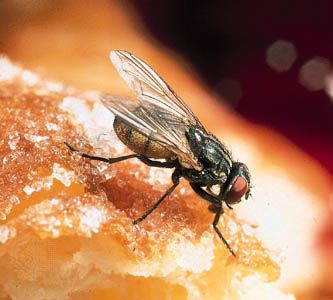
Fruit flies are classified as insects because they possess the fundamental anatomical features shared by all members of the class Insecta. These defining…
What are the key characteristics that define fruit flies as insects?
Fruit flies are classified as insects because they possess the fundamental anatomical features shared by all members of the class Insecta. These defining characteristics include:1
- Segmented Body: Their bodies are organized into three distinct regions: the head (bearing mouthparts, eyes, and antennae), the three-segmented thorax, and the many-segmented abdomen.12
- Exoskeleton: They are supported and protected by an external skeleton.1
- Jointed Legs: Like other insects, adult fruit flies have three pairs of jointed legs attached to the thorax.1
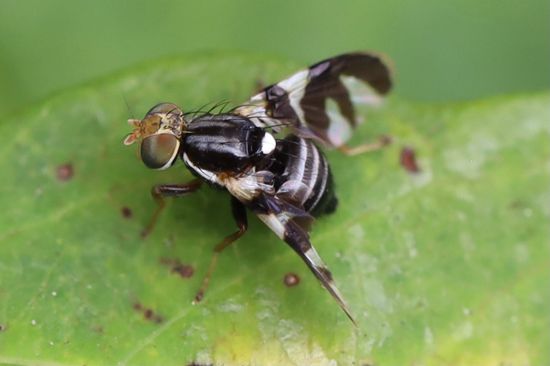
As members of the order Diptera, fruit flies are further distinguished from other insects by their unique wing structure. They possess a single pair of functional forewings, while their hind wings are modified into small, knoblike balancing organs called halteres. Their thorax is primarily composed of the mesothorax, which houses the powerful muscles required to operate these wings.34
How do fruit flies reproduce and what is their life cycle like?
Fruit flies reproduce through complex reproductive behaviour that relies on species-specific courtship rituals. These rituals involve chemical, visual, auditory, or tactile stimuli, including the use of pheromones and physical contact to ensure species recognition and successful mating.6
The life cycle begins when a female lays eggs in suitable habitats, such as rotting fruit, fermenting materials, or the rind of growing fruits. Females utilize specialized structures called ovipositors to deposit their eggs; small fruit flies (Drosophilidae) typically use these to press eggs into decaying matter, while larger fruit flies (Trypetidae) may use stiffer ovipositors to pierce the skin of growing fruits.78
A single female can lay hundreds of eggs, often in successive batches. Once the eggs hatch, the larvae emerge and feed on the surrounding vegetative matter, which is a defining behavior for the family. While the provided information details the egg-laying and larval feeding stages, the subsequent developmental phases involve further maturation into adulthood.78
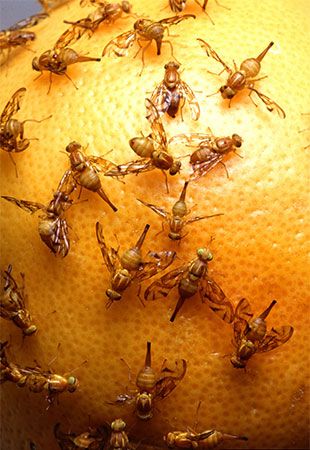
How do fruit flies impact agriculture and what methods are used to control them?
Fruit flies are significant agricultural pests because their larvae feed on cultivated crops, often rendering produce unfit for human consumption or sale. By tunneling into fruits, stems, or leaves, they cause physical damage, discoloration, and decay, leading to substantial economic losses for farmers. Because of the destructive potential of species like the Mediterranean fruit fly, many countries enforce strict worldwide quarantine laws to regulate the movement of produce.391011
To manage these populations, growers employ various control methods:
- Chemical Control: The application of insecticides during the egg-laying season is a common strategy, often guided by predictive models of fly emergence to maximize efficiency.311
- Physical and Mechanical Control: Orchard sanitation—collecting and destroying infested or fallen fruit—interrupts the life cycle by preventing larvae from pupating in the soil. Sticky traps and lures are used to monitor populations and reduce adult numbers. In smaller operations, protective bags can be placed over individual fruits to prevent egg-laying.311
- Biological and Integrated Control: Biological controls, such as the use of parasites or predators, are increasingly utilized. The sterile-insect technique, which involves releasing sterilized males into the wild, has proven successful in controlling certain fruit fly populations. Often, an “integrated control” approach is used, combining multiple methods to minimize environmental impact and reduce reliance on chemicals.31213
What are some common species of fruit flies and how do they differ?
Fruit flies are generally categorized into two main families: Trypetidae (also known as Tephritidae or large fruit flies) and Drosophilidae (small fruit flies or vinegar flies).314
Key Differences and Common Species
The primary distinction between these groups lies in their size and feeding habits. Trypetidae species are typically larger and often attack cultivated fruits, while Drosophilidae are smaller and associated with fermenting vegetative matter.3
Notable Trypetidae (Large Fruit Flies):
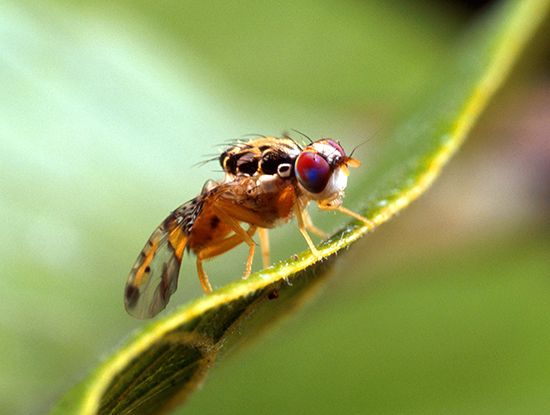
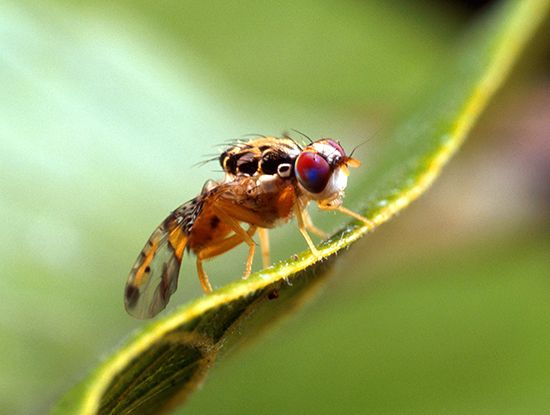
- Mediterranean Fruit Fly (Ceratitis capitata): A highly destructive pest that lays eggs in various citrus fruits, leading to strict international quarantine regulations.3
- Apple Maggot (Rhagoletis pomonella): A North American pest that tunnels into apples, causing them to become spongy and decayed. It is a key model for studying host-specific speciation.315
- Other Pests: The Mexican fruit fly (Anastrepha ludens) targets citrus, the Oriental fruit fly (Dacus dorsalis) infests subtropical fruits, and the olive fruit fly (Dacus oleae) destroys olives.3
Notable Drosophilidae (Small Fruit Flies):
- Genus Drosophila: These are extensively studied in evolutionary biology. For example, the Drosophila willistoni group includes sibling species that are morphologically nearly identical but exhibit distinct reproductive isolation, making them vital for studying the origin of species.9
Sources
- Diptera - Distinguishing taxonomic features — Encyclopædia Britannica
- List of insects — Encyclopædia Britannica
- Fruit fly — Encyclopædia Britannica
- insect - Head — Encyclopædia Britannica
- vinegar fly — Encyclopædia Britannica
- Diptera - Eggs — Encyclopædia Britannica
- evolution - Ethological (behavioral) isolation — Encyclopædia Britannica
- fly agaric: Top Questions — Encyclopædia Britannica
- Apple maggot — Encyclopædia Britannica
- Agricultural technology - Biological controls — Encyclopædia Britannica
- insect - Control of insect damage — Encyclopædia Britannica
- Mediterranean fruit fly — Encyclopædia Britannica
- Diptera - Importance — Encyclopædia Britannica
- Tephritidae — Merriam-Webster
- evolution - Geographic speciation — Encyclopædia Britannica
Published on · 4 min read