Siberian Tiger
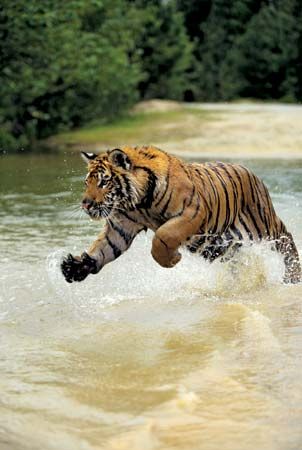
The Siberian tiger (Panthera tigris altaica), also known as the Amur tiger, is a subspecies of tiger primarily inhabiting the Primorye and Khabarovsk…
What is Siberian tiger?
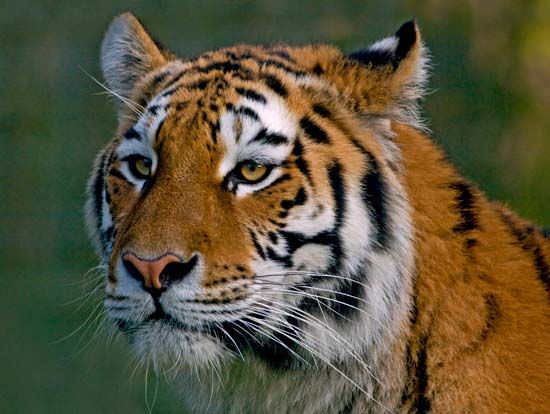
The Siberian tiger (Panthera tigris altaica), also known as the Amur tiger, is a subspecies of tiger primarily inhabiting the Primorye and Khabarovsk territories of far-eastern Russia and northeastern China.1
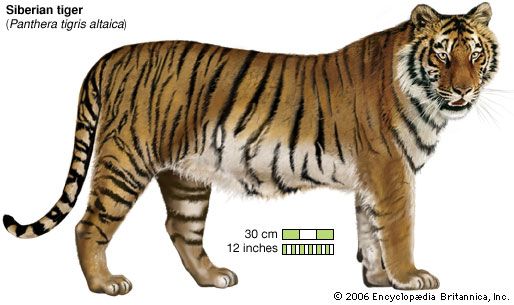
Widely considered the world’s largest tiger, the Siberian tiger is uniquely adapted to the cold taiga and boreal forests of its range. It features a thick coat for insulation and can grow up to 3.7 meters (12.1 feet) in length, weighing as much as 423 kg (933 pounds). As an apex predator, it is a solitary hunter that preys on animals such as wild boars and various deer.12
Currently classified as endangered, the population is estimated at approximately 500 individuals in the wild. Their survival remains threatened by poaching, habitat loss, and limited genetic diversitylaw), habitat loss, and limited genetic diversity.21
How does the taiga biome influence the Siberian tiger’s survival?
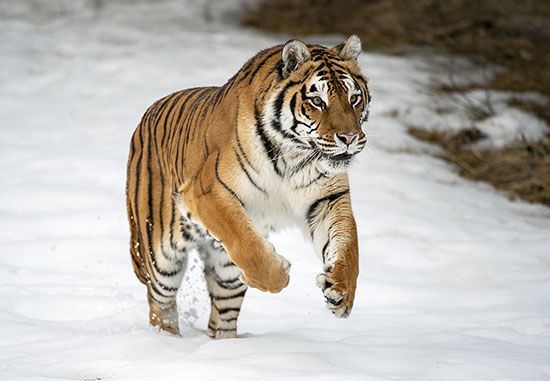
The taiga biome, characterized by long, harsh winters and cold temperatures, has driven significant evolutionary adaptations essential for the Siberian tiger’s survival. To thrive in this environment, the tiger has developed a dense, coarse coat and a layer of body fat up to 4 cm (1.5 inches) thick, which provide critical insulation against the snow and help conserve body heat.31
Furthermore, the tiger’s massive size—making it the world’s largest tiger—is an adaptation to its cold-climate habitat, as larger body mass helps minimize heat loss. The taiga also dictates the tiger’s ecological role as an apex predator, where it must navigate and hunt within these boreal and mixed forests to secure prey such as wild boars and deer. While these physical traits are well-suited for the biome, the species remains endangered due to habitat loss from logging and forest fires, which threaten the integrity of their environment.31
What are the main reasons why Siberian tigers are endangered?
The Siberian tiger is currently classified as an endangered subspecies, with its recovery hindered by several persistent pressures:
- Poaching: Despite legal protections and the banning of the trade in tiger parts, illegal hunting remains a significant threat. Tiger parts, including bones, teeth, and skins, are still highly valued for use in traditional medicine, as talismans, and for display.35
- Habitat Loss and Degradation: The size and quality of the tiger’s habitat have declined due to logging and forest fires. As forests are cleared for human use, the tigers lose the space necessary to thrive.31
- Prey Depletion: A reduction in the populations of the tiger’s natural prey species limits the food supply, which can force tigers to rely on livestock, leading to conflict with humans.35
- Genetic Vulnerability: The population is largely fragmented, preventing individuals from different groups from meeting to reproduce. This isolation, combined with a historical population crash in the 1930s that left only 20–30 individuals, has resulted in a lack of genetic diversity and increased risks from inbreeding.3
How do Siberian tigers differ from other tiger subspecies?
The Siberian tiger (Panthera tigris altaica), also known as the Amur tiger, is distinguished from other tiger subspecies primarily by its size, coat, and physical adaptations to its cold-climate habitat.136
Key Differences
- Size: The Siberian tiger is widely considered the world’s largest tiger. While a Bengal tiger typically reaches lengths of about 3.2 meters (10.5 feet) and weighs around 295 kg (650 pounds), the Siberian tiger can grow up to 3.7 meters (12.1 feet) and weigh as much as 423 kg (933 pounds).31
- Coat and Insulation: To survive in the taiga and boreal forests of Russia and China, the Siberian tiger has evolved a thicker, softer, and paler coat compared to the bright reddish-tan fur of southern subspecies like the Sumatran or Indo-Chinese tigers. Additionally, they possess a layer of body fat up to 4 cm (1.5 inches) thick to help conserve heat in freezing temperatures.36
- Adaptations: Their larger body mass is a direct adaptation to minimize heat loss in their northern environment, whereas smaller subspecies are better suited for navigating the dense, humid vegetation and swamps of southern regions.13
While some classifications treat the Siberian tiger as a distinct subspecies, others suggest it may be a subpopulation of the Bengal tiger. Regardless of classification, all tiger subspecies are currently endangered and face similar threats, including poaching and habitat loss.361
Sources
- Which is bigger: A Siberian tiger or a Bengal tiger? — Encyclopædia Britannica
- Siberian tiger — Merriam-Webster
- Siberian tiger — Encyclopædia Britannica
- tiger - Natural history — Encyclopædia Britannica
- tiger - Tigers and humans — Encyclopædia Britannica
- tiger — Encyclopædia Britannica
- white tiger — Encyclopædia Britannica
Published on · 4 min read