Forester Moth
The term "forester moth" typically refers to members of the genus Procris or Ino within the family Zygaenidae, rather than the unrelated eight-spotted…
What is forester moth?
The term “forester moth” typically refers to members of the genus Procris or Ino within the family Zygaenidae, rather than the unrelated eight-spotted forester (Alypia octomaculata), which belongs to a different family.12
The forester moth is characterized by its shining green forewings, which span approximately 3 cm (1.2 inches), translucent dark hind wings, and an iridescent body. Their green coloration when at rest is believed to be the origin of their common name. These moths are weak fliers that are active only during sunny conditions.1
Their life cycle involves larvae that initially mine within the leaves of herbaceous plants before moving to the undersides of leaves as they grow. When ready to pupate, the larvae spin a durable, white, silken cocoon, often attached to a grass stem. In contrast, the eight-spotted forester is a distinct North American species known for its black wings marked with eight pale spots and its tendency to feed on grapevines.12
What are burnet moths?
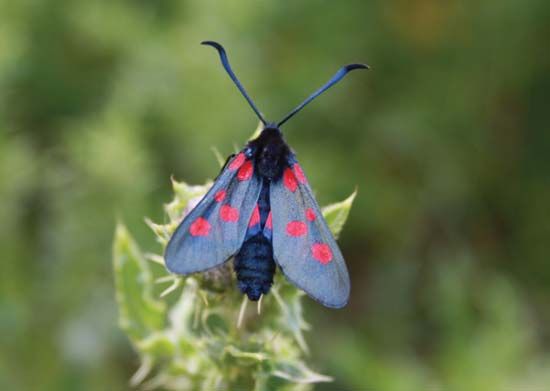
Burnet moths are members of the family Zygaenidae, a group of moths that are typically bright-colored and active during the day. They are closely related to forester moths, which share the same family classification.341
A well-known example is the European burnet moth (Zygaena filipendulae), which is easily recognized by the distinct crimson spots on its wings.3
These moths possess a unique defense mechanism against predators: they are capable of producing and storing toxic substances within their bodies. Specifically, they utilize hydrogen cyanide as a chemical defense, which makes them distasteful to potential predators. This toxicity is often advertised through aposematism—the use of warning colors or patterns that signal to predators that the insect is inedible or dangerous.5
How do leaf-mining insects affect plants?
Leaf-mining insects are larvae from various orders, including Lepidoptera, Hymenoptera, Coleoptera, and Diptera, that live and feed within the tissues of a leaf.78
Their impact on plants is primarily characterized by the following:
- Physical Damage: As they feed on the leaf parenchyma, they create distinct tunnels known as serpentine mines (thin, winding trails) or blotch mines (broad, whitish or brownish patches).78
- Aesthetic Impact: While they generally do not cause significant injury to the overall health of a plant, they often mar the appearance of ornamental trees and shrubs.7
- Management Challenges: Because these larvae reside in a protected habitat within the leaf tissue, they are often difficult to control using standard insecticides. A common manual control method for garden plants is the removal and destruction of infested leaves.7
In the broader context of herbivory, leaf miners are among the many types of insects that influence plant communities, though they are typically less destructive than sap-sucking insects like leafhoppers, which can transmit plant diseases and cause severe physiological damage.7910
What is the difference between moths and butterflies?
Moths and butterflies are both members of the order Lepidoptera, but they exhibit several key differences in their physical characteristics and behaviors.12
Physical Differences
- Antennae: Most moths have thick or feathery antennae, whereas butterflies possess simple, club-tipped antennae.12
- Body Shape: Butterflies typically have slim, dainty bodies, while moths are generally stout and often fuzzy.12
- Coloration: Butterflies are often brightly colored with dramatic patterns, while moths are frequently more drab, though notable exceptions exist in both groups.12
Behavioral and Developmental Differences
- Activity: Butterflies are typically diurnal (active during the day), while most moths are nocturnal.12
- Resting Position: When at rest, butterflies usually hold their wings vertically over their backs; moths often fold their wings tentlike over the body, wrap them around the body, or hold them extended at the sides.12
- Metamorphosis: During the pupal stage, butterflies form a naked chrysalis, whereas most moths construct a fibrous cocoon around themselves.1213
Sources
- forester moth — Encyclopædia Britannica
- eight-spotted forester — Merriam-Webster
- burnet moth — Merriam-Webster
- Zygaenidae — Merriam-Webster
- leopard moth — Encyclopædia Britannica
- Lepidoptera - Protection against danger — Encyclopædia Britannica
- leaf miner — Encyclopædia Britannica
- Eating the rainforest — Encyclopædia Britannica
- Lepidoptera - Feeding habits — Encyclopædia Britannica
- leafhopper — Encyclopædia Britannica
- leaf miner — Merriam-Webster
- What’s the difference between moths and butterflies? — Encyclopædia Britannica
- Lepidoptera - Pupa , or chrysalis — Encyclopædia Britannica
Published on · 3 min read