Front Range
The Front Range and the San Juan Mountains are both prominent segments of the Southern Rocky Mountains, yet they differ significantly in their geological…
How do the Front Range mountains compare to other mountain ranges in Colorado, such as the San Juan Mountains?
The Front Range and the San Juan Mountains are both prominent segments of the Southern Rocky Mountains, yet they differ significantly in their geological composition and physical structure.
- Geology: The Front Range is composed primarily of gneiss, schist, and granite, formed through compressional folding and high-angle faulting during the Laramide Orogeny. In contrast, the San Juan Mountains are a large, heavily ice-dissected volcanic plateau composed mainly of volcanic rocks.1234
- Topography: The Front Range is a 40- to 50-mile-wide uplift that serves as the easternmost section of the Southern Rockies. The San Juan Mountains, located in southwestern Colorado, are characterized by their volcanic origins and extensive glacial dissection.134
- Elevation: Both ranges feature numerous peaks exceeding 14,000 feet. The highest point in the Front Range is Grays Peak (14,278 feet), while the San Juan Mountains contain Uncompahgre Peak, which reaches 14,309 feet.13
What is the Front Range and where is it located within Colorado?
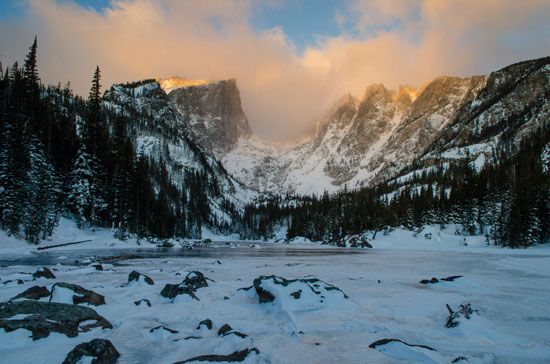
The Front Range is the easternmost section of the Southern Rocky Mountains in the west-central United States. It spans approximately 300 miles, extending south-southeast from near Casper, Wyoming, into south-central Colorado.1
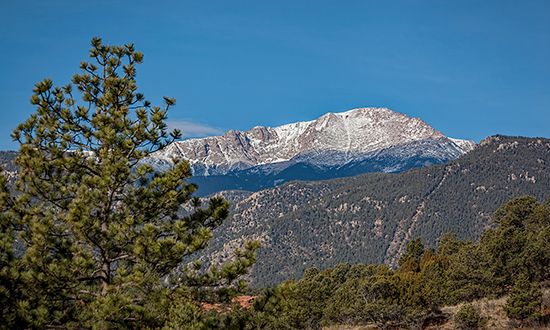
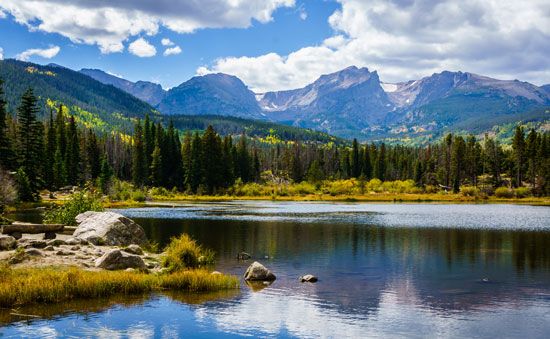
The range is typically 40 to 50 miles wide and is composed primarily of gneiss, schist, and granite. It includes several prominent peaks exceeding 13,000 feet, such as Grays Peak, Mount Evans, and Pikes Peak. The Front Range encompasses the entirety of Rocky Mountain National Park and occupies portions of several national forests. It serves as a vital source region for the headstreams of the Cache la Poudre and Colorado rivers and is widely recognized for its diverse mineral deposits and recreational appeal.1
What is the highest peak in the Front Range, and how tall is it?
The highest peak in the Front Range is Grays Peak, which reaches an elevation of 14,278 feet (4,352 meters).8
While some sources may cite slightly varying elevations due to measurement methods, Grays Peak is recognized as the highest point within this section of the Rocky Mountains. It is situated in central Colorado, near other notable peaks such as Mount Evans and Pikes Peak.98
How does the elevation of the Front Range vary from north to south?
The Front Range maintains a consistently high elevation throughout its extent, characterized by numerous summits that exceed 13,000 feet (4,000 meters). While the range stretches approximately 300 miles from southeastern Wyoming into south-central Colorado, it does not follow a simple linear gradient of increasing or decreasing elevation from north to south.1
Instead, the range features a series of prominent high peaks distributed along its length. Notable examples include:
- Grays Peak: Located in central Colorado, reaching 14,278 feet (4,352 meters).1
- Mount Evans: Situated about 35 miles west-southwest of Denver, with an elevation of 14,265 feet (4,348 meters).1
- Pikes Peak: Located just west of Colorado Springs, reaching 14,115 feet (4,302 meters).1
The terrain is defined by its rugged, high-altitude nature, with significant passes such as Trail Ridge Road in Rocky Mountain National Park reaching 12,183 feet (3,713 meters). The overall elevation is a result of the Laramide Orogeny, which arched crystalline rocks upward, creating the high-mountain landscape seen today.13
Sources
- Front Range — Encyclopædia Britannica
- San Juan Mountains — Encyclopædia Britannica
- Rocky Mountains - Physiography — Encyclopædia Britannica
- Colorado - Climate of Colorado — Encyclopædia Britannica
- Rocky Mountains - Climate — Encyclopædia Britannica
- Colorado - Relief and drainage — Encyclopædia Britannica
- list of cities and towns in the United States - Colorado — Encyclopædia Britannica
- Grays Peak — Merriam-Webster
- Longs Peak — Encyclopædia Britannica
- Elk Mountains — Encyclopædia Britannica
Published on · 3 min read