Elk Mountains
The Elk Mountains are a segment of the southern Rocky Mountains located in west-central Colorado, U.S. Stretching 50 miles (80 km) through Pitkin and…
What is Elk Mountains?
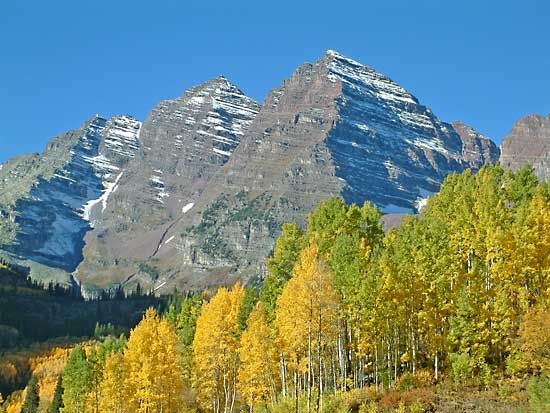
The Elk Mountains are a segment of the southern Rocky Mountains located in west-central Colorado, U.S. Stretching 50 miles (80 km) through Pitkin and Gunnison counties, this range is characterized by several peaks exceeding 14,000 feet (4,300 metres), such as Pyramid, Snowmass, Capitol, and Maroon peaks. The highest point in the range is Castle Peak, which reaches an elevation of 14,259 feet (4,346 metres).1
A southwesterly extension of the range is known as the West Elk Mountains, where Mount Gunnison serves as the high point at 12,714 feet (3,875 metres). Situated within the Gunnison and White River national forests, the region is well-regarded for its significant mineral deposits and its popularity for outdoor recreation.1
What are the characteristics of a ‘fourteener’ in the Rocky Mountains?
In the context of the Rocky Mountains, a “fourteener” is a mountain peak that reaches an elevation of at least 14,000 feet (approximately 4,267 metres) above sea level. These peaks are prominent features of the landscape in Colorado, drawing significant interest from hikers and mountaineers.23
Key characteristics of these mountains include:
- Elevation: They must exceed the 14,000-foot threshold, with Mount Elbert standing as the highest point in the entire American Rocky Mountain range at 14,440 feet.2
- Topography: These peaks are often located within major ranges such as the Sawatch Range or the Front Range.23
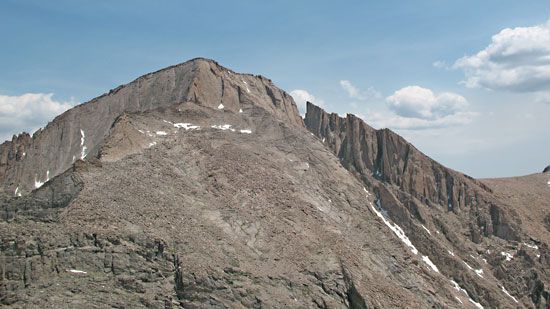
- Accessibility: Many fourteeners, such as Longs Peak, are popular destinations served by well-maintained hiking trails, though they may feature challenging terrain like false summits.23
How do national forests like Gunnison and White River protect mountain ecosystems?
National forests like the Gunnison and White River are managed by the U.S. Forest Service under a mandate of multiple-use, sustainable management. This approach balances the conservation of ecosystem services—such as clean water, timber, and wildlife habitat—with public recreation and other land uses.45
To protect mountain ecosystems, the Forest Service employs several strategies:
- Localized Stewardship: By decentralizing management, the agency allows local offices to address the unique needs of the flora, fauna, and specific ecosystems within their jurisdictions.4
- Fire Ecology: While early policies focused on total suppression, modern management incorporates prescribed burns to maintain forest health and reduce the risk of catastrophic wildfires.4
- Resource Regulation: The agency works to mitigate the impacts of human activities, such as grazing and recreation, which can be particularly damaging to sensitive alpine vegetation that struggles to recover from disturbance.6
- Legislative Protection: Significant portions of these forests may be designated as wilderness under the Wilderness Act, which provides permanent protection from development to preserve the land’s natural qualities.7
What kind of mineral deposits are found in the Elk Mountains?
The Elk Mountains, a segment of the southern Rocky Mountains in Colorado, are well-known for their significant mineral deposits. While the region is noted generally for these resources, the historical development of nearby areas—such as the city of Aspen—highlights that the local mining industry was historically driven by the extraction of silver.19
The broader region, including the adjacent Sawatch Range, also saw extensive historical mining activity focused on gold and lead with high silver content, which played a major role in attracting early settlers to the area.10
Sources
- Elk Mountains — Encyclopædia Britannica
- Mount Elbert — Encyclopædia Britannica
- Longs Peak — Encyclopædia Britannica
- U.S. Forest Service — Encyclopædia Britannica
- national forest — Encyclopædia Britannica
- Mountain ecosystem - Biological productivity — Encyclopædia Britannica
- Wilderness Act — Encyclopædia Britannica
- Rocky Mountains - Plant life — Encyclopædia Britannica
- Sawatch Range — Encyclopædia Britannica
- Aspen — Encyclopædia Britannica
Published on · 2 min read