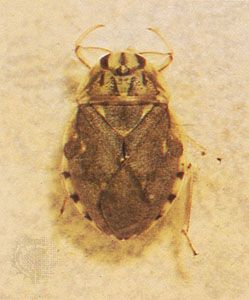
Giant Water Bug
Giant water bugs (family Belostomatidae) possess several specialized adaptations that allow them to thrive in aquatic environments:
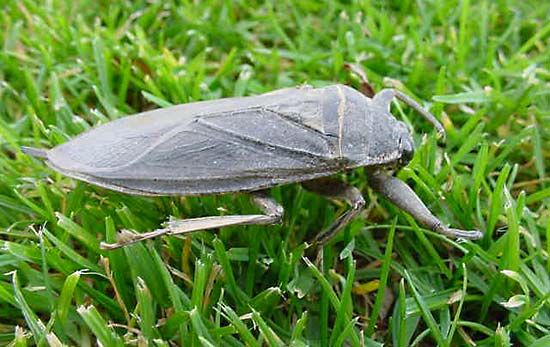
What adaptations do giant water bugs have for living in aquatic environments?
Giant water bugs (family Belostomatidae) possess several specialized adaptations that allow them to thrive in aquatic environments:
- Locomotion: Their hind legs are flattened and oarlike, which are specifically adapted for efficient swimming. Conversely, their front legs are modified for grasping and holding onto prey.123
- Respiration: These insects are often observed suspended in quiet water with the tip of their abdomen piercing the surface to access atmospheric air. Like many other aquatic insects, they utilize a tracheal system for gas exchange.14
- Reproductive Strategy: In some genera, such as Belostoma and Abedus, females exhibit a unique behavior by forcefully gluing their eggs onto the backs of the males, where the eggs remain until they hatch. Other genera deposit their eggs on aquatic vegetation.1
- Defensive Mechanisms: When threatened, these bugs may employ various strategies, including playing dead, emitting an odorous fluid from the anus, or producing a soft chirping sound.1
How do giant water bugs breathe underwater?
Giant water bugs (family Belostomatidae) are aquatic insects that rely on atmospheric air for respiration rather than extracting oxygen directly from the water. Because they possess hard body walls, they cannot respire through their skin like some immature aquatic insects.25
Instead, they utilize a specialized tracheal system that communicates with the outside air through spiracles—small openings located on their thoracic and abdominal segments. To breathe while submerged, these insects typically employ one of the following strategies:57
- Surface Breathing: Many species submerge just below the water’s surface and extend a snorkel-like breathing tube or their posterior end to break the surface film, allowing air to enter their tracheal system.25
- Air Storage: Some aquatic heteropterans carry a supply of air in storage chambers formed by their folded wings or trapped by dense, water-repellent (hydrofuge) hairs. While these chambers can absorb some dissolved oxygen from the surrounding water, the air supply eventually diminishes as nitrogen diffuses outward. Consequently, these insects must periodically return to the surface to replenish their air supply to prevent drowning.25
How do giant water bugs defend themselves against predators?
When giant water bugs (family Belostomatidae) are disturbed or threatened by predators, they employ several distinct defensive strategies to survive:
- Playing Dead: Some species will remain motionless, effectively “playing dead” to avoid detection or further attack by a predator.1
- Chemical Defense: They can emit an odorous fluid from their anus, which serves as a chemical deterrent against potential attackers. This is a common strategy among many insects that use volatile compounds to repel predators.112
- Acoustic Signaling: Certain species are capable of producing a soft chirping sound when disturbed, which may serve as a warning or a distraction.1
- Biting: While primarily a method for subduing prey, giant water bugs are capable of inflicting a very painful bite, which can also serve as a potent deterrent if the insect is handled or threatened by a larger animal.113
How large can giant water bugs grow?
Giant water bugs (family Belostomatidae) are recognized as the largest insects within the order Heteroptera. Their size varies significantly depending on their environment:
- Northern Climates: In these regions, giant water bugs typically range between 2 and 5 cm (approximately 0.8 to 2 inches) in length.1
- South American Species: Some species, such as Lethocerus grandis, can grow quite large, sometimes exceeding 10 cm (4 inches) in length.1
These insects are characterized by their wide, flat bodies, which allow them to hang suspended below the water’s surface while they wait for prey.1
Sources
- giant water bug — Encyclopædia Britannica
- Respiratory system - Trachea — Encyclopædia Britannica
- insect - Aquatic insects — Encyclopædia Britannica
- water bug — Merriam-Webster
- heteropteran - Habitats — Encyclopædia Britannica
- giant wētā: Top Questions — Encyclopædia Britannica
- spiracle — Encyclopædia Britannica
- heteropteran - Respiratory system — Encyclopædia Britannica
- arthropod - Respiratory system — Encyclopædia Britannica
- crustacean - The respiratory system — Encyclopædia Britannica
- Respiratory system - Gills of invertebrates — Encyclopædia Britannica
- giant water bug — Merriam-Webster
- Chemoreception - Defensive odors — Encyclopædia Britannica
- Chemoreception - Predator chemical cues and prey escape — Encyclopædia Britannica
- arthropod - Size range — Encyclopædia Britannica
- Big Bugs and Colossal Crabs: 7 Invertebrates of Unusual Size — Encyclopædia Britannica
- Lethocerus — Merriam-Webster
Published on · 3 min read