Galapagos Finch
Galápagos finches (also known as Darwin’s finches) are a group of 14 closely related songbird species belonging to the family Emberizidae. They are primarily…
What are the Galápagos finches and why are they significant in the field of evolutionary biology?
Galápagos finches (also known as Darwin’s finches) are a group of 14 closely related songbird species belonging to the family Emberizidae1. They are primarily distinguished by the varied configurations of their bills, which have evolved to suit diverse feeding habits, such as crushing seeds, biting, or probing for grubs.12
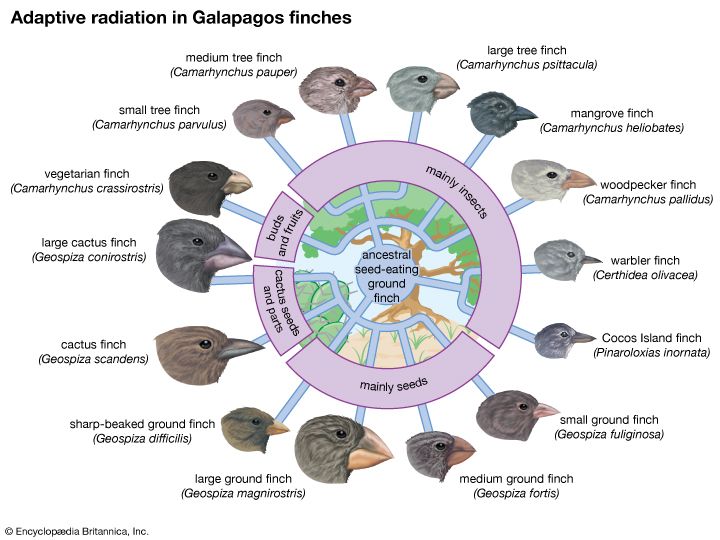
These birds are highly significant in evolutionary biology as a classic example of adaptive radiation. When their common ancestor arrived in the Galápagos Islands, it encountered an environment with few competitors and many unoccupied ecological niches. Over time, the population diverged into multiple species, each adapted to specific diets and habitats.31
This process provided Charles Darwin with critical evidence for his theory of natural selection. By observing these closely related species co-occurring in the same archipelago, Darwin was able to support his thesis that species are not immutable and that they evolve through adaptation to their specific environments.241
How many species of Galápagos finches are there, and what are their main characteristics?
There are 14 species of Galápagos finches, which are categorized into three genera: Geospiza, Camarhynchus, and Certhidea.1
These birds share several common physical characteristics:
- Size: They typically measure between 10 and 20 cm (4 to 8 inches) in length.1
- Coloration: They generally exhibit brownish or black plumage.1
- Bill Variation: While their overall appearance is similar, they differ significantly in the configuration of their bills. These variations are specialized adaptations to their diverse feeding habits, such as crushing seeds or probing for food.1
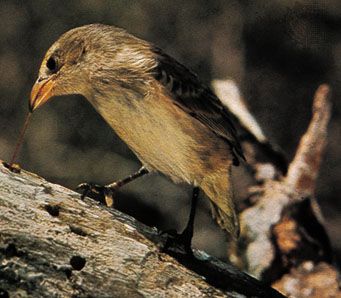
A notable behavioral characteristic among two specific species—the woodpecker finch (Camarhynchus pallidus) and the mangrove finch (C. heliobates)—is their use of cactus spines as tools to probe for grubs.1
What role did the Galápagos finches play in Charles Darwin’s theory of evolution?
The Galápagos finches played a pivotal role in Charles Darwin’s development of his theory of natural selection by providing key evidence that species are not immutable.13
During his 1835 voyage on the HMS Beagle, Darwin collected specimens of these birds. Upon his return, ornithologist John Gould identified them as a group of closely related finches that had diverged into different species. Darwin observed that these birds, while sharing a common origin, had adapted to the specific ecological niches of the different islands in the Galápagos archipelago.45
The birds’ varied bill shapes—specialized for tasks like crushing seeds, biting, or probing for insects—offered a clear example of adaptive radiation. This pattern of closely related species inhabiting adjacent territories supported Darwin’s thesis that species evolve and branch off from common ancestors to exploit available resources. This realization was fundamental to his understanding of how speciation occurs through the process of natural selection.354
How do the beak shapes and sizes vary among different species of Galápagos finches?
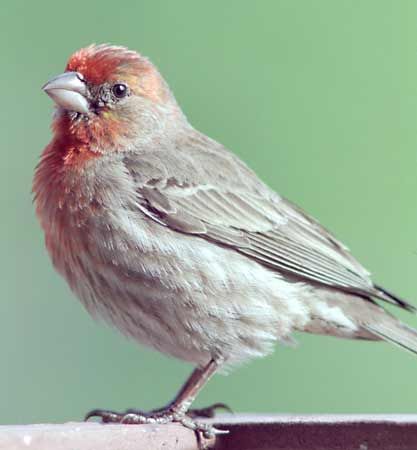
The 14 species of Galápagos finches exhibit significant variation in the configuration of their bills, which serves as a primary adaptation to their diverse feeding habits. While these birds share a similar size and coloration, their beaks have evolved into specialized tools suited to the specific ecological niches they occupy across the Galápagos Islands.1
These bill variations are a classic example of adaptive radiation, where a group evolves into a variety of types to exploit different resources. For instance, some species possess heavy, powerful bills designed for crushing seeds, while others have developed more delicate or elongated bills for probing into crevices or flowers to extract insects.12
In some cases, the birds have adapted their behavior alongside these physical traits; for example, the woodpecker finch and the mangrove finch use cactus spines as tools to reach grubs that their beaks alone cannot access.1
Sources
- Galapagos finch — Encyclopædia Britannica
- adaptive radiation — Encyclopædia Britannica
- What Darwin Got Right (and Wrong) About Evolution — Encyclopædia Britannica
- evolution - Adaptive radiation — Encyclopædia Britannica
- Charles Darwin - Evolution by natural selection: the London years, 1836–42 — Encyclopædia Britannica
- Darwin's finches — Merriam-Webster
- Finch — Encyclopædia Britannica
Published on · 3 min read