King Penguin
In the wild, king penguins have a maximum life span of 26 years. In captivity, they can live significantly longer, reaching up to 41 years.
How long do king penguins typically live in the wild?
In the wild, king penguins have a maximum life span of 26 years. In captivity, they can live significantly longer, reaching up to 41 years.1
What is the breeding and parenting behavior of king penguins?
King penguins (Aptenodytes patagonicus) exhibit complex breeding and parenting behaviors adapted to their subantarctic environment. They typically breed in dense colonies on flat shorelines, following a 14- to 18-month cycle that results in two breeding attempts every three years.21
Courtship and Mating
To attract a mate, males perform an “ecstatic display,” which involves producing a trumpet call while stretching their bodies upward. Both partners then engage in a visual display, shaking their heads or moving them in an arc toward their chests. Pairs are monogamous for the duration of a single breeding season.1
Incubation
Unlike many other birds, king penguins do not build nests. Instead, they produce a single egg that is incubated on top of the parent’s feet, covered by a fold of abdominal skin known as a brood patch. Both parents share incubation duties, alternating turns while the other forages at sea.214
Parenting
After approximately 54 days, the chick hatches. For the first month, it is kept warm by the parents’ feet and brood patches. During the subsequent 313-day fledging period, the chick joins a crèche—a nursery group of other young—for protection while parents forage. Because food can be scarce, chicks may go 3 to 5 months between feedings. They become independent after this long fledging period.21
What are the distinctive physical characteristics of king penguins?
The king penguin (Aptenodytes patagonicus) is the second-largest member of the penguin order, recognized by its dignified, upright posture and long bill. Adults typically reach 85–95 cm (33–37 inches) in length and weigh between 14 and 17 kg (about 31–37 pounds), with males generally being slightly heavier than females.6
Their distinctive coloration includes:
- Body: Black feathers on the back with white feathers on the chest and underside.6
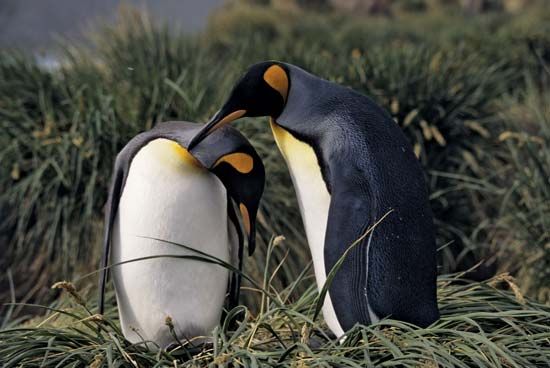
- Head and Neck: Bright orange ear patches and an orange teardrop-shaped patch on the lower part of the bill.6
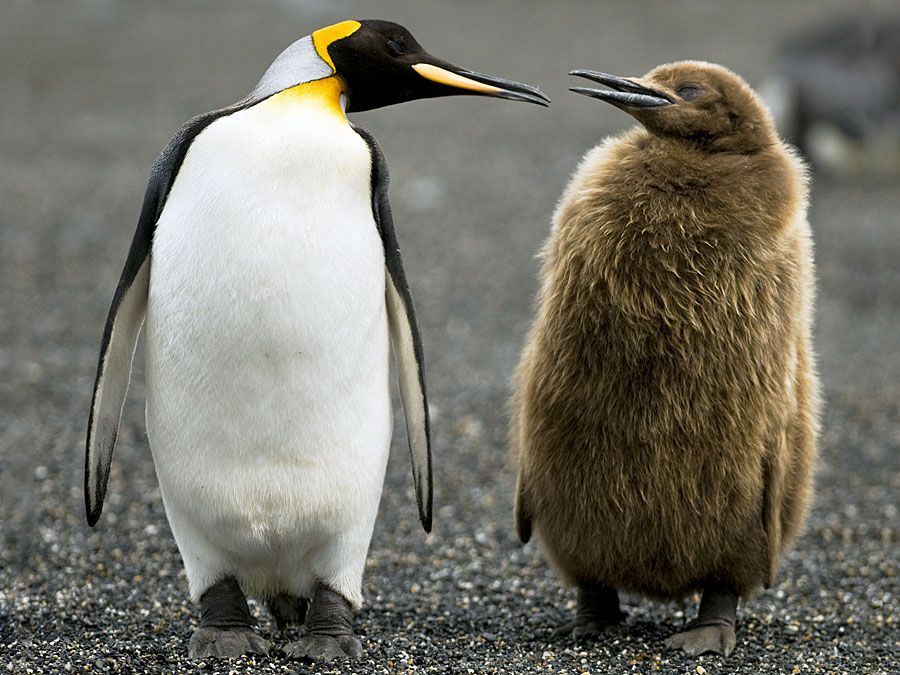
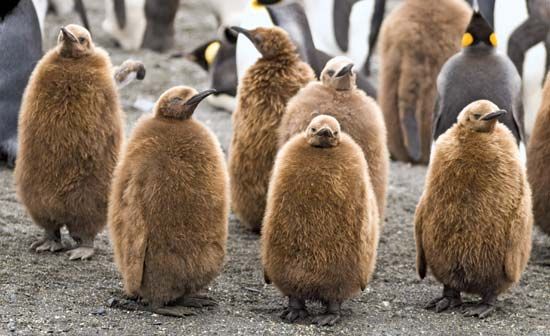
- Juveniles: Similar to adults, but with gray-tipped black feathers, yellow ear patches, and grayish-white lower necks. Chicks are covered in a thick, dark brown down until they molt at 10–12 months of age.6
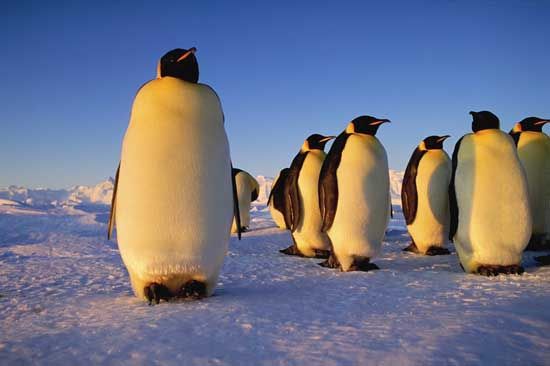
These birds bear a striking resemblance to their larger relative, the emperor penguin.6
How do king penguins hunt and what is their diet?
King penguins (Aptenodytes patagonicus) rely on the rich resources of the Southern Ocean for their survival. Their hunting and dietary habits are specialized to support their high energy needs in subantarctic environments.18
Diet
The diet of the king penguin consists almost exclusively of fish, with lantern fish serving as their primary food source. They also consume other marine life, including squid, crustaceans, barracudinas, and escolars (snake mackerels).1
Hunting Behavior
King penguins are skilled divers capable of foraging at significant depths to capture their prey. While many seabirds feed primarily at the surface, king penguins and other penguins are known to hunt at depths reaching approximately 150 feet (about 45 meters). During the long breeding cycle, parents must alternate foraging trips to the sea to sustain themselves and provide food for their developing chicks, which are fed a regurgitated “soup” of fish or crustaceans.812
Sources
- King penguin — Encyclopædia Britannica
- penguin - Reproduction — Encyclopædia Britannica
- Emperor penguin — Encyclopædia Britannica
- Bird - Nesting — Encyclopædia Britannica
- Do emperor penguins mate for life? — Encyclopædia Britannica
- Australian little penguin: Top Questions — Encyclopædia Britannica
- king penguin — Merriam-Webster
- penguin - Food habits — Encyclopædia Britannica
- Antarctica - Birds — Encyclopædia Britannica
Published on · 3 min read