Frigate Bird
There are five living species of frigate birds, all belonging to the genus Fregata within the family Fregatidae.
How many species of frigate birds exist, and how do they differ from each other?
There are five living species of frigate birds, all belonging to the genus Fregata within the family Fregatidae.12
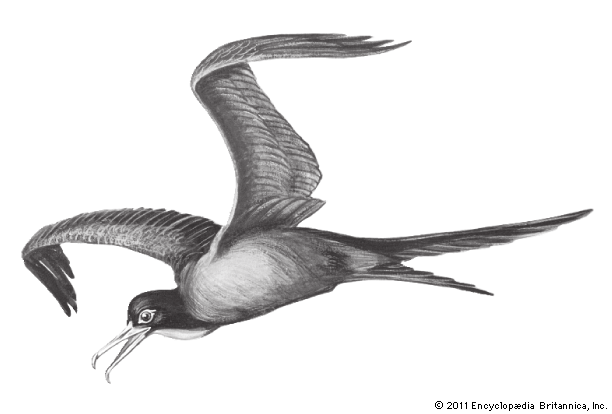
While these species share common characteristics—such as long, slender wings, deeply forked tails, and a highly distensible red throat pouch in courting males—they are distinguished primarily by their size and geographic distribution. Notable species include:12
- Magnificent frigate bird (Fregata magnificens): The largest species, reaching lengths of up to 115 cm (45 inches). It is found along the coasts of the Americas, the Caribbean Sea, and Cape Verdeplace/Caribbean-Sea), and Cape Verde.1
- Great frigate bird (F. minor) and Lesser frigate bird (F. ariel): These species are widely distributed and breed on islands throughout the tropics worldwide.1
Across all species, females are generally larger than males, and plumage often differs by sex and age, with adult males typically appearing all black while females and juveniles often feature white underparts.12
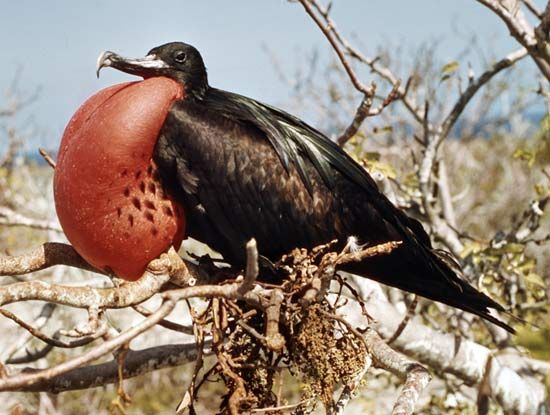
How do frigate birds hunt and what is their primary diet?
Frigate birds are highly skilled aerial hunters that primarily consume fish and squid. Because they lack sufficient preening oil to waterproof their plumage, they rarely land on the water, instead relying on their exceptional flight capabilities to secure food.14
Their feeding strategies include:
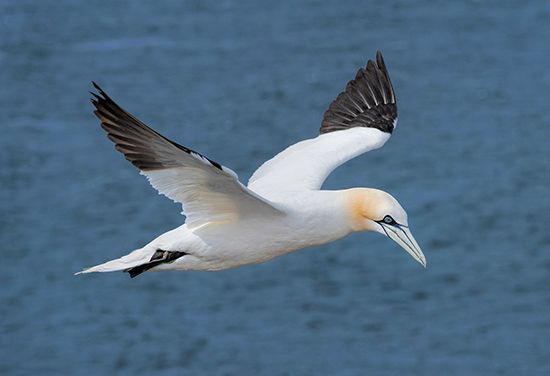
- Kleptoparasitism: This is their most well-known hunting method. Frigate birds act as kleptoparasites, harassing other seabirds—such as boobies—until they disgorge their prey. The frigate bird then catches the falling food in midair or retrieves it from the water’s surface. They also hover above nesting colonies to steal food from parent birds returning to their nests.145
- Surface Feeding: Frigate birds course low over the water, using their long, hooked bills to snatch fish and squid directly from the surface without alighting.14
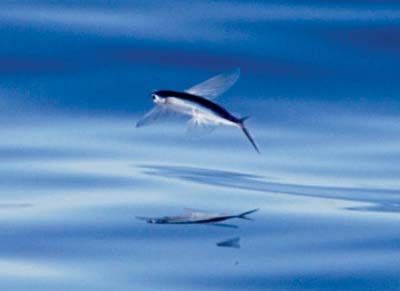
- Aerial Pursuit: They are adept at pursuing flying fish as the fish leap through the air.4
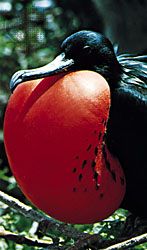
What are the distinctive physical characteristics of frigate birds?
Frigate birds are highly specialized seabirds characterized by several distinctive physical features that support their exceptionally aerial lifestyle:
- Wings and Tail: They possess extremely long, slender, and pointed wings with a span that can reach up to 2.3 meters (nearly 8 feet). These wings, combined with a long, deeply forked tail, allow for graceful, maneuverable flight and quick changes in direction.167
- Throat Pouch: A notable feature is the bare-skinned throat pouch. In courting males, this pouch becomes bright red and can be inflated to the size of a person’s head for display purposes.1
- Bill and Feet: They have a long, hooked bill used for snatching prey and robbing other birds. In contrast to their impressive flight capabilities, their feet are tiny, almost helpless, and possess four webbed toes.1
- Plumage: Adult males are typically all black, while adult females are marked with white underparts. Notably, frigate birds lack sufficient preening oil to waterproof their feathers, meaning they cannot swim or dive and will become waterlogged if they alight on the water.18
- Skeleton: Like other aerial pelecaniforms, their bones are extensively pneumatized, consisting of thin-walled, hollow tubes that reduce weight for flight.18
Where are frigate birds typically found, and what is their habitat like?
Frigate birds are found throughout the world in tropical and semitropical regions, typically inhabiting coastal areas and islands. They are essentially confined to the tropics, and while they are highly aerial and can be seen over the open ocean, they generally remain within 100 miles (160 km) of land, as they must return to shore to roost at night.18
Their habitat is defined by the need for safe, predator-free environments for reproduction. They breed in crowded, colonial nesting sites on oceanic islands, small islets, or stacks off continental coasts. Because they lack waterproof plumage and cannot swim or dive, they avoid alighting on the water and rely on these land-based sites for resting and nesting. Their presence in these areas is often sensitive to the introduction of mammalian predators, which can force them to abandon traditional breeding grounds for more isolated, offshore locations.1710
Sources
- Frigate bird — Encyclopædia Britannica
- Pelecaniform - Annotated classification — Encyclopædia Britannica
- Pelecaniform - Distribution and abundance — Encyclopædia Britannica
- Pelecaniform - Feeding ecology — Encyclopædia Britannica
- kleptoparasitism — Encyclopædia Britannica
- Bird - Flight — Encyclopædia Britannica
- frigate bird — Merriam-Webster
- Pelecaniform - Distinguishing characteristics — Encyclopædia Britannica
- Bird - Muscles and organs — Encyclopædia Britannica
- Pelecaniform - Reproduction — Encyclopædia Britannica
Published on · 3 min read