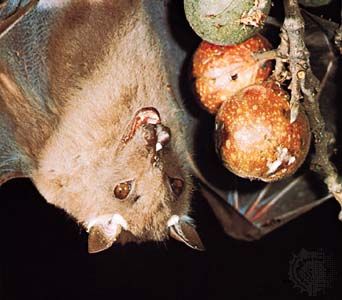
Hipposiderinae
Hipposiderinae is a subfamily of insect-eating bats belonging to the family Rhinolophidae within the suborder Microchiroptera. Commonly referred to as…
What is Hipposiderinae?
Hipposiderinae is a subfamily of insect-eating bats belonging to the family Rhinolophidae within the suborder Microchiroptera. Commonly referred to as roundleaf bats, they are distinguished by a unique, round nose leaf on their muzzle, which consists of an anterior horseshoe-shaped leaf, various accessory leaves, and an upright transverse leaf.1
These bats are found throughout the tropics, ranging from Africa through Asia to Australia. They exhibit a variety of colors, including reddish, grayish, brown, and almost black shades. Physically, they measure approximately 3–11 cm (1.2–4.3 inches) in head and body length, with a tail that is either absent or up to 6 cm (2.4 inches) long. While a few species are solitary, most are gregarious and typically roost in caves or similar sheltered environments. The subfamily includes 9 genera and approximately 66 species.1
How does echolocation work in bats?
Bats utilize echolocation—a biological form of sonar—to navigate and hunt in their environment. By emitting short, high-frequency pulses of sound and interpreting the returning echoes, they can determine the distance, direction, velocity, and nature of surrounding objects.45
The Mechanism of Echolocation
- Sound Production: Bats generate pulses by vibrating membranes in the larynx. These sounds are emitted through the mouth or nose; in some species, specialized structures called nose leaves help channel the sound.4
- Signal Characteristics: These pulses typically range from 12 to over 150 kilohertz, well above the range of human hearing. They may consist of frequency-modulated (FM) sweeps or constant-frequency (CF) signals.4
- Echo Interpretation: When sound waves strike an object, they reflect back to the bat. The bat’s large external ears and specialized middle and inner ears detect these echoes. The auditory complex is often acoustically isolated from the skull to improve signal comparison between the two ears.4
- Neural Processing: The bat’s brain integrates vocal and auditory data to analyze echoes in milliseconds, allowing it to distinguish its own signals from background noise and the pulses of other bats.4
Behavioral Phases
During tasks like insect pursuit or obstacle avoidance, bats adjust their pulse output in three distinct phases:
- Search: Emitting pulses at a low rate (about 10 per second) while scanning the environment.4
- Approach: Increasing the pulse rate (25–50 per second) as a target is detected and distance decreases.4
- Terminal: Emitting extremely short, rapid pulses (up to 200+ per second) for final interception maneuvers.4
This sophisticated system is facilitated by a mutated form of the Prestin protein, which enhances high-frequency sensitivity—a prime example of convergent evolution.5
What are the main differences between Old World and New World leaf-nosed bats?
The primary differences between New World and Old World leaf-nosed bats lie in their biological classification, physical characteristics, and dietary habits.
Taxonomic Classification
- New World Leaf-nosed Bats: Belong to the family Phyllostomidae, which includes 55 genera and approximately 160 species.2
- Old World Leaf-nosed Bats: Belong to the family Hipposideridae, which consists of 9 genera and about 81 species.2
Physical Characteristics
- Nose Leaf Structure: Phyllostomids typically possess a simple, spearhead-shaped nose leaf on their muzzle. In contrast, Hipposiderids are characterized by a more complex, round nose leaf consisting of an anterior horseshoe-shaped leaf, various accessory leaves, and an upright transverse leaf.2
- Size: Phyllostomids range from 4–13.5 cm in head and body length, with some species reaching large sizes, such as the spectral bat, which can have a wingspan of 90 cm. Hipposiderids are generally smaller, measuring about 3–11 cm in length.2
Diet and Behavior
- Diet: Phyllostomids exhibit a highly diverse diet, including insects, fruit, nectar, pollen, and meat; this family also includes vampire bats. Hipposiderids are primarily insect-eating bats.27
- Distribution: Phyllostomids are found in the New World tropics from the United States to Argentina. Hipposiderids are found in the Old World tropics, ranging from Africa across Asia to Australia.2
Why do some bats choose to roost in caves?
Bats choose to roost in caves primarily because these environments offer essential stability and protection. For many species, caves provide a secure refuge characterized by darkness and a consistent temperature and humidity, which are critical for their survival during periods of rest, reproduction, or hibernation.8
Beyond environmental stability, caves offer significant protection from predators. By roosting in secluded, elevated, or hard-to-reach areas, bats gain a vantage point that allows them to monitor their surroundings and make a swift escape if threatened. Because bats are not adapted for ground takeoff, hanging in these high, secluded spots allows them to utilize gravity to drop into flight, providing the necessary momentum to become airborne. Furthermore, caves often support large colonies, creating complex ecosystems where bats, their excretions, and various satellite organisms—such as insects and fungi—interact within the cave environment.98
Sources
- Hipposiderinae — Encyclopædia Britannica
- leaf-nosed bat — Encyclopædia Britannica
- hippopotamus — Encyclopædia Britannica
- bat - Orientation — Encyclopædia Britannica
- Echolocation — Encyclopædia Britannica
- sound reception - Echolocation in other mammals — Encyclopædia Britannica
- bat - Distribution — Encyclopædia Britannica
- bat - Roosting — Encyclopædia Britannica
- Why do bats sleep upside down? — Encyclopædia Britannica
Published on · 4 min read