Ghost Pipefish
The ghost pipefish (genus Solenostomus) refers to a group of small, rare marine fishes found in the Indian and western Pacific oceans. Typically reaching…
What is ghost pipefish?
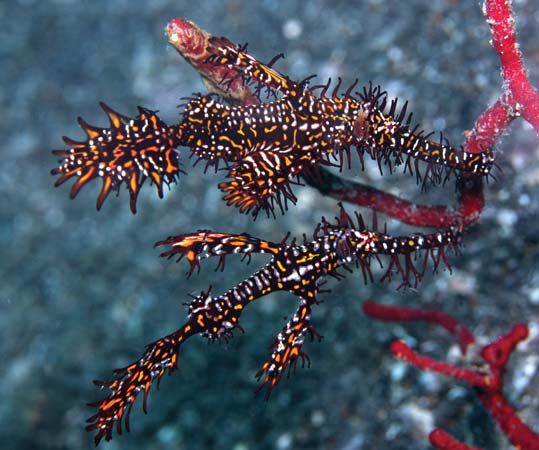
The ghost pipefish (genus Solenostomus) refers to a group of small, rare marine fishes found in the Indian and western Pacific oceans. Typically reaching lengths of 7.5 to 17 cm (about 3 to 7 inches), they are characterized by their long snouts and enlarged fins.1
While they are closely related to pipefishes and sea horses, ghost pipefishes differ in both behavior and physical structure. Unlike the armored rings found on syngnathids, ghost pipefishes are covered in large bony plates. Furthermore, their reproductive strategy is distinct: while male pipefishes and sea horses typically carry fertilized eggs, female ghost pipefishes brood their eggs in a specialized pouch formed by the fusion of their pelvic fins on their ventral side.12
How do ghost pipefish use camouflage to hide from predators?
The provided search results do not contain information regarding how ghost pipefish use camouflage to hide from predators. While the articles describe the physical characteristics, anatomy, and reproductive habits of the ghost pipefish, they do not detail specific camouflage behaviors or survival strategies related to predator avoidance.
Sorry, the Britannica knowledge base does not contain this information.
What are the main differences between ghost pipefish and seahorses?
While ghost pipefishes and seahorses are both members of the order Gasterosteiformes and the family Syngnathidae (or closely related to it), they exhibit significant differences in their physical structure and reproductive behavior.
Physical Differences
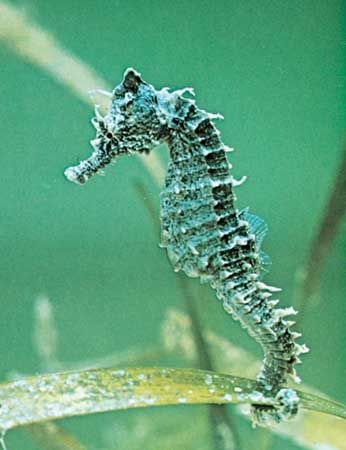
- Body Armor: Ghost pipefishes are covered in large, bony plates that unite to form rings. While seahorses also possess bony rings, their overall body shape is distinct; seahorses have a characteristic horselike head set at an angle to the body, whereas the ghost pipefish’s head is in line with its body.142
- Tail and Fins: Seahorses have a prehensile tail used for clinging to plants and corals and lack a caudal fin. In contrast, ghost pipefishes possess large, spinous dorsal and ventral fins and a pointed caudal fin.24
- Posture: Seahorses are known for their unique, upright swimming posture, whereas ghost pipefishes do not maintain this vertical orientation.24
Reproductive Differences
The most notable difference lies in which parent carries the eggs:
- Seahorses: The male is responsible for brooding the eggs. The female deposits her eggs into a specialized brood pouch located at the base of the male’s tail, where they are fertilized and nurtured until they hatch.12
- Ghost Pipefishes: The female carries the eggs. She broods them in a specialized pouch formed by the fusion of her pelvic fins on her ventral (lower) side.15
Why do female ghost pipefish carry the eggs instead of the males?
While it is well-documented that female ghost pipefishes (genus Solenostomus) brood their eggs in a specialized pouch formed by the fusion of their pelvic fins, the specific evolutionary reasons why this role is held by the female rather than the male—as is the case with their relatives, the pipefishes and seahorses—are not explicitly detailed in the current scientific literature provided.12
In the family Syngnathidae, male brooding is a common trait, often interpreted as a strategy to maximize reproductive success. However, ghost pipefishes differ from these syngnathids in both their physical structure, such as their bony plates, and their reproductive behavior. While researchers continue to study the life cycles of the order Gasterosteiformes, the precise selective pressures that led to female-led brooding in ghost pipefishes remain a subject for further investigation.12
Sources
- ghost pipefish — Encyclopædia Britannica
- gasterosteiform - Reproduction and life cycle — Encyclopædia Britannica
- gasterosteiform - Form and function — Encyclopædia Britannica
- gasterosteiform - Annotated classification — Encyclopædia Britannica
- seahorse — Encyclopædia Britannica
- Reproductive behaviour - Group care — Encyclopædia Britannica
Published on · 3 min read