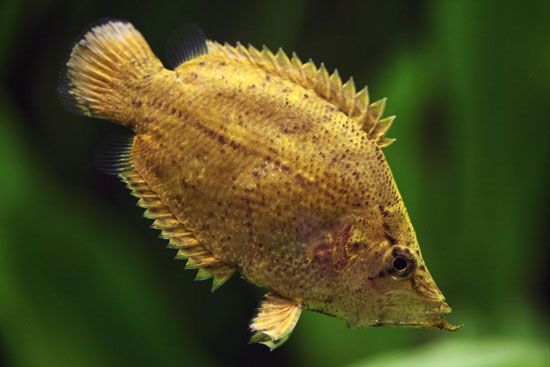
Leaf Fish
Leaf fish, which belong to the family Nandidae, are primarily found in freshwater habitats, though some species are capable of entering brackish water. They…
In which habitats are leaf fish typically found?
Leaf fish, which belong to the family Nandidae, are primarily found in freshwater habitats, though some species are capable of entering brackish water. They have a circumtropical distribution, meaning they inhabit tropical regions across the globe, including the Amazon River basin, western Africa, India, southeastern Asia, and the Malay Archipelago.1
Specifically, the South American leaf fish (Monocirrhus polyacanthus) is known to inhabit quiet, freshwater environments where it drifts to mimic a dead, floating leaf. Due to their unique appearance and behavior, many members of the Nandidae family are also commonly kept as aquarium fish.12
What are the defining characteristics of leaf fish?
Leaf fish comprise approximately 10 species within the family Nandidae (order Perciformes). While the term is often used to describe the entire family, it specifically refers to the South American species Monocirrhus polyacanthus.1
The defining characteristics of these fish include:
- Camouflage: They are renowned for their remarkable resemblance to dead, drifting leaves, which aids in both protection and hunting.1
- Physical Appearance: M. polyacanthus is typically about 7.5 cm (3 inches) long with a mottled brown coloration. It features serrated dorsal and anal fins that mimic the edges of a leaf and a chin barbel that resembles a broken leaf stem.1
- Behavior: They inhabit quiet waters and often drift in a head-down position. They propel themselves using transparent pectoral fins and a transparent tail, making their movement nearly imperceptible.1
- Feeding Strategy: They are ambush predators that either wait for or slowly approach small fish, capturing prey with a sudden, expansive gape of their large mouths.1
How large do leaf fish typically grow, and are there significant size differences between species?
The South American leaf fish (Monocirrhus polyacanthus) typically grows to a length of about 7.5 cm (3 inches).1
While the family Nandidae includes approximately 10 species, the provided information does not detail the specific size variations across the other members of this family. These fish are generally recognized for their shared ability to inhabit fresh water and their popularity as aquarium specimens.1
What is the taxonomic classification of leaf fish, and which other fish families are they closely related to?
Leaf fish belong to the family Nandidae, which falls under the order Perciformes. The family is characterized as a group of small, deep-bodied percoid fishes found in warm fresh and salt waters across the Southern Hemisphere.13
Regarding their evolutionary relationships, the provided search results do not specify which other fish families are most closely related to the Nandidae. While the order Perciformes is a broad classification that includes various fish groups, the available data does not offer a detailed phylogenetic breakdown or identify specific sister taxa for the Nandidae family.12
Sources
- leaf fish — Encyclopædia Britannica
- leaf fish — Merriam-Webster
- Nandidae — Merriam-Webster
- nandid — Merriam-Webster
- paracanthopterygian - Critical appraisal — Encyclopædia Britannica
- paracanthopterygian - Annotated classification — Encyclopædia Britannica
Published on · 2 min read