Lancet Fish
The term "lancet fish" is sometimes confused with "lancelets," but they are distinct animals. While lancelets are small, streamlined cephalochordates, the…
What is lancet fish?
The term “lancet fish” is sometimes confused with “lancelets,” but they are distinct animals. While lancelets are small, streamlined cephalochordates, the lancet fish refers to two species of deep-sea marine fish belonging to the genus Alepisaurus (family Alepisauridae).1
These fish are characterized by their elongated, slender, and scaleless bodies, which can reach lengths of up to 1.8 meters (6 feet). They are easily identified by a very tall dorsal fin and a large mouth filled with formidable, fanglike teeth. As voracious carnivores, they feed on various invertebrates and other fish.123
The two recognized species are:
- Longnose lancet fish (A. ferox): Found in both the Atlantic and Pacific Oceans.1
- Shortnose lancet fish (A. brevirostris): Inhabits the Atlantic and South Pacific oceans.1
Note that the name “lancet fish” is occasionally used to refer to surgeonfish, which are unrelated to the Alepisaurus genus.3
What are some other examples of deep-sea predators?
The deep sea is home to a variety of specialized predators that have evolved unique adaptations to survive in extreme, dark, and high-pressure environments. These predators often utilize bioluminescence, specialized sensory organs, or extreme physical traits to secure food in the vast, resource-scarce ocean depths.
Mid-water Predators
Mid-water species are often characterized by their ability to attract prey using light-producing organs or by possessing specialized anatomy for capturing food in the water column:
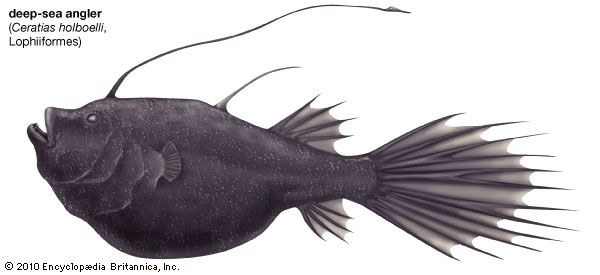
- Deep-sea anglerfishes: These fish use an extended dorsal fin spine that acts as a lure to attract prey within reach of their mouths. Some species are capable of swallowing prey several times their own size due to highly distensible stomachs.56
- Viperfishes: Known for their numerous, formidable fanglike teeth, these fish are highly effective predators in the deep sea.5
- Giant squid: These massive cephalopods use their long tentacles, equipped with suckers and sucker rings, to capture fish, crustaceans, and other cephalopods. They possess some of the largest eyes in the animal kingdom, which help them detect large predators like the sperm whale.7
Bottom-dwelling (Benthic) Predators
Benthic predators often hunt on or near the seafloor and may rely on camouflage or ambush tactics:
- Chimaeras and ghost sharks: These fish dwell near the bottom at depths of at least 2,500 meters and are active at night, feeding on small invertebrates and fish.8
- Grenadiers: These are common bottom-dwelling fish found along continental slopes.56
- Cusk eels: These are the dominant family of teleosts at depths greater than 2,000 fathoms, where they hunt as bottom dwellers.6
How do fish survive in the extreme pressure of the deep ocean?
Deep-sea fish have evolved specialized physiological adaptations to survive the extreme hydrostatic pressure of the ocean, which increases by one atmosphere for every 10 meters of depth.5
To withstand these crushing forces, many deep-sea species have eliminated air-filled cavities that would otherwise collapse under pressure. Unlike many surface-dwelling fish that use a swim bladder to control buoyancy, deep-sea and bottom-living forms often have significantly reduced swim bladders or have lost the organ entirely. Some species that retain a buoyancy organ may use oils instead of gas to avoid the complications of gas compression at depth.105
Furthermore, deep-sea fish often possess a “feebly developed” body structure, appearing to consist of little more than gelatinous material. By reducing the density and complexity of their skeletons and muscles, these fish require less energy to maintain their bodies in a food-poor environment. These traits, combined with other evolutionary specializations like bioluminescence and modified sensory organs, allow them to thrive in an environment characterized by extreme pressure, cold, and darkness.1112
What is the difference between a lancetfish and a surgeonfish?
It is important to clarify that while some dictionaries may list “lancetfish” as an alternate name for a surgeonfish, these are biologically distinct groups of fish with vastly different characteristics and habitats.
Key Differences
Feature
Lancetfish
Surgeonfish
Habitat
Deep-water marine environments
Tropical marine environments
Body Shape
Elongated and slender
Thin and deep-bodied
Diet
Voracious carnivores (fish and invertebrates)
Mostly algae eaters
Size
Up to 1.8 meters (6 feet)
Usually under 50 cm (20 inches)
Distinctive Traits
Tall dorsal fin and fanglike teeth
Sharp, scalpel-like spines on the tail base
Lancetfish, belonging to the genus Alepisaurus, are large, predatory deep-sea dwellers known for their formidable teeth and high dorsal fins. In contrast, surgeonfish (family Acanthuridae) are smaller, tropical fish characterized by the sharp, retractable spines on their tails that resemble a surgeon’s scalpel.113
Sources
- lancet fish — Encyclopædia Britannica
- Alepisaurus — Merriam-Webster
- lancet fish — Merriam-Webster
- cephalochordate - External features — Encyclopædia Britannica
- deep-sea fish — Encyclopædia Britannica
- giant squid — Encyclopædia Britannica
- chondrichthyan - Rays — Encyclopædia Britannica
- megalodon - Predators and prey — Encyclopædia Britannica
- paracanthopterygian - Ecology and behavior — Encyclopædia Britannica
- fish - The respiratory system — Encyclopædia Britannica
- protacanthopterygian - Ecology — Encyclopædia Britannica
- Biosphere - Hydrostatic pressure — Encyclopædia Britannica
- surgeonfish — Encyclopædia Britannica
Published on · 3 min read