Gila Monster
The Gila monster (Heloderma suspectum) is a distinct, stout-bodied lizard native to the southwestern United States and northern Mexico. Its unique physical…
What are the unique physical characteristics of the Gila monster?
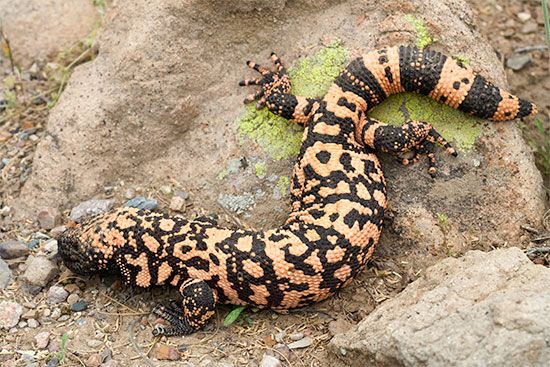
The Gila monster (Heloderma suspectum) is a distinct, stout-bodied lizard native to the southwestern United States and northern Mexico1. Its unique physical characteristics include:1
- Appearance: It typically grows to about 50 cm (20 inches) in length and is covered in beadlike, rough scales. Its skin features a striking pattern of black and pink, orange, or yellowish blotches or bands.213
- Body Structure: The lizard possesses a large head and powerful, muscular jaws. It also has a thick tail, which, along with its abdomen, serves as a storage site for fat that the animal utilizes during the winter months.213
- Venom System: The Gila monster is one of the few venomous lizards in the world. It has venom glands located in its lower jaw. Many of its teeth contain two grooves that function to conduct this nerve poison into a wound while the lizard maintains a strong, locked bite on its prey.21
How does the Gila monster’s venom work, and how is it different from other venomous reptiles?
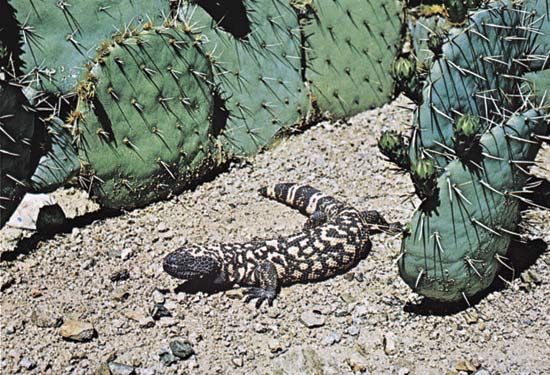
The Gila monster’s venom is a potent nerve poison produced by glands located in the animal’s lower jaw. Unlike many venomous snakes that inject venom through hollow fangs, the Gila monster relies on a different delivery mechanism: it possesses teeth with two grooves that conduct the venom into a wound while the lizard maintains a strong, muscular grip on its prey.13
While the toxicity of Gila monster venom is roughly equivalent to that of a diamondback rattlesnake, the delivery method is significantly slower and more methodical. Because the venom must seep into the wound during a sustained bite rather than being injected rapidly, fatalities in humans are rare. This slow, deliberate process reflects the lizard’s nature as a methodical predator that feeds primarily on small mammals, birds, and eggs.13
How did the Gila monster get its name, and what is its scientific classification?
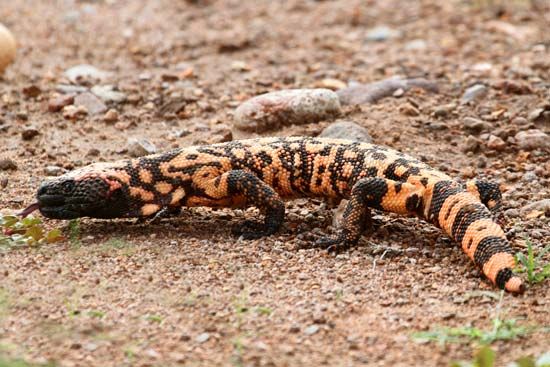
The Gila monster (Heloderma suspectum) derives its name from the Gila River basin in Arizona and New Mexico, where the lizard is found. The term “Gila” is a Spanish transcription of a Native name for the river or region, while the descriptor “monster” was applied to the creature, perhaps reflecting its status as a large, venomous lizard.143
Regarding its scientific classification, the Gila monster is categorized as follows:
- Kingdom: Animalia
- Phylum: Chordata
- Class: Reptilia
- Order: Squamata
- Family: Helodermatidae
- Genus: Heloderma
- Species: Heloderma suspectum14
It is one of only two species within the genus Heloderma, the other being the Mexican beaded lizard (H. horridum).1
How does the Gila monster use its tail to survive in the desert?
The Gila monster uses its tail as a vital energy reservoir to survive in the harsh desert environment. During periods of warm weather, the lizard consumes mammals, birds, and eggs, storing excess fat within its tail and abdomen. This stored energy is then utilized to sustain the animal during the winter months when food is scarce and the lizard is less active.1
Sources
- Gila monster — Encyclopædia Britannica
- 7 of the World’s Most Dangerous Lizards and Turtles — Encyclopædia Britannica
- 10 Fascinating Region-Specific Animals | Gila Monster — Merriam-Webster
- Gila monster — Merriam-Webster
Published on · 3 min read